ENERGY POLICY RESEARCH FOUNDATION

GET THE LATEST NEWS

A silhouette of an oil pumpjack against a white background.

The Energy Policy Research Foundation (EPRINC) was established in 1944 and is based in Washington DC. It is an independent, not-for-profit, and non-partisan research institution that focuses on policy issues at the intersection of energy, economics, and security with special emphasis on oil, natural gas, petroleum products, electricity markets, and energy transitions. EPRINC is recognized internationally for providing objective and technical analyses on these topics.

Chart of the Week

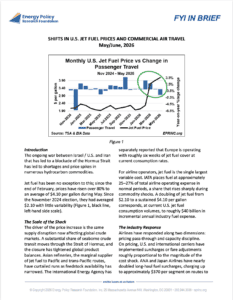
U.S. Jet Fuel and Air Travel: The Demand Test Comes This Summer

Since the late-February closure of the Strait of Hormuz, U.S. jet fuel has risen more than 80%, to an average of about $4.10 per gallon in May. Over the period following the November 2024 election it had averaged near $2.10 with little variability. Jet fuel has moved further and faster than gasoline or diesel, reflecting both higher crude and an acute shortage of refined supply as Asian refineries, the marginal supplier to Pacific routes, curtail runs. The International Energy Agency reports that Europe is operating with roughly six weeks of jet fuel cover at current consumption.

Carriers are absorbing the shock along two channels: pricing pass-through and capacity discipline. U.S. and international airlines have raised fares or added fuel surcharges, and several have begun trimming schedules. United cut roughly 5% of planned capacity for the remainder of 2026, with CEO Scott Kirby noting that at sustained prices near current levels, jet fuel alone would add about $11 billion in annual expense, more than the carrier’s best year on record. Delta has pulled back roughly 3.5% of planned capacity. Spirit, already in financial distress, ceased operations entirely on May 2, the first shutdown of a major U.S. carrier in 25 years.

What the chart does not yet show is a clear demand response. Year-on-year passenger counts have softened modestly over the past two months (the blue bars), but the magnitude is small and the window too short to separate the price shock from ordinary seasonal and weather-driven variation. The cleaner test is summer, normally the most resilient stretch of the travel calendar. If softness deepens through June and July as surcharges and capacity cuts propagate, the case for a structural demand response strengthens. If summer holds, travel demand is less elastic at these price levels than first feared.

On September 25, 2025, Energy Policy Research Foundation’s President Lucian Pugliaresi provided the scene-setting speech at the Heritage Foundation’s workshop, “Unlocking Affordable Energy: The Plan to Solve America’s Energy Crisis.” “Power markets represent the challenge to the energy trilemma–they’re no longer affordable, reliable, and sustainable,” remarked Mr. Pugliaresi. “Fixing our electric power system is job No.1. I encourage you to join our Power Vision 2030 program.”

Link to the recording of the event can be found here.

His slide deck can be accessed here.


The Energy Policy Research Foundation has provided commentary to EPA on the proposed rule entitled “Reconsideration of 2009 Endangerment Finding and Greenhouse Gas Vehicle Standards”. The attached EPRINC analysis study shows that CO2 emissions from new Light Duty Vehicles in the U.S. will represent just 0.57 percent to 0.75 percent, with a midpoint of 0.66 percent, of total global GHG emissions between 2026 and 2045. The EPRINC analysis shows that the contribution of CO2 emissions from new Medium Duty Vehicles is likely to be 0.12 percent during the same period. Taken together, estimates suggest that the two motor vehicle classes will contribute less than 1 percent—a total of 0.78 percent—to global GHG emissions over the next 20 years. This estimate represents a 56 percent reduction in the LDV and MDV contribution estimate of 1.8 percent provided in the Proposed Rule.
EPRINC President Lucian Pugliaresi and Director of Energy Transition Research Batt Odgerel were invited to contribute an article to the National Interest’s debate series, “Is a Net Zero World Possible?”
In “The Trouble With a One Hundred Percent Green Energy Dream,” the authors argue that a hundred percent green energy world risks destroying all three components of the energy trilemma. The full piece can be read on The National Interest’s Energy World here.

On September 4, 2025, Energy Policy Research Foundation Distinguished Fellow Michael Lynch was published in Forbes. His article, entitled “Shale Oil Pessimism Could Be Overdone“, included a quote from another Distinguished Fellow, Trisha Curtis, in her piece “US Shale Oil Dynamics in a Low Price Environment” published by the Oxford Institute of Energy Studies.

The Energy Policy Research Foundation has written on this topic before, and has released several pieces discussing how forecasting, particularly oil supply forecasting, is fraught with underestimates. A slide from a recent EPRINC presentation that covers this can be found here.

Energy Policy Research Asia Policy Research Analyst Dominic Pugliaresi has penned a “Letter from China (August 2025): China Revises Incentive Structure for LNG Receiving Terminals and Oil and Gas Pipeline Networks“. Dominic is based in Nanjing, China, and has spent time researching and analyzing China’s energy policies across a range of issues. This short document focuses on LNG and oil and gas pipelines in China, as well as the impacts of the U.S.-China Trade War tariffs on both countries.

Energy Policy Research Foundation Director of Research Max Pyziur wrote an op-ed for The National Interest entitled “How Mozambique LNG Enhances Global Energy Security and Supports the US Economy“. In the article published July 30, 2025, he begins: “An export powerhouse such as Japan has a phalanx of government-backed entities to support its own country’s trade and economy. So, why shouldn’t the United States do likewise?”

This article is available with no paywall at this link.

Batt Odgerel, Director of Energy Transition Research at Energy Policy Research, was interviewed for a Reuters article entitled Tesla’s easy money from regulatory credits set to dry up amid weakening sales. “They are making conventional ICE vehicles more competitive while making EVs less competitive,” said Odgerel, referring to the U.S. Congress, the Trump administration, and the U.S. federal government. Tesla risks losing revenue from the credits as well as market share, he added.

The Energy Policy Research Foundation has partnered with the Hellenic Association for Energy Economics (HAEE) for the 10th HAEE Energy Transition Symposium, which took place on the 3rd–5th of June 2025 at the Maroussi Plaza Centre in Athens.

The purpose of this symposium was to drive dialogue, research, and action in energy transition and sustainability. Speakers included influential thought leaders, government officials, and top executives from across the energy world leading the Plenary Sessions. A full list of the speakers as well as other information about the event can be found here.

A recording of the highlights is here.

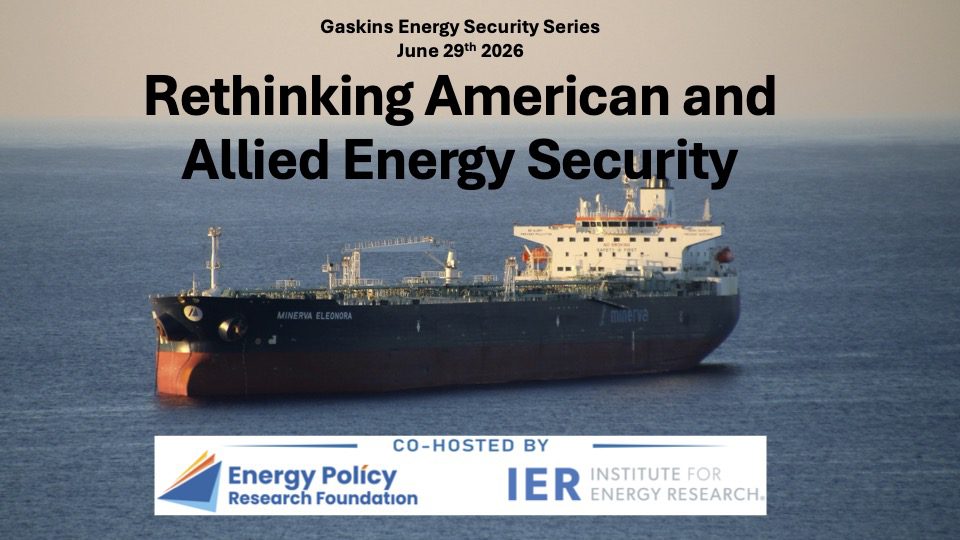
On May 29th 2025 at the Energy Policy Research Foundation offices in Washington DC, a joint workshop was cohosted by the Energy Policy Research Foundation and the Institute for Energy Research on the North American Energy Production Platform.

Energy policy has taken center stage, and the United States is at a pivotal moment in shaping its energy future. Cross-border trade of oil, natural gas, and electricity has made North America one of the most dynamic energy markets in the world. As each country responds to market dynamics and geopolitical shifts, the role of energy imports and exports across the three countries has never been more critical to understand.


With panels moderated by IER President Tom Pyle and EPRINC President Lucian Pugliaresi, energy policy experts participated in an in-depth look at the evolving landscape of energy development across the continent. The event provided a forum for candid dialogue on shared opportunities and challenges in shaping sustainable, secure, and economically sound energy strategies for North America.

The discussion, focused on North American energy trade, covered specifically:

  1. Crude oil and petroleum product flows and their effect on refining operations
  2. Natural gas flows and pipeline infrastructure
  3. Electricity and energy security overview

The agenda of the workshop can be found here, and the presentations given can be downloaded here and here.

In an interview with Kevin Killough for JusttheNews, Energy Policy Research’s Director of Energy Transition Research Batt Odgerel discussed California’s Advanced Clean Cars II regulation and its potential impact on US carmakers and consumers. The article, “California likely to fight for EV mandate, but data shows that EV sales way below mandate targets,” was published May 22, 2025.

On Tuesday, May 23 2025 (DC time), the Economic Research Institute for ASEAN and East Asia (ERIA), the Institute of Energy Economics, Japan (IEEJ) and Energy Policy Research cohosted a virtual discussion on the role of LNG and natural gas in Asia and how Asia views LNG potentials from the United States in and after 2025.

The presentations from the webinar can be found below, and the recording of the event can be viewed here.

On Wednesday, April 2 2025, Energy Policy Research Foundation Distinguished Fellow and Asia-Pacific Energy Resource Centre Senior Vice President Glen Sweetnam provided witness testimony at the House Committee on Natural Resources Oversight and Investigations Subcommittee hearing on “Unleashing the Golden Age of American Energy Dominance.


In his testimony, one of the reasons that Glen was positive about future oil production is that the U.S. oil industry is highly competitive and has demonstrated technological innovation and advanced industrial capabilities. The most efficient and productive oil companies in the world are in the U.S., and between 2010 and 2020, the U.S. served 90% of incremental demand.

Glen’s testimony was highlighted on Forbes Breaking News (Glen’s reply starts at 2:33)

Another article about the hearing appeared on JustTheNews, which quotes Glen’s response to Resident Commissioner Pablo José Hernández of Puerto Rico.

Glen’s testimony and accompanying slide deck can be found below, along with the testimony of the other witnesses at the hearing. A full video of the hearing can be found here.

The Energy Policy Research Foundation is pleased to announce the addition of François Baird as our newest Distinguished Fellow! François brings a wealth of knowledge and experience to our team as we expand our work into new geographical areas of focus and adjust to the shifts in the world of energy policy. His bio can be found below:

François Baird is an Africa expert, leader, trusted advisor and entrepreneur. He consults to governments, international institutions, and companies internationally on public affairs, issue and crisis management, community creation, communication strategy, reputation risk assessment and management, and market entry strategies. He has worked in a range of sectors including energy, development, health, financial services, ICT, agriculture, mining, consumer goods and education.

François started his career on the gold mines, attained a degree in international politics and political science at the University of Pretoria and served as a commissioned officer in the SA Air Force. He founded his own business in 1987, following various corporate management positions at Gold Fields of SA, Small Business Development Corporation, and Sappi, the South African multi-national forestry products company. He is emeritus Chairman of Africa, of Daniel J Edelman Inc and emeritus Board member of The Montpelier Foundation, where he served a term as Treasurer and Finance Committee Chairman.

François is founder and chairman of Baird’s CMC Ltd, Baird’s US LLC and Calbridge Investments (Pty) Ltd. He serves on the Board of the Presidential Precinct and is an advisor to its Young Africa Leaders Initiative (YALI) program. François is also the founder of the FairPlay anti-dumping trade movement, the Good Hope Wine Club in Washington DC and a Board member of Airborne Lifeline Foundation. Baird’s CMC is an international communications management consultancy with partners across the world. He is Co-Chairman, Africa of Taylor Advisories, the boutique American M&A firm.

François can be reached at Francois.Baird@bairdsus.com, on LinkedIn here, or on X (Twitter) here.

On March 5 2025, the Energy Policy Research Foundation hosted a book event with Jack Spencer, author of Nuclear Revolution: Powering the Next Generation.

Jack, Heritage Foundation’s Senior Research Fellow for Energy and Environmental Policy, drew upon on his extensive experience advising national policymakers—including testimony before the Blue Ribbon Commission on America’s Nuclear Future and Congress—to chart a clear path forward for nuclear energy in America. He was joined by Kirk Sorensen of Flibe Energy, who added commentary from his experience in the nuclear industry.

The book reveals how nuclear power, once an economically competitive energy source, became increasingly costly due to regulatory burden—and how targeted policy reforms can restore its affordability while maintaining safety. Through detailed analysis, Spencer demonstrates how free enterprise can drive innovation in the nuclear sector more effectively than government management.

Nuclear Revolution: Powering the Next Generation can be purchased at this link.

A quick video on the Thorium Fuel Cycle by Flibe Energy can be found here.

Subscribe

Get the latest news and updates on energy economics and policy issues.

A series of short executive briefings providing essential background information on often challenging debates on energy and security policy. 

A list of personal publications by EPRINC trustee Larry Goldstein

Energy Policy Research Foundation Distinguished Fellow Ashutosh Shastri’s perspectives on energy in Europe

Follow

Follow us on Twitter to get the latest updates from us in real-time.