
The war that began with Hamas’ attack on Israel on October 7, 2023 quickly expanded across the Middle East, with further points of escalation in April 2024 and again on October 1, 2024, when Iran launched multiple missile attacks against Israel. Over the intervening twelve months, crude oil prices have been buffeted from one side by military aggression that has diverted crude supplies, and from the other by OPEC+ supply management challenges and demand weakness tied to slowing economic activity.
Before October 2023, about 20% of total Suez vessel traffic consisted of tankers carrying crude oil. As Iranian-backed Houthi forces in Yemen attacked shipping crossing the Bab al-Mandab strait with drones and missiles, many vessels rerouted around the Cape of Good Hope, cutting Red Sea tanker traffic to roughly 40% of its pre-war level. Cape of Good Hope-routed traffic rose in response, but by considerably less than the volume of Red Sea traffic lost.
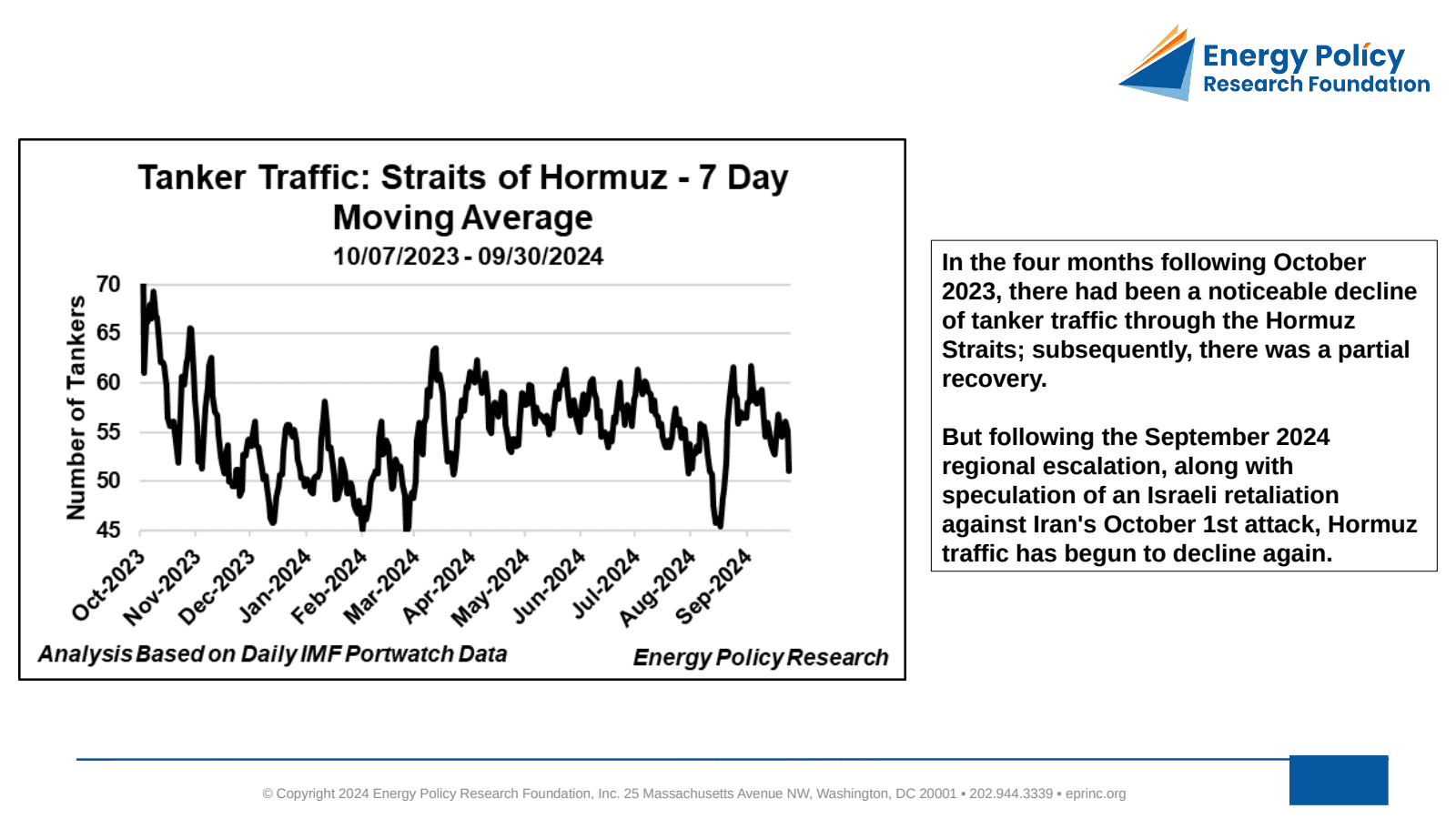
Traffic through the Hormuz Straits declined noticeably in the four months following October 2023, then partially recovered. Following the September 2024 regional escalation and speculation over an Israeli retaliation for Iran’s October 1 attack, Hormuz traffic has again begun to fall.
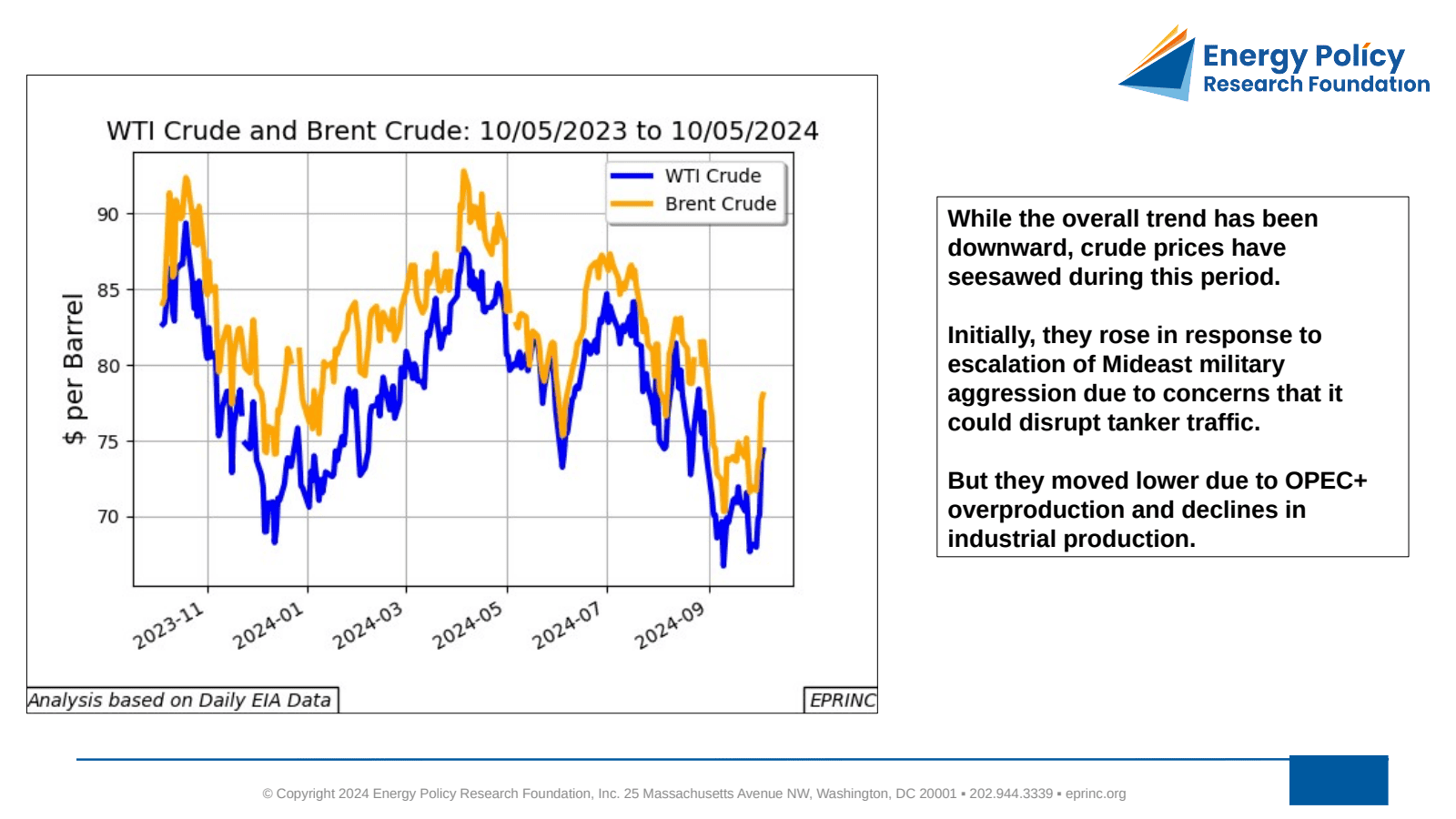
Benchmark crude prices have seesawed over this period while trending downward overall. Escalations in the conflict initially lifted prices on fears of disrupted tanker traffic, but they moved lower amid OPEC+ overproduction and declining industrial output. In mid-2024, OPEC+ cited Iraq, Kazakhstan, and Russia for overproduction and asked the three to submit plans to compensate other members, which added to price weakness and foregone revenues. Flattening demand also weighed on prices, with U.S. manufacturing activity declining since March 2024 and reducing requirements for transportation fuels such as diesel.
The October 1, 2024 Iranian attack has nonetheless edged global crude benchmarks higher. With no sign of Middle East aggression abating, the conditions are set for continued volatility, though U.S. hurricane disturbances have so far produced no perceptible price spikes.
From the EPRINC Chart of the Week archive.
Cite: EPRINC, “Mideast Military Aggression and OPEC+ Crude Production Management and Their Impact on Red Sea and Hormuz Straits Tanker Traffic and Crude Oil Prices,” Chart of the Week 2024-40, September 30, 2024.