
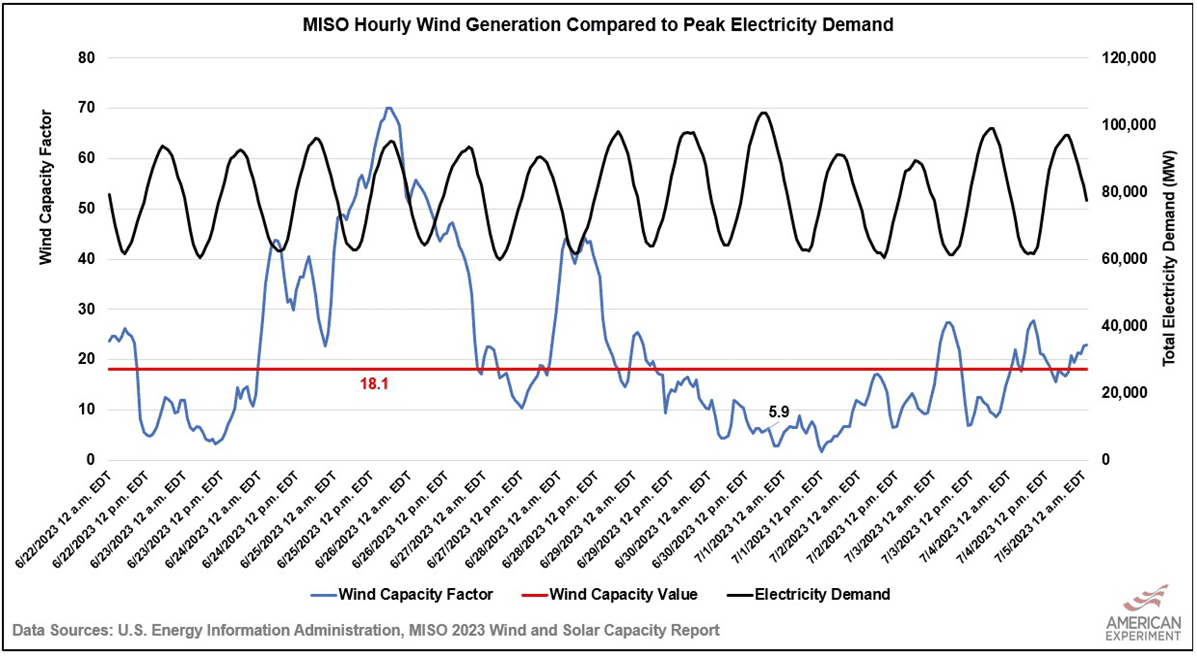
MISO (the Midcontinent Independent System Operator) is an independent electricity system operator (ISO) managing the flow of electricity from the Canadian province of Manitoba to the U.S. Gulf Coast states of Louisiana and Mississippi. It includes the territory of most of the states that lie in between. The ISO has 191,000 megawatts of generating capacity. Of this, 42% (80,200 MWs) uses natural gas, 25% (47,750 MWs) uses coal, 16% (30,550 MWs) uses wind, and 7% (13,370 MWs) is nuclear-powered.
EPA has promulgated rules (EPA–HQ–OAR–2023–0072) governing electricity generation seeking to aggressively decrease the amount of GHGs that are generated. The Center of the American Experiment (https://www.americanexperiment.org/), a think-tank focused on Minnesota, one of the U.S. states in MISO’s operating area, has issued research and submitted public challenges to EPA’s rulemaking citing high conversion costs, estimated at $246 billion, as well as future system resilience and reliability problems leading to potential extensive blackouts. The Center’s research on this is available here: https://www.americanexperiment.org/american-experiment-modeling-finds-epas-carbon-rule-would-cause-blackouts-in-miso-cost-246-billion/.
Energy Policy Research has sampled two recent monthly periods of MISO’s daily hourly generation. Focusing on the summer period from mid-July to mid-August 2023 (left-side) and the winter month of January 2023 (right-side), the analysis shows the hourly percentage contributions from natural gas, coal, and wind. Clearly, they illustrate the ISO’s high reliance on natural gas and coal.
In particular, where coal (yellow line) hovers at about 30% of load requirements, natural gas (blue line) and wind (green line) generation are complementary: when there is a fall-off in wind, natural gas power quickly increases; when wind recovers, natural gas utilization declines. It is important to note that intermittent generation such as wind are predicated on the availability of the resource, while natural gas, especially through simple-cycle generation, can quickly respond (“ramp”) to meet load requirements.
From the EPRINC Chart of the Week archive.
Cite: EPRINC, “EPA’s Proposed Grid Performance Standards and Their Impact on MISO’s Electricity Grid,” Chart of the Week 2024-09, February 26, 2024.