
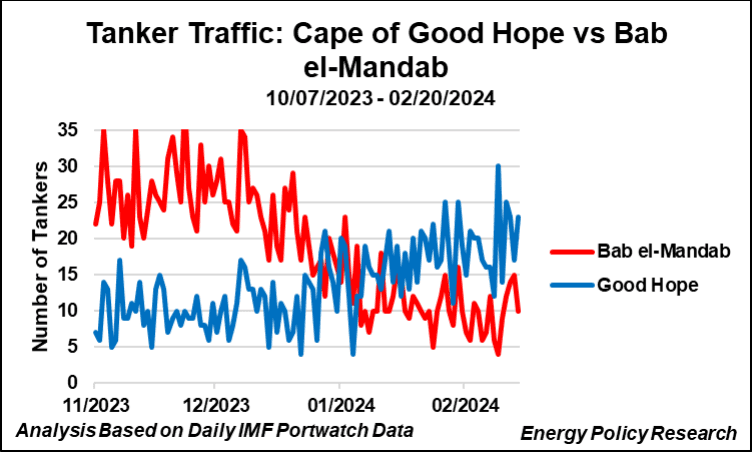
Crude oil prices are rising with Suez Canal tanker traffic increasingly re-routed around southern Africa in the face of ongoing attacks on Red Sea shipping, a new analysis released today by the Energy Policy Research Foundation reveals.
The war that began with Hamas’ attack of Israel on October 7, 2023 has quickly spilled over across the Middle East. Notably, commercial vessel traffic consisting of bulk carriers, container and other cargo vessels, and a variety of crude oil, product, and chemical tankers crossing the Bab al-Mandab strait at the southern entrance to the Red Sea, have been attacked by pirates, drones, and missiles from the Iranian-backed Houthi-controlled region of Yemen. About 20 percent of total Suez vessel traffic is comprised of tankers moving crude oil. Many ships have been forced to journey around the Cape of Good Hope, with Red Sea traffic having dropped by more than half its pre-war level.
“This disruption and rerouting is leading to longer transit times, which, in turn, lead to higher costs that are invariably passed through,” said EPRINC Research Director Max Pyziur. “The more prolonged this disruption lasts, the higher the inflationary impact will be, and it will be generally felt everywhere. It seems that we are beginning to see them now with rising crude oil prices.”
On November 19, 2023, the Galaxy Leader, a RoRo (Roll On/Roll Off vessel used for transporting motor vehicles), was seized by Houthis and is being held in the port of Hodeida along with its crew.
On November 26, 2023, the Central Park, a chemical tanker operated by Zodiac Maritime, was attacked by Houthi missiles. Since then, there have been a total of 32 commercial vessels targeted with Houthi weaponry of which 11 have been tankers.
Commercial operators detouring vessels around the Cape of Good Hope face at least 14 extra days of transit time and increased insurance premiums, along with additional fuel costs. Beginning January 4, Cape of Good Hope tanker traffic exceeded that of Bab el-Mandab (Figure 1).
Despite soft demand, crude oil prices started rising from their lows after a series of tanker attacks in mid-December (Figure 2).
In conjunction with coalitions of other countries, the U.S. has initiated two military responses:
- Operation Prosperity Guardian (December 18, 2024), a coalition of more than 20 countries with a mandate to protect international shipping in the Red Sea; and
- Operation Poseidon Archer (January 11, 2024), a separate coalition working to conduct offensive operations to degrade Houthi military capabilities.
“Despite increased multinational security operations in the Red Sea, commercial operators remain prudent in rerouting their vessels away from the region,” said Matthew Sawoski, EPRINC’s Senior Research Analyst for Energy and National Security. “While this has yet to reach the crisis-level of the 1973 Arab Oil Embargo, until security is improved, this is set to continue.”
More information is available at: https://eprinc.org/chart-of-the-week/.
From the EPRINC Chart of the Week archive.
Cite: EPRINC, “Tanker Traffic: Bab el-Mandab Strait vs Cape of Good Hope,” Chart of the Week 2024-08, February 19, 2024.