
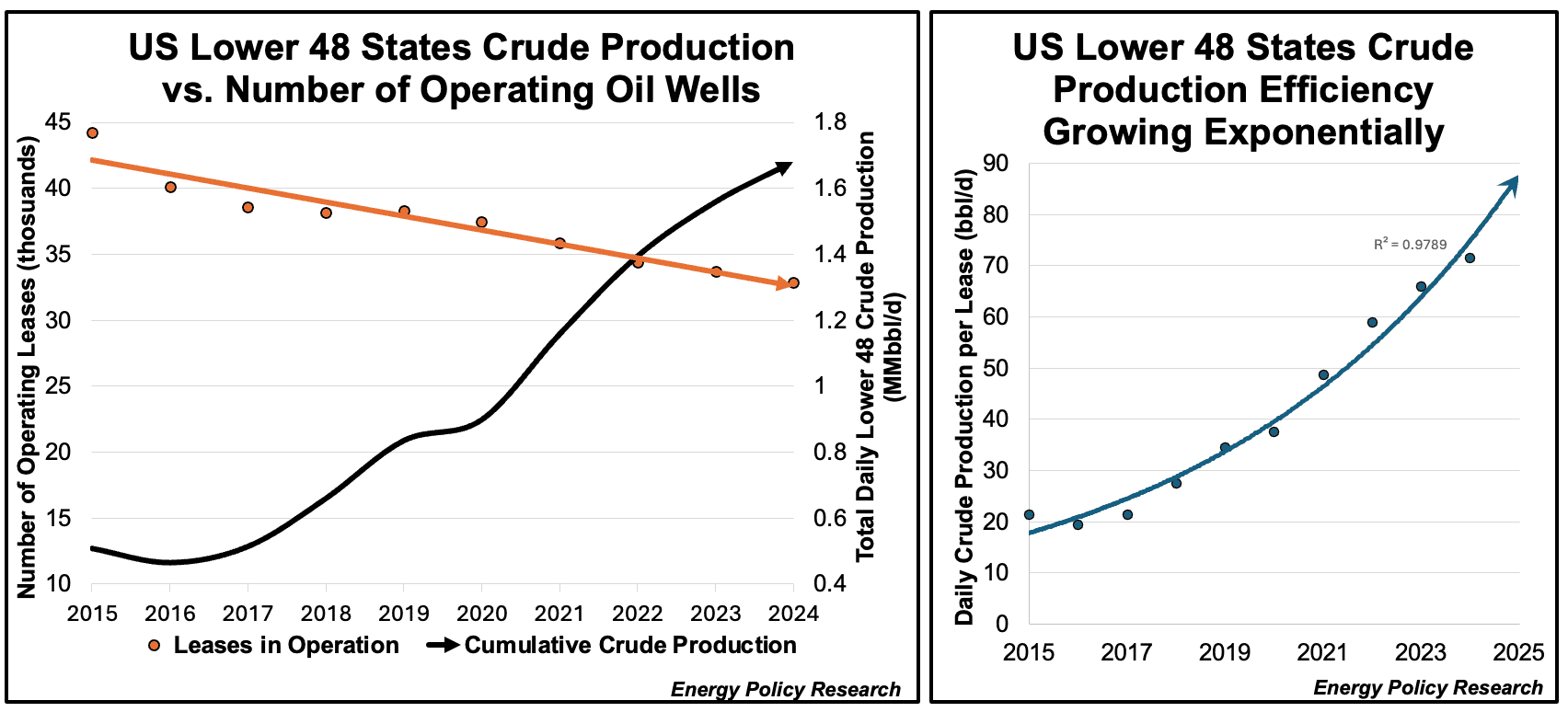
The chart tracks two measures on Federal lands in the Lower 48 States since 2015: the number of oil leases in operation and the total cumulative daily crude production of the wells still operating on those leases. Over the period, operational leases declined 25%, from more than 44,000 to just under 33,000, while daily crude production tripled from just over 1.6 million barrels per day.
This divergence is possible only because of rapidly rising efficiency in production per lease. Calculated on a yearly basis, the implied rate of gain is a 17% increase in crude production per lease each year, with no signs of slowing. Notably, these gains continued and accelerated in recent years, well into the second decade of the shale revolution.
The improvements reflect advances in drilling technology, enhanced recovery techniques, and optimized field development strategies that allow operators to extract significantly more oil from each lease. The trend demonstrates the industry’s ability to maintain and increase production levels even with a reduced operational footprint on Federal lands.
If the Trump Administration fulfills promises to reverse the decline in Lower 48 leasing, new leases would operate at a much higher level of productivity than in past periods with the same number of leases. Any expansion of Federal leasing could therefore result in substantial increases in domestic crude oil production capacity at current or potentially lower costs.
From the EPRINC Chart of the Week archive.
Cite: EPRINC, “Despite Decrease in Operational Leases, Crude Oil Production Efficiency Gains are Growing Exponentially in the US Lower 48,” Chart of the Week 2025-30, July 21, 2025.