
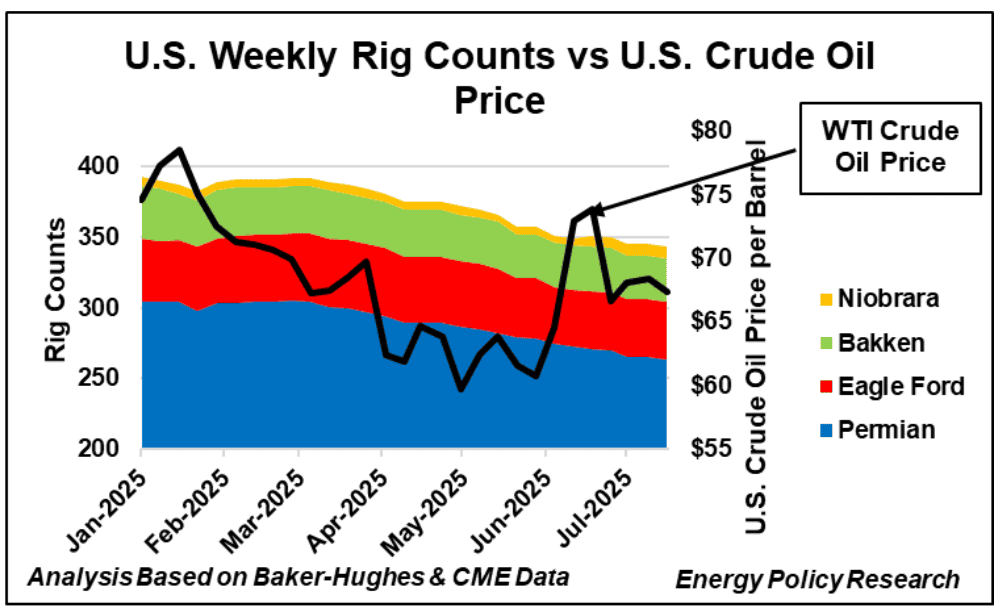
Drilling rig counts are a key metric for tracking exploration and production (E&P) activity in crude oil and natural gas fields. Although drilling rigs have become considerably more efficient in their commissioning and resource recovery, shifts in rig counts remain a useful indicator of potential growth or reduction in resource production.
The Trump administration’s policies have generally been supportive of U.S. oil and gas production. The recently signed One Big Beautiful Bill Act (OBBBA) included significant provisions easing E&P activity and favoring drilling on federal lands.
Other administration policies, however, have worked in the opposite direction. Increased universal and reciprocal tariffs have created economic uncertainty and headwinds that have flattened demand for petroleum products and crude oil. Reflecting this uncertainty, West Texas Intermediate (WTI), the U.S. crude oil benchmark, has been volatile but trending lower since the beginning of 2025.
Rig counts have trended correspondingly lower across the primary U.S. crude oil producing basins — the Permian, Eagle Ford, Bakken, and Niobrara — tracking the softer price environment despite the supportive policy backdrop.
From the EPRINC Chart of the Week archive.
Cite: EPRINC, “U.S. Rig Counts and Crude Oil Prices,” Chart of the Week 2025-29, July 14, 2025.