
The number of U.S. data centers continues to grow to accommodate expanding data needs driven by entertainment (streaming services), telecom (smartphones and tablets), security (doorbell cameras), SCADA (Supervisory Control and Data Acquisition), and many other requirements for data storage and dissemination. As of early 2024, there were over 10,600 data centers worldwide, with approximately half located in the United States. These facilities are not distributed evenly, but cluster in states with affordable commercial real estate, robust network connectivity, infrequent natural disasters, and lower-cost electricity. Washington State, Illinois, and Texas all host high concentrations, but Virginia dominates them all.
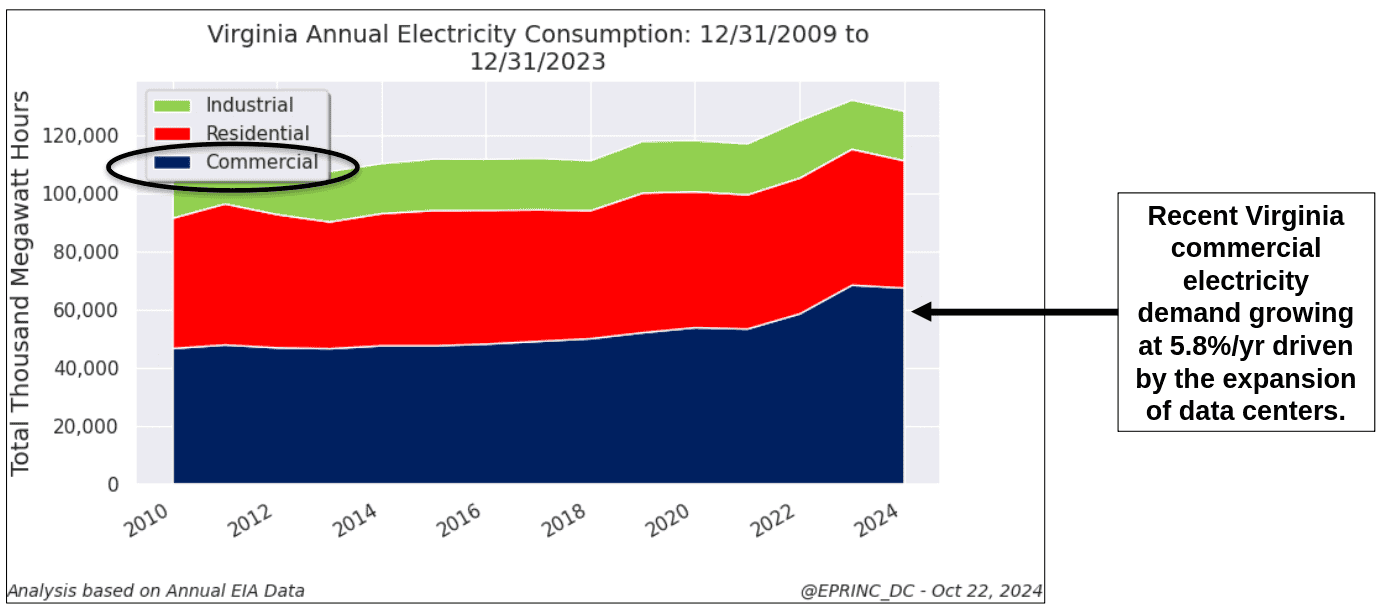
During 2023, Virginia data center electricity demand is estimated to have accounted for 32 terawatt hours (TWh)—over 25% of the state’s total power needs of 128 TWh, and nearly half of Virginia’s total 2023 commercial electricity demand of 67.5 TWh. From 2019 to 2023, Dominion Energy, one of Virginia’s primary utilities, connected 94 data centers for a total load of 4,000 MW, with another 15 expected in 2024. Individual facilities are also growing larger, now requiring capacities ranging from 100 to 1,000 megawatts.
This build-out has reshaped the state’s demand profile. From 2009 to 2019, Virginia’s commercial power demand grew at an annual rate of 1.4%; from 2019 to 2023, it grew at 5.8%, primarily driven by data centers—a pace that would double commercial demand within 12 years. Over the same period, residential and industrial electricity demand declined by 1.6% and 1%, respectively. Additional growth is expected from generative artificial intelligence: an AI data request currently consumes roughly ten times the electricity of a typical Google search, though the rate of future AI adoption remains uncertain, complicating generation planning.
The rapid scale of Virginia’s data center development is challenging planners’ ability to manage power generation capacity additions. Adding to this uncertainty is the EPA’s power plant rule (New Source Performance Standards; Docket EPA-HQ-OAR-2023-0072), finalized July 8, 2024, which mandates that most coal- and gas-fired power plants capture 90% of their greenhouse gas emissions by 2032 or shut down by 2039. EPA estimates the rule will lead to the retirement of 42,000 megawatts of coal plants and a 37% decline in natural gas use for power generation.
The rule has been challenged by affected parties who asked the U.S. Supreme Court to stay its enforcement. On October 16, 2024, while acknowledging the merits of the plaintiffs’ interests, the Court declined to issue a stay. The case is set to continue on December 5, 2024, in the U.S. Court of Appeals for the D.C. Circuit.
From the EPRINC Chart of the Week archive.
Cite: EPRINC, “Virginia Electricity Demand Growth: The Case of Data Centers,” Chart of the Week 2024-43, October 21, 2024.