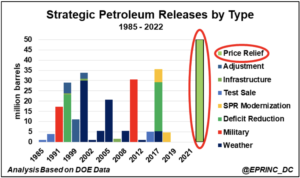
Annual SPR release categories from 1985 to 2022

Over the course of 2021, U.S. transportation fuel prices have climbed steeply and rapidly, rising to levels not seen in almost a decade. From the beginning of 2020 through the most recent period, the increase at the national level has been about 40% (see Figure 1).

In an attempt to lower gasoline prices, the Biden administration announced on November 23, 2021 the release of 50 million barrels (MBs) from the U.S. Strategic Petroleum Reserve (SPR). This is the equivalent of three to four days of U.S. consumption. Concurrently, the administration requested the FTC to investigate oil companies to determine whether “illegal conduct is costing families at the pump.”

These actions were taken after the administration requested both U.S. producers and OPEC+ members to increase crude oil production in order to lower its price given that it is the main feedstock in the production of gasoline and other transportation fuels. In addition to requesting more production from oil producers, the Administration pursued a coordinated release of strategic oil stocks from China, India, Japan, and Korea. Stock releases are traditionally undertaken under the auspices of the International Energy Agency (IEA). The Administration has been criticized over these initiatives as they have pursued a range of policies that are likely to constrain U.S. oil and gas production, among the more important are decisions earlier in the year to halt construction of the Keystone XL Pipeline and suspension of the oil and gas lease sale program on federal lands.

The U.S. Strategic Petroleum Reserve (SPR) was established in the 1970s in reaction to oil supply shortages brought on by political instability in producing countries in the Middle East. Any potential SPR releases would be coordinated by the IEA on behalf of OECD member countries, which includes the U.S.

Read the full publication (PDF)

Filed under
Geopolitics and Energy SecurityPetroleum and Natural GasStrategic Petroleum Reserve