
On October 9, President Trump announced an agreement with President Putin to make Russian diesel available to U.S. and global markets, and Treasury issued OFAC General License 135 authorizing the trade through April 7, 2027. Announced volumes total roughly 4.8 Mt (about 36 million barrels): 0.3 Mt in October, 0.5 Mt in November, 1 Mt in December, and a further 3 Mt “within a short period,” according to Deputy Prime Minister Novak. The license came three weeks after the President signed the Lindsey O. Graham Sanctioning Russia and Iran Act, which authorizes tariffs of up to 100% on countries importing Russian energy. On October 16, two days before those measures were due to take effect, the President waived nearly all of the Act’s Russia provisions.
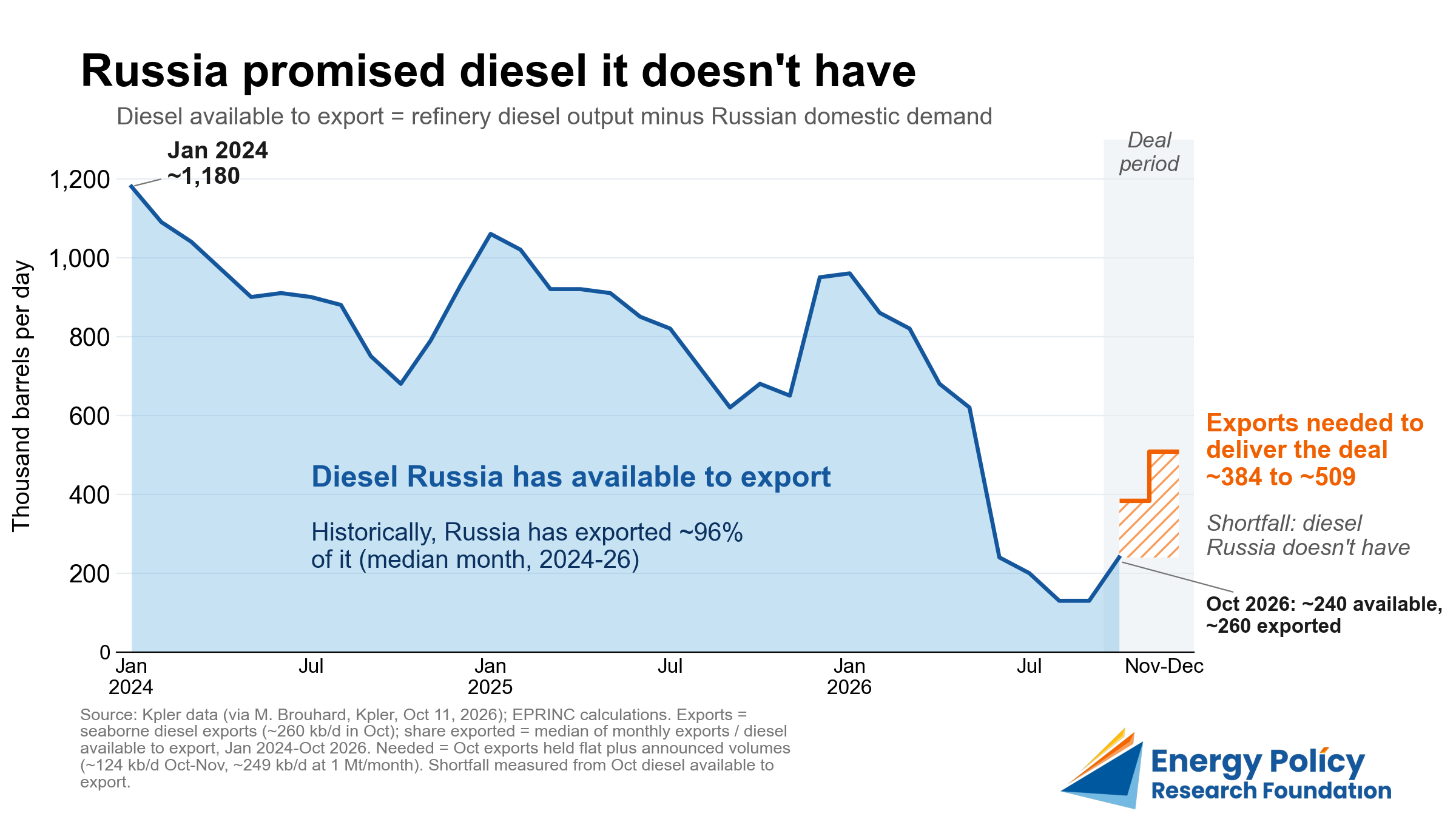
Drawing on Kpler data, EPRINC finds that Russia has little diesel left to deliver. Exportable diesel is what Russian refineries produce after domestic demand is met. It has fallen from about 1,180 kb/d in January 2024 to roughly 240 kb/d in October 2026. Nearly 40% of Russian refining capacity is idle after repeated Ukrainian strikes. Russia is already exporting about 260 kb/d, slightly more than it has available, and meeting the announced schedule on top of existing exports would require roughly 384 to 509 kb/d.
Cargoes that do move will most likely be diverted from Russia’s existing buyers, chiefly Turkey and Brazil, and so add nothing to the world market. The United States does not need them. It remains the world’s largest diesel exporter, shipping about 1.4 mb/d in October, and has imported effectively no Russian diesel since 2024. Sending Russian cargoes into a net exporting market creates trade flows that would not otherwise occur, and it does so while freight is exceptionally expensive: VLCC rates have topped $30/bbl on major crude routes, against less than $10/bbl earlier this year. The export routes are also under pressure, with Ukrainian drones targeting the Baltic terminals at Primorsk and Ust-Luga. GL 135 changes only U.S. law. UK and EU price cap and asset freeze measures remain in force, which limits the shipping and insurance services these cargoes depend on.
EPRINC thanks Michelle Brouhard, Kpler’s Head of Policy and Geopolitical Risk, for the data and analytical help behind the above findings.
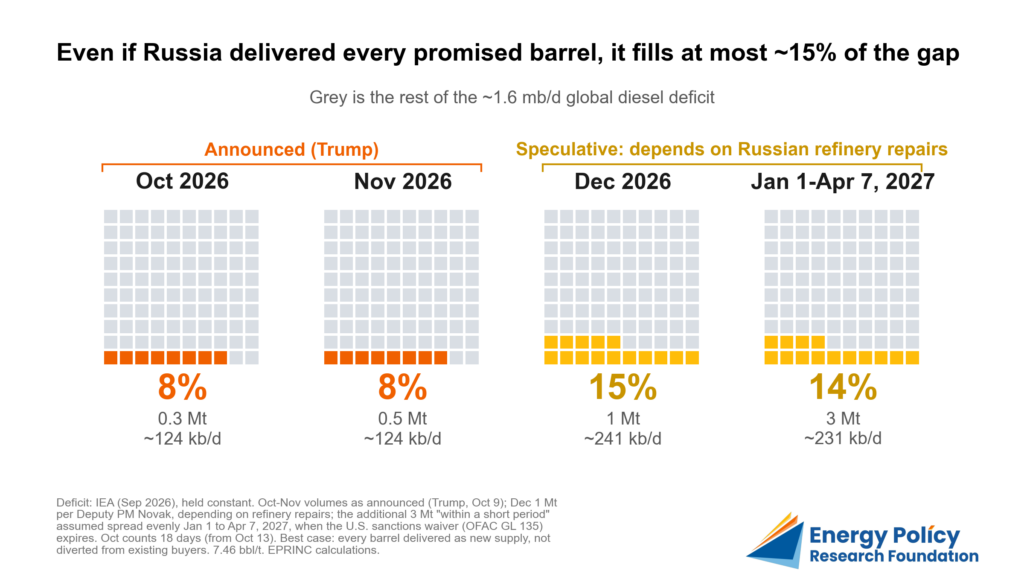
Even full delivery would fill only a small share of the gap. The IEA puts the global diesel deficit at about 1.6 mb/d. The October and November tranches (~124 kb/d each) would cover about 8% of it, December’s 1 Mt about 15%, and the remaining 3 Mt about 14%. Averaged over the license period, the deal amounts to roughly 203 kb/d, or 13% of the gap.
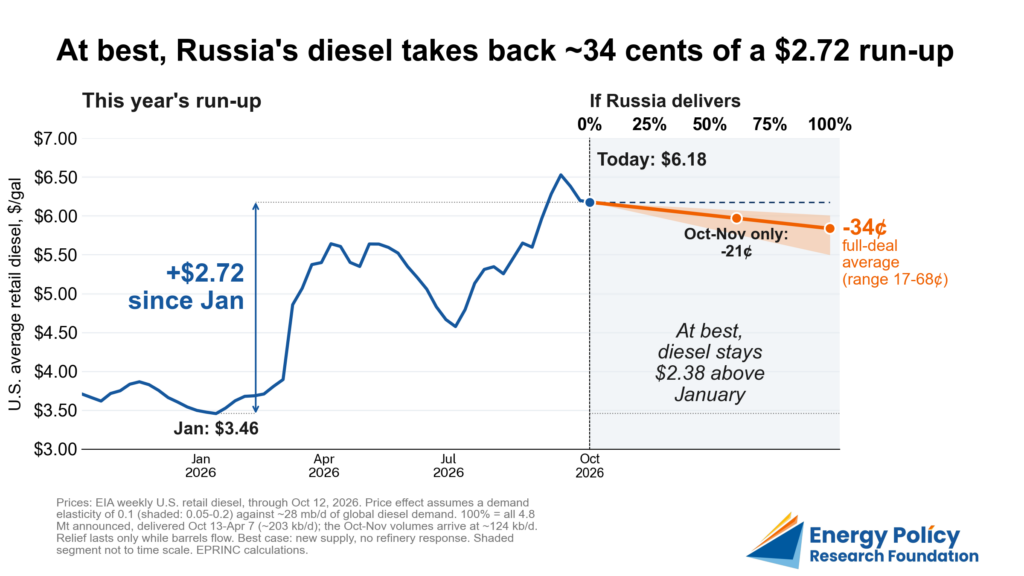
The price relief would be measured in cents. EPRINC scales the added supply against global diesel demand of about 28 mb/d, using a demand elasticity of 0.1. On that basis, full delivery would lower retail diesel by about 34 cents (17 to 68 cents across elasticities of 0.05 to 0.2), to $5.84/gal. U.S. retail diesel rose from $3.46/gal in January to $6.18/gal in mid-October, an increase of $2.72, or 79%. Even in the best case, diesel would stay about $2.40 above January levels heading into the November 3 midterms. Given how little diesel Russia has to export, the realistic delivery share is close to zero.
That estimate is an upper bound, because it assumes refiners do not respond to lower prices. Margins at simpler refineries in Singapore and Northwest Europe are already below zero. Further price declines risk run cuts that would tighten supply of diesel, gasoline and jet fuel alike.
What the deal delivers with more certainty is revenue for Moscow. At about $193/bbl (ICE gasoil), the full 4.8 Mt is worth roughly $6.9 billion. Russia abolished export duties on oil products in 2024, so most of that stays with refiners. EPRINC estimates the federal budget’s take, from the mineral extraction tax and the profit tax, at 13% to 24% of export value, or about $1.3 billion. With military spending at roughly 35% to 43% of Russia’s 2026 federal budget, about $0.5 billion of that (range $0.3 to $0.7 billion) would go to the military.
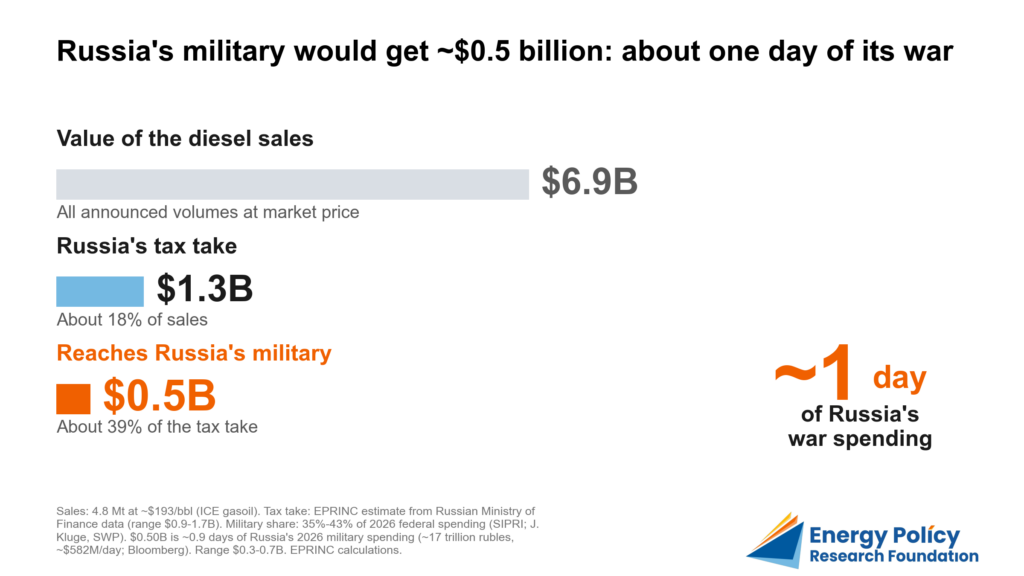
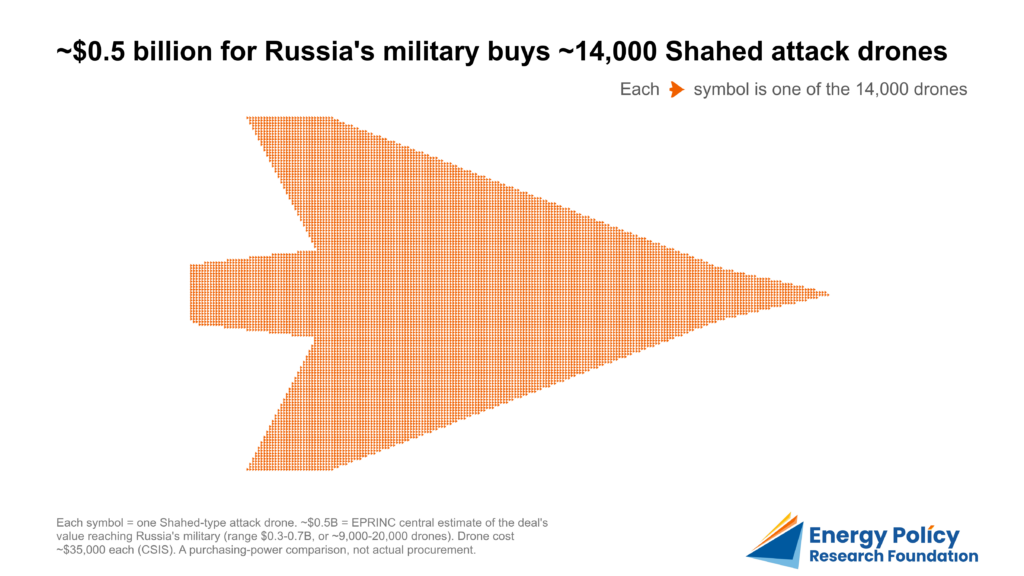
Russia plans about 17 trillion rubles of military spending in 2026, or roughly $582 million per day. At that rate, $0.5 billion pays for about one day of the war, or about 14,000 Shahed attack drones at roughly $35,000 each.
Washington moved in September to penalize buyers of Russian energy, licensed Russian diesel three weeks later, and a week after that waived those same penalties before they took effect.
Most of the barrels the license is meant to unlock do not exist, and those that move will mostly be diverted from other buyers at higher freight cost. In the best case, the deal trims about 34 cents from a $2.72 run-up. (In the October to November period, this best case reduces to 21 cents.)
What it delivers with more certainty is roughly half a billion dollars to the Russian military. And importantly, those dollars would come from the United States amid contradictory signals about the future of sanctions regimes.
Cite: EPRINC, “Russia Diesel for America: A Deal on Paper,” Chart of the Week 2026-36, October 20, 2026.