
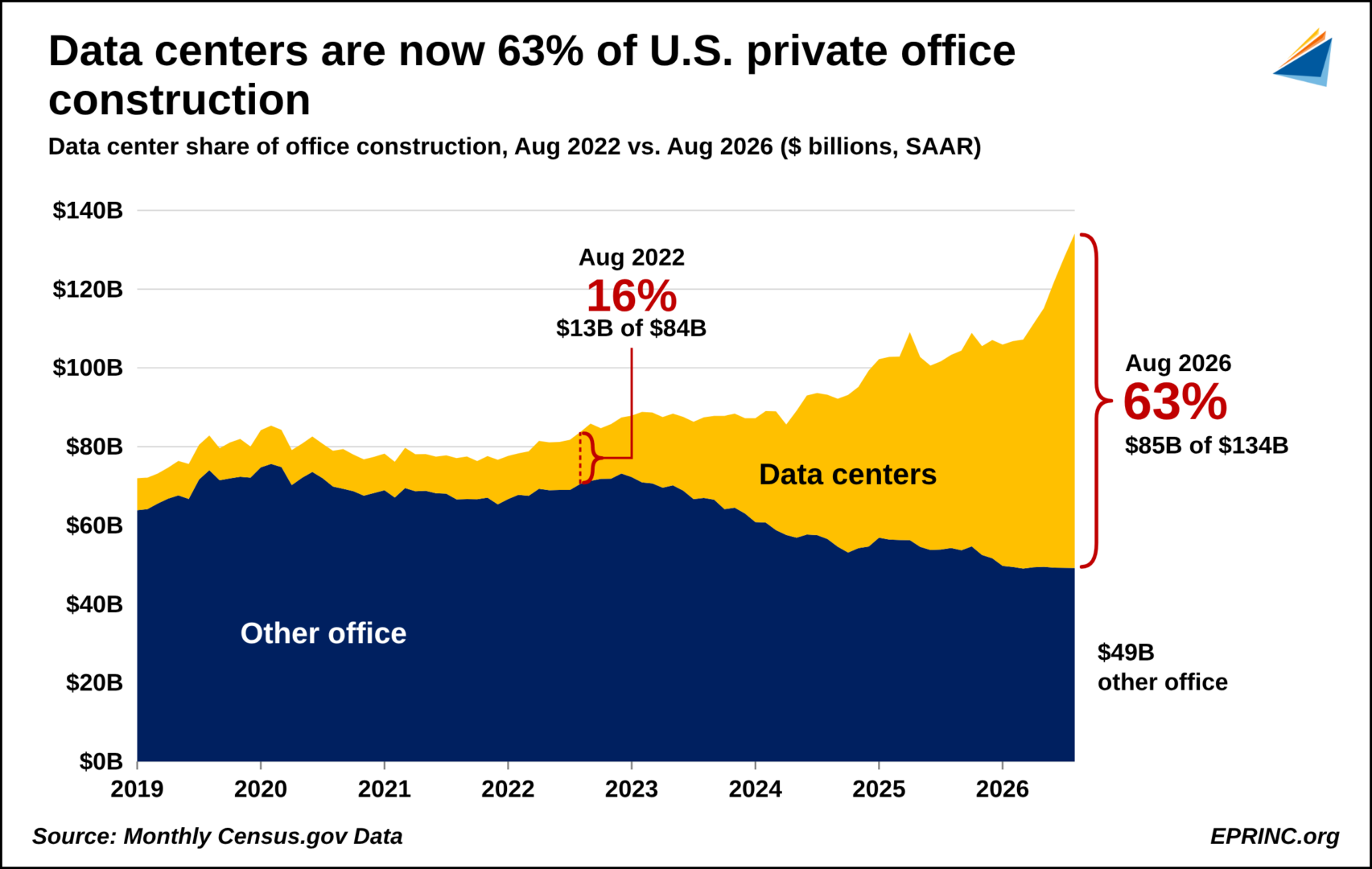
Data centers have gone from a minor part of U.S. office construction to its main driver. In December 2019, the Census Bureau put total private office construction spending at just over $80 billion (seasonally adjusted annual rate), of which data centers accounted for $7.9 billion, or about 10%. By December 2025 the total had reached $107 billion, with data centers making up $55.5 billion, or 52%. The latest figures, for August 2026, show data center construction at $85 billion, 63% of a $134 billion total.
The rest of the category has moved the other way. Spending on other office construction has fallen from more than $70 billion in late 2022 to about $49 billion, amid elevated post-pandemic vacancies and higher borrowing costs. Since late 2022, data centers have accounted for more than all of the category’s growth.
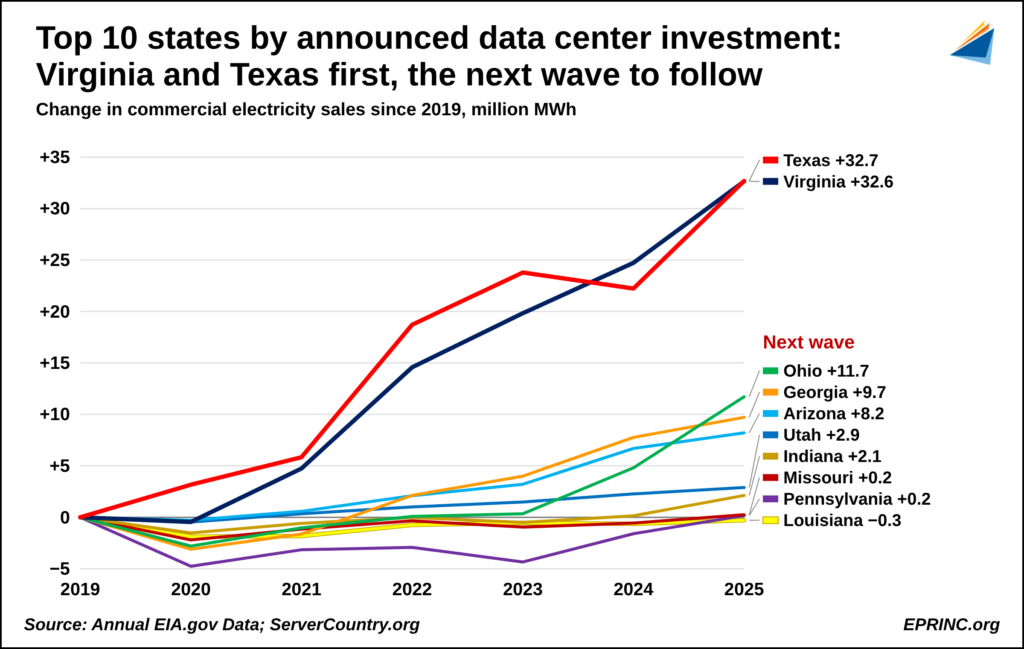
The buildout shows up in power demand as well as dollars. In Virginia and Texas, commercial electricity sales, driven mostly by new data centers, have grown by 32.6 million and 32.7 million megawatt-hours respectively since 2019. Virginia’s increase is equivalent to about 3.7 GW of round-the-clock load.
Barring local opposition or grid constraints, that growth has much further to run. According to the Server Country project tracker, developers have announced $234.5 billion in Virginia projects that would need another 19.2 GW of capacity, more than five times the average load the state has added since 2019. Announced Texas projects total $177 billion and would require another 42.9 GW.
Virginia and Texas are where the growth has already happened. The next wave is expected in the other eight states in the tracker’s top 10 by announced investment, where commercial demand has so far grown far less. Missouri leads with $207.5 billion in announced projects requiring 9.0 GW, followed by Utah ($181.3 billion, 26.9 GW), Georgia ($153.7 billion, 14.7 GW), Pennsylvania ($128.6 billion, 24.1 GW), Arizona ($127.5 billion, 13.1 GW), and Ohio ($119.1 billion, 21.4 GW). Indiana has $76.9 billion requiring 10.6 GW, and Louisiana $75.7 billion requiring 5.8 GW, led by Meta’s 5 GW Hyperion data center in Richland Parish.
These announced figures are not directly comparable to the Census series. They cover multiyear buildouts and can include IT equipment, which construction spending excludes, and the tracker’s power totals count only projects that disclose a capacity figure. Even so, their scale relative to current load points to a substantial need for new generation and transmission in states that have so far seen far less data center demand.
Many of these projects have already broken ground, but local resistance is growing. In Missouri, residents have sued to overturn data center rezonings approved in Franklin County in September and to set back the approval process for a project in Montgomery County. In Festus, recall petitions were filed this spring against the mayor and three council members who voted for a hyperscale data center.
Cite: EPRINC, “Data Center Construction and Power Demand: It’s Not Just Virginia and Texas,” Chart of the Week 2026-37, October 30, 2026.