
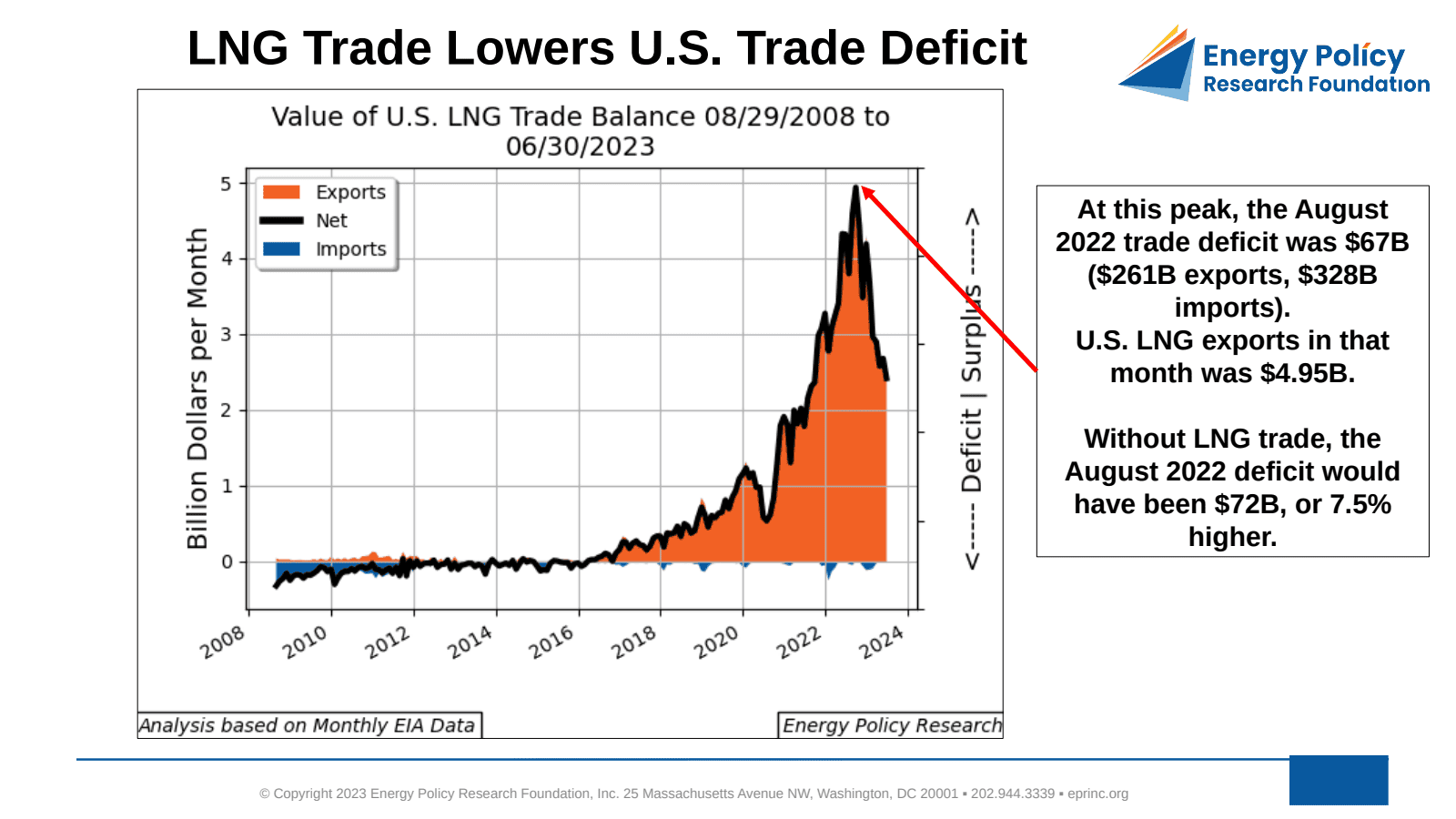
Record natural gas production gains in the 2000s, driven by improvements in hydraulic fracturing and lateral drilling, generated a domestic surplus that prompted large-scale development of LNG export facilities along the Gulf Coast. The first LNG cargoes shipped in 2016, and U.S. LNG exports have grown considerably since.
This growth has made a material contribution to narrowing the U.S. trade deficit. According to the EIA, natural gas trade accounted for 5% of U.S. energy import value and 22% of energy export value in 2020, producing an annual surplus of $26 billion.
The monthly U.S. LNG trade surplus peaked at $4.95 billion in August 2022. That month, the overall trade deficit was $67 billion, reflecting $261 billion in exports against $328 billion in imports. Without LNG trade, the August 2022 deficit would have been $72 billion, or 7.5% higher.
Congress has considered measures to support this trade. H.R. 1130, the “Unlocking our Domestic LNG Potential Act,” sought to expedite the permitting required for natural gas liquefaction plant construction and LNG exports. After clearing the Energy and Commerce Committee by a vote of 27-21, it failed a full House vote on September 21, 2023, by a vote of 212-215.
From the EPRINC Chart of the Week archive.
Cite: EPRINC, “LNG (Liquefied Natural Gas) Trade Lowers U.S. Trade Deficit,” Chart of the Week 2023-37, September 11, 2023.