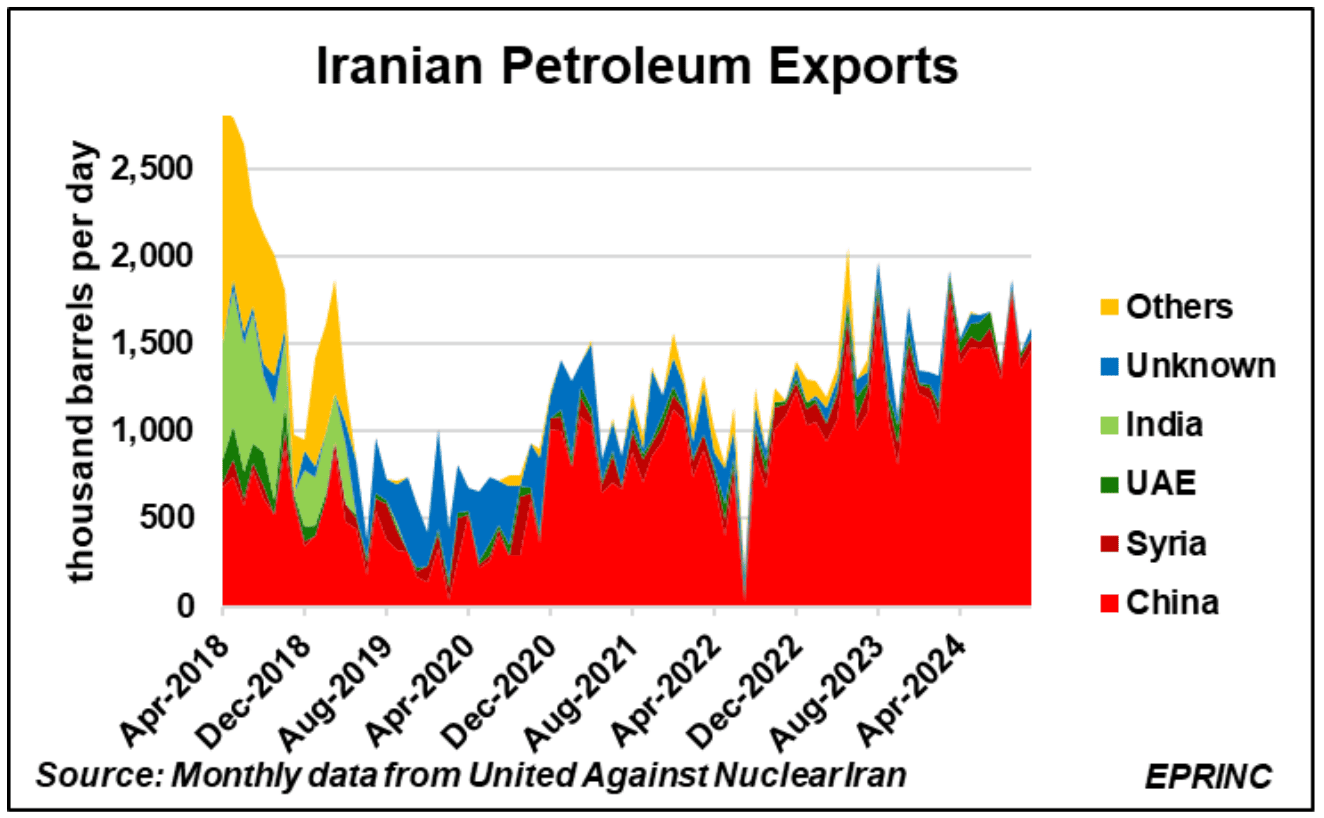
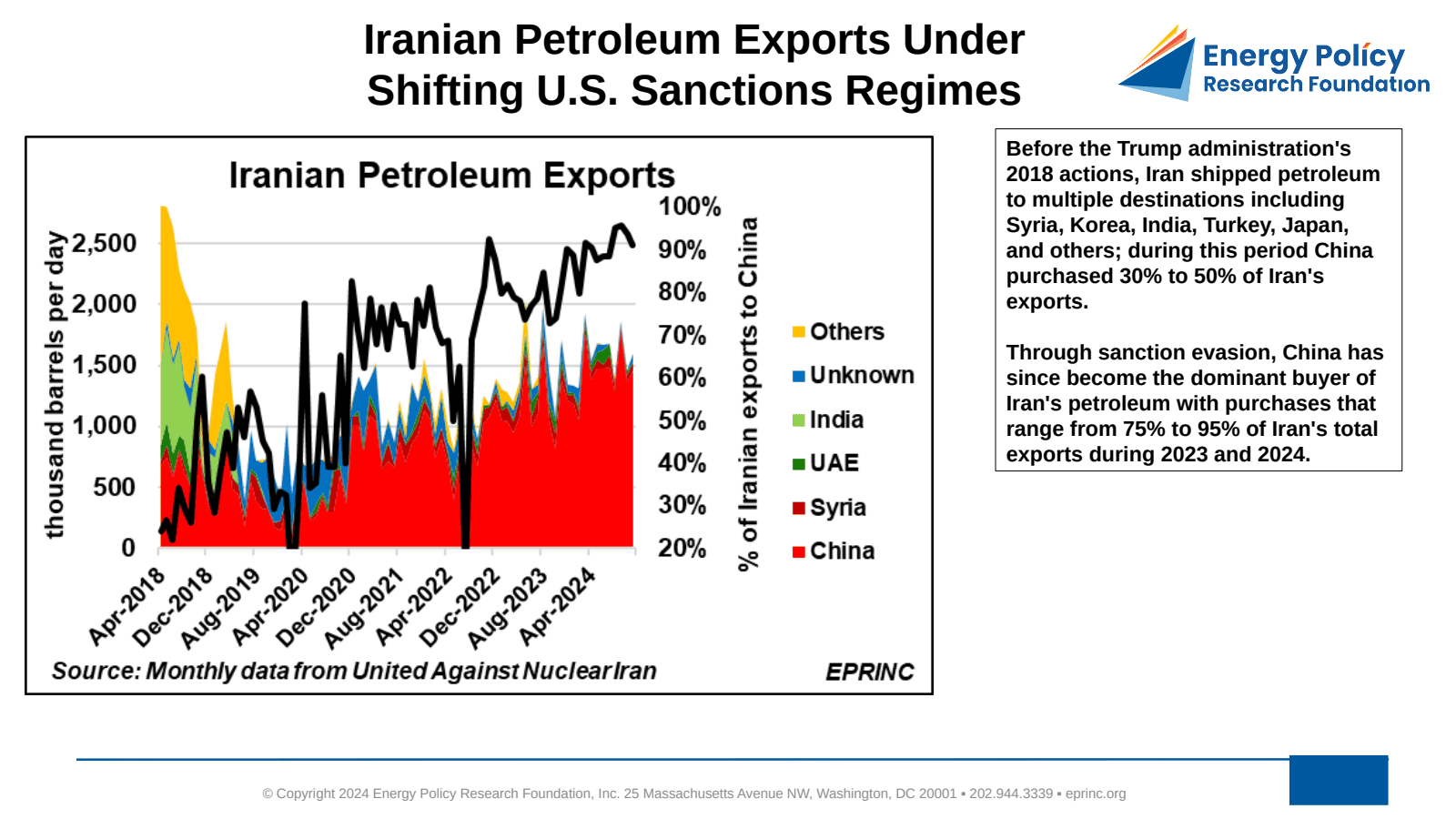
The chart traces Iranian petroleum exports across successive U.S. sanctions regimes. After two decades of constraints, the Obama administration’s 2015 Joint Comprehensive Plan of Action (JCPOA) gave Iran latitude to expand production and exports. Following the Trump administration’s 2018 withdrawal from the agreement and its return to stringent enforcement, exports fell from a peak of 2.8 million barrels per day (bpd) to 680 thousand bpd by mid-2020. Since then, shifting sanction regimes, lax enforcement, and skillful evasion have driven a resurgence, with exports now standing at approximately 1.5 million bpd.
The destination mix has also shifted sharply. Before the 2018 actions, Iran shipped petroleum to multiple markets including Syria, Korea, India, Turkey, and Japan, with China purchasing 30% to 50% of the total. Through sanction evasion, China has since become the dominant buyer, accounting for 75% to 95% of Iran’s exports during 2023 and 2024.
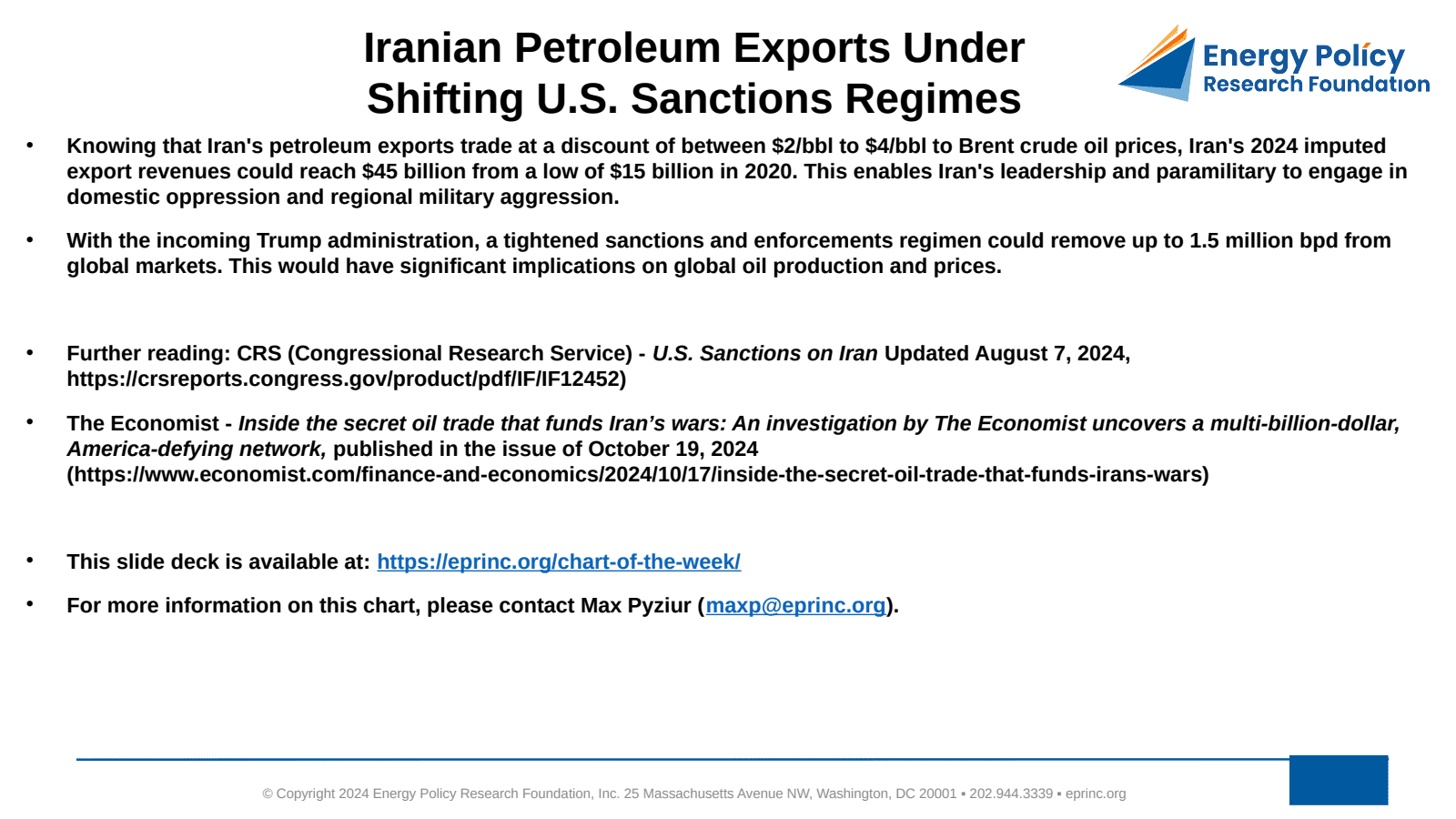
Iran’s petroleum trades at a discount of $2 to $4 per barrel to Brent crude. On that basis, imputed 2024 export revenues could reach $45 billion, up from a low of roughly $15 billion in 2020 — revenue that, in EPRINC Research Director Max Pyziur’s assessment, enables Iran’s leadership and paramilitary to engage in domestic oppression and regional military aggression. A tightened sanctions and enforcement regimen under the incoming Trump administration could remove up to 1.5 million bpd from global markets, with significant implications for global oil production and prices.
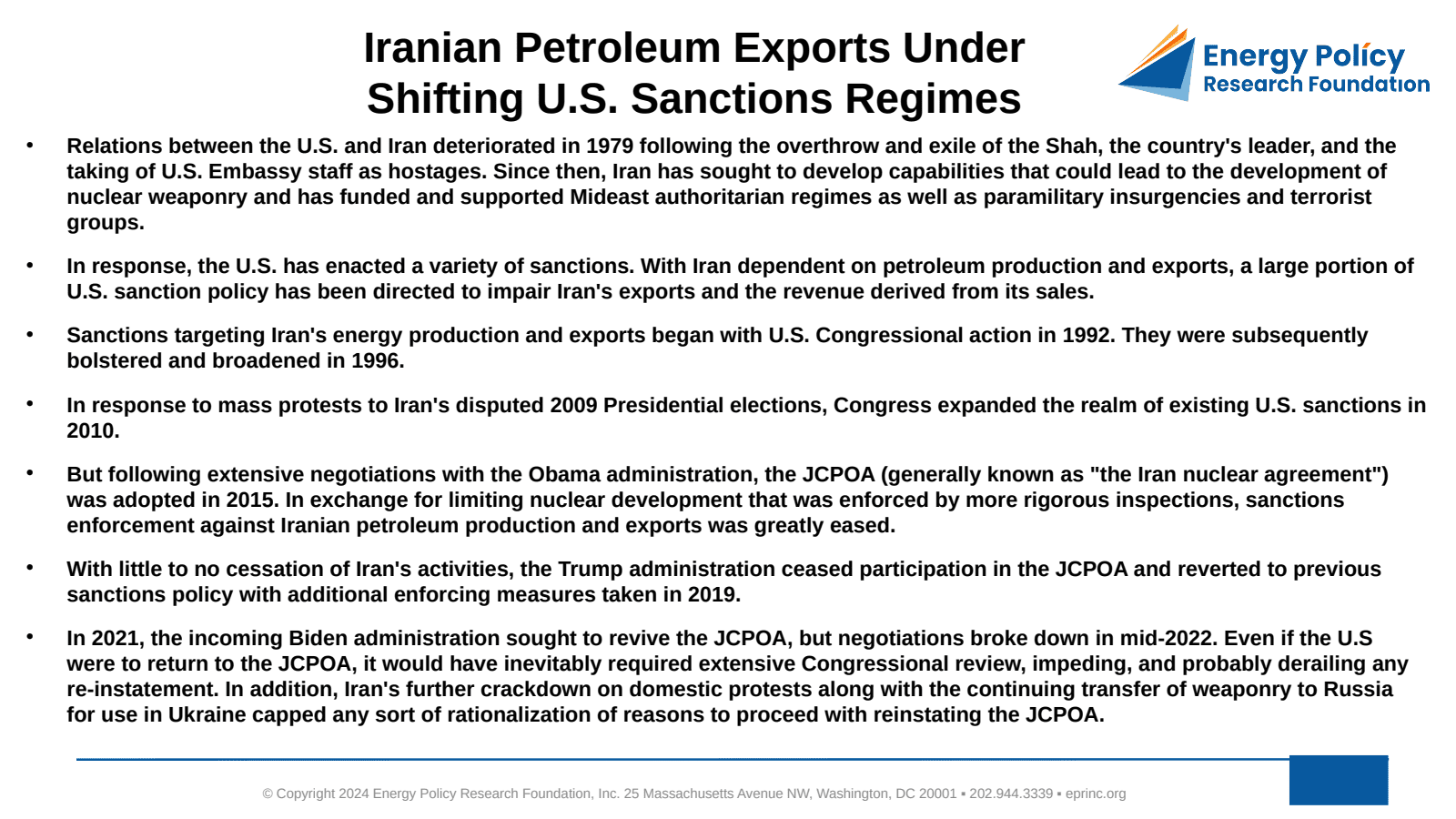
U.S.-Iran relations deteriorated in 1979 following the overthrow of the Shah and the taking of U.S. Embassy staff as hostages. Because Iran depends heavily on petroleum production and exports, much of subsequent U.S. sanctions policy has aimed to impair those exports and the revenue they generate. Congressional action targeting Iran’s energy sector began in 1992 and was broadened in 1996 and again in 2010 after Iran’s disputed 2009 elections, before the JCPOA eased enforcement in 2015.
The Biden administration sought to revive the JCPOA in 2021, but negotiations broke down in mid-2022. Any return to the agreement would have required extensive Congressional review, while Iran’s crackdown on domestic protests and its continuing transfer of weaponry to Russia for use in Ukraine further undercut the rationale for reinstatement. Additional background is available from the Congressional Research Service and The Economist.
From the EPRINC Chart of the Week archive.
Cite: EPRINC, “Iranian Petroleum Exports Under Shifting U.S. Sanctions Regimes,” Chart of the Week 2024-48, November 25, 2024.