
On October 22, 2025, the United States announced additional sanctions against Rosneft and Lukoil, Russia’s two largest oil producers, to take effect on November 21. One day later, the European Union joined with its own set of measures, including bans on imports of Russian coal and LPG and on future LNG investments, alongside an extensive list of other steps. The EU also sanctioned an additional 117 tankers of Russia’s “shadow fleet,” bringing the total to 558.
Both sets of measures target Russia’s oil revenues, a major source of national treasury receipts that fund the government and its war effort against Ukraine. They add to sanctions imposed since Russia’s full-scale military aggression against Ukraine began in February 2022.
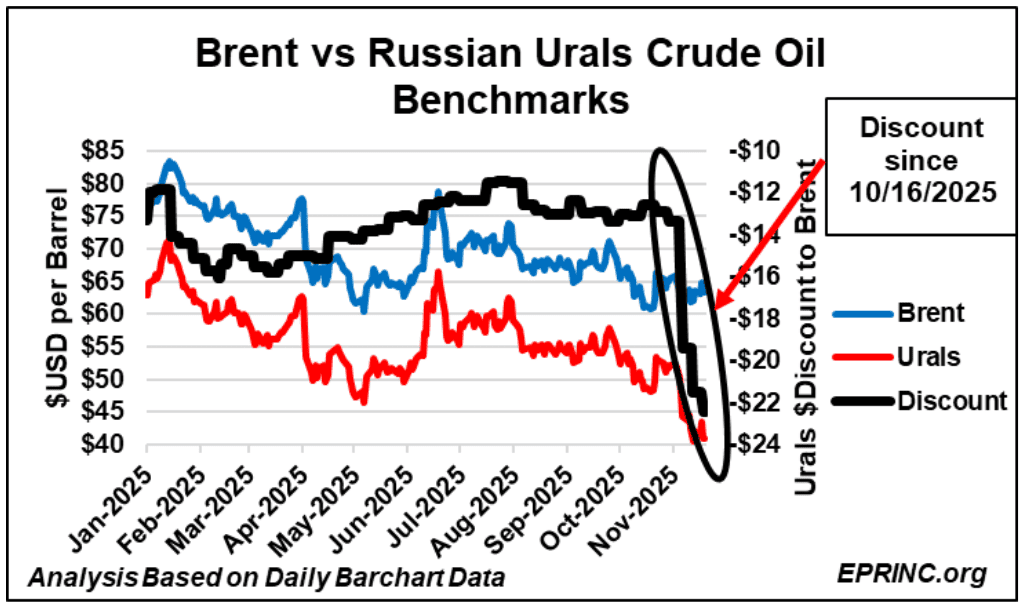
The chart tracks the price of Urals crude, Russia’s benchmark, against Brent, the global benchmark. In reaction to the new measures, Urals prices—already trading at $49 per barrel, a $13.50 discount to Brent—declined to $41 per barrel, widening the discount to $22.
Approaching the deadline, Russia had been exporting 3.5 million barrels per day (MB/d) of crude oil, of which roughly 1.7 MB/d was shipped to China, 1.1 MB/d to India, and 0.35 MB/d to Türkiye.
Russian producers have taken aggressive actions ahead of the deadlines to lock in future revenues. Among these, they are storing 1.4 billion barrels of oil on maritime vessels—equivalent to about 1,400 Suezmax tankers—pending shipment to final destinations. Lukoil, meanwhile, has been seeking to liquidate many of its global assets, including its Bulgarian refinery.
From the EPRINC Chart of the Week archive.
Cite: EPRINC, “Impact of Recent U.S. and EU Sanctions on the Price of Russian Urals Crude Oil,” Chart of the Week 2025-44, October 27, 2025.