
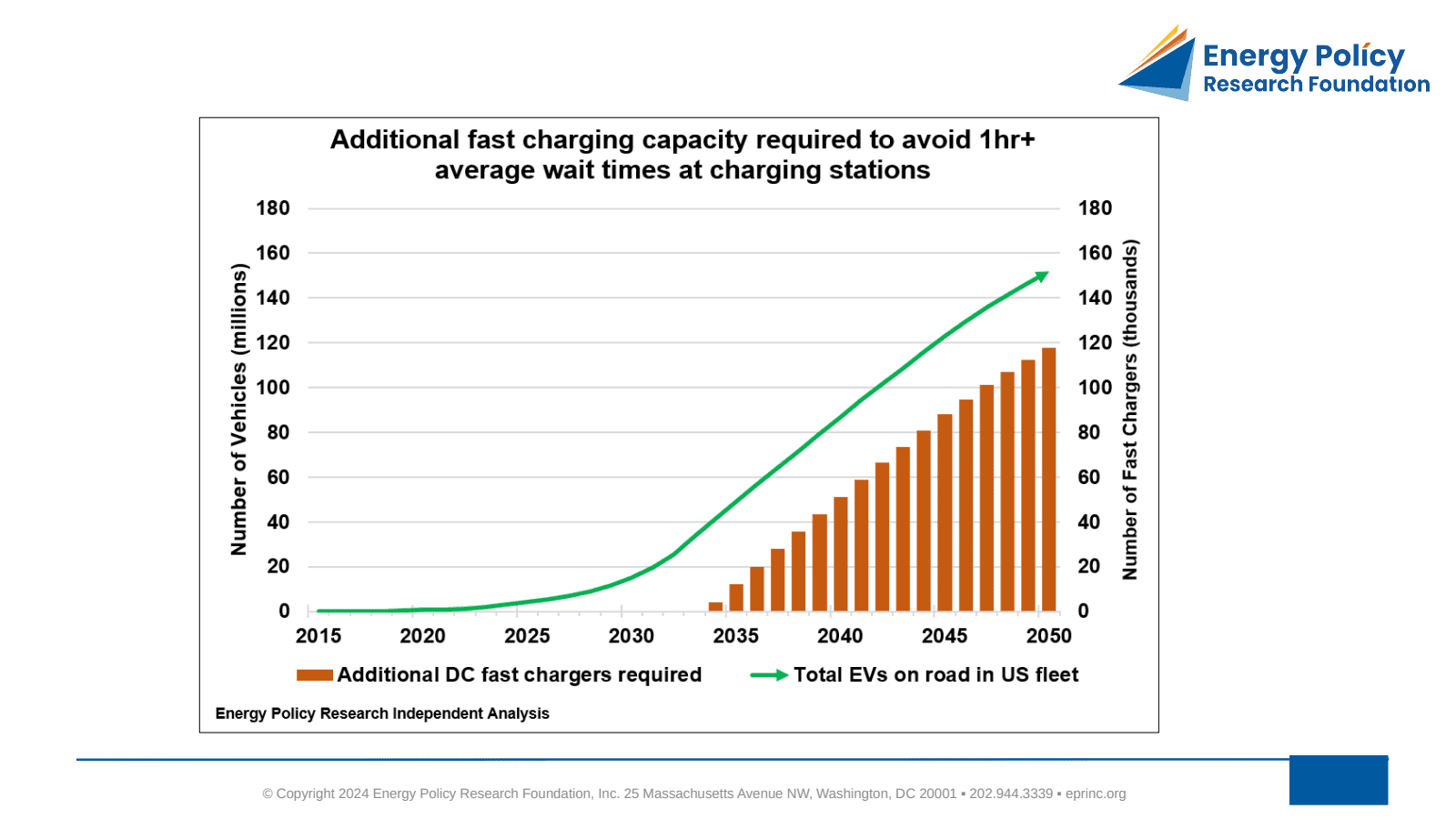
This erratum revises two charts published earlier in July 2024 as part of EPRINC’s analysis of potential wait times at EV charging stations under the EPA’s electric vehicle expansion program. Both revisions draw on EPRINC’s briefing, “The Energy Economics of EVs and ICEVs: A Comprehensive Analysis of Potential Wait Times at Charging Stations.”
The first revision updates Chart 2024-26, published July 3, 2024. The total number of DC fast chargers projected to be required in 2050 is now 118,000, down from the 169,000 initially projected. However, the total expected cost has risen from $3.4 billion to $5.1 billion, reflecting a more comprehensive per-port cost assumption of $50,000 rather than the initial $20,000. In sum, while the number of required charging ports falls by 30%, the total installation cost rises by 50%.
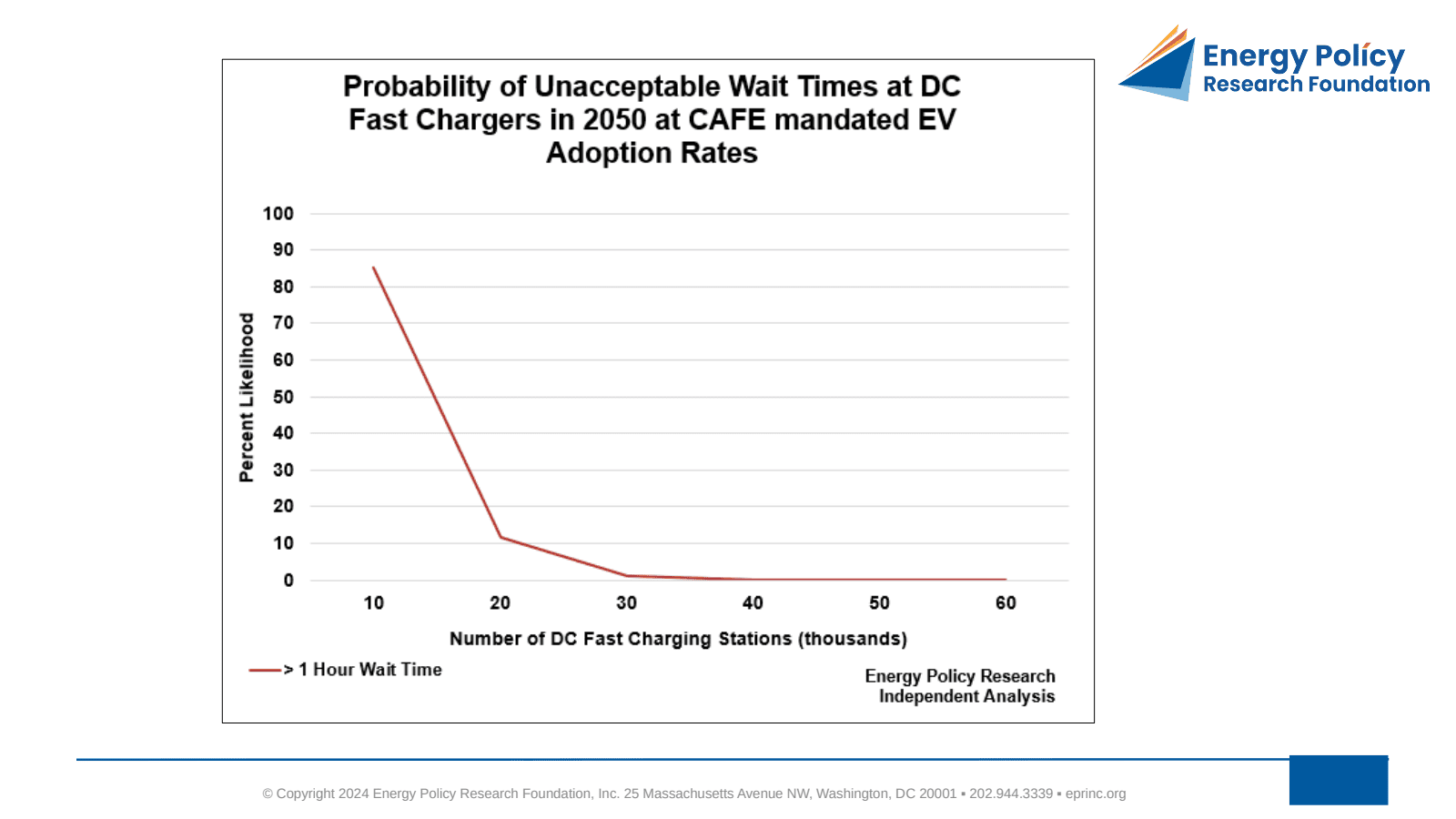
The second revision updates Chart 2024-28, published July 17, 2024. Using the benchmark scenario of 30,000 total charging stations, the probability of wait times in excess of one hour was found to be 0.37%. Though this figure appears low, under EPRINC’s model—which estimates 5.5 million Americans in EVs needing fast charging on any given day in 2050—it would equate to 20,000 Americans facing wait times over an hour every day.
This probability only falls below statistically significant levels when 40,000 to 50,000 fast charging stations are built. Reaching that threshold would require $8.0 billion of investment, rather than the $5.1 billion needed when considering average wait times alone. The analysis assumes DC fast charging stations are built in line with the current average of five charging ports per station.
From the EPRINC Chart of the Week archive.
Cite: EPRINC, “Errata: Additional DC Fast Charging Capacity Required Acceptability of EV Wait Times,” Chart of the Week 2024-29, July 15, 2024.