
The recent EPA rule tightening Corporate Average Fuel Economy (CAFE) emission standards to half their current level by 2032 will require automakers to build more electric vehicles in coming model years. Even with no further tightening after 2032, compliance would leave roughly 52.7 percent of the automotive fleet on U.S. roads electric by 2050, placing rapid pressure on the nation’s fast charging infrastructure. The United States currently has approximately 7,700 DC fast charging stations.
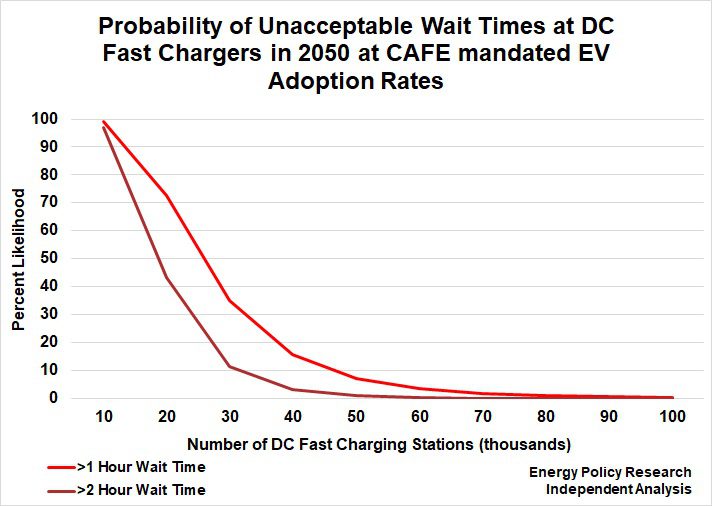
An earlier EPRINC Chart of the Week found that avoiding expected wait times in excess of one hour would require more than 169,000 fast charging ports by 2050. This chart examines a distinct problem: the prevalence of lower-frequency, higher-impact events. Even in the scenario where average wait times fall under an hour, 15 percent of charging stations would still experience waits exceeding one hour, and 3 percent would exceed two hours.
The consequences scale with the population of drivers. If roughly 30,000 new stations are built, the 3 percent probability of two-hour waits is equivalent to about 150,000 American families facing such delays each day. To hold the probability of waits over one hour under 1 percent, EPRINC’s analysis indicates 70,000 new stations—totaling 350,000 charging ports—would need to be built, more than double the count needed to control average wait times alone. Even at that level, about 50,000 families would face waits over one hour per day, of which 5,000 would exceed two hours.
These figures assume the current average of five charging ports per station. Doubling that average to ten ports per station cuts the required number of stations by close to 50 percent, while the total number of ports and the total construction cost remain roughly constant at 350,000 ports and over $7 billion.
The analysis underscores the considerable uncertainty surrounding a rapid EV transition. Even where average wait times are held to acceptable levels, unacceptable waits may remain frequent enough to make the system prohibitive for many drivers, and anything short of full charging-station reliability would only increase the prevalence of such outcomes. This chart is informed by a forthcoming EPRINC report, Electric Vehicles vs Internal Combustion Engines: An Energy Economic Analysis.
From the EPRINC Chart of the Week archive.
Cite: EPRINC, “Acceptability of EV Wait Times at DC Fast Charging Locations,” Chart of the Week 2024-28, July 8, 2024.