
Alaska’s North Slope holds some of the largest crude oil reserves in the United States, yet only a small portion has been developed. Prudhoe Bay, at roughly 215 thousand acres, has produced over 16 billion barrels of crude oil since 1980. To its west lies the National Petroleum Reserve-Alaska (NPR-A), an area of almost 23 million acres identified in 1923 by the Harding administration as favorable to the occurrence of valuable petroleum fields. Across twenty-four plays, estimated total economically recoverable crude oil ranges from 6.7 to 15 billion barrels, with a mean of 10.6 billion barrels, depending on global benchmark prices.
On March 13, 2023, the Biden administration approved the long-awaited ConocoPhillips Willow Project after extensive deliberation. Located on approximately 100,000 acres near the eastern edge of the NPR-A, Willow has ready access to the Trans-Alaska Pipeline System (TAPS), which currently operates at roughly one quarter of its 2 million barrels per day capacity, near minimum throughput. Willow’s expected volumes would be timely in keeping the system operating.
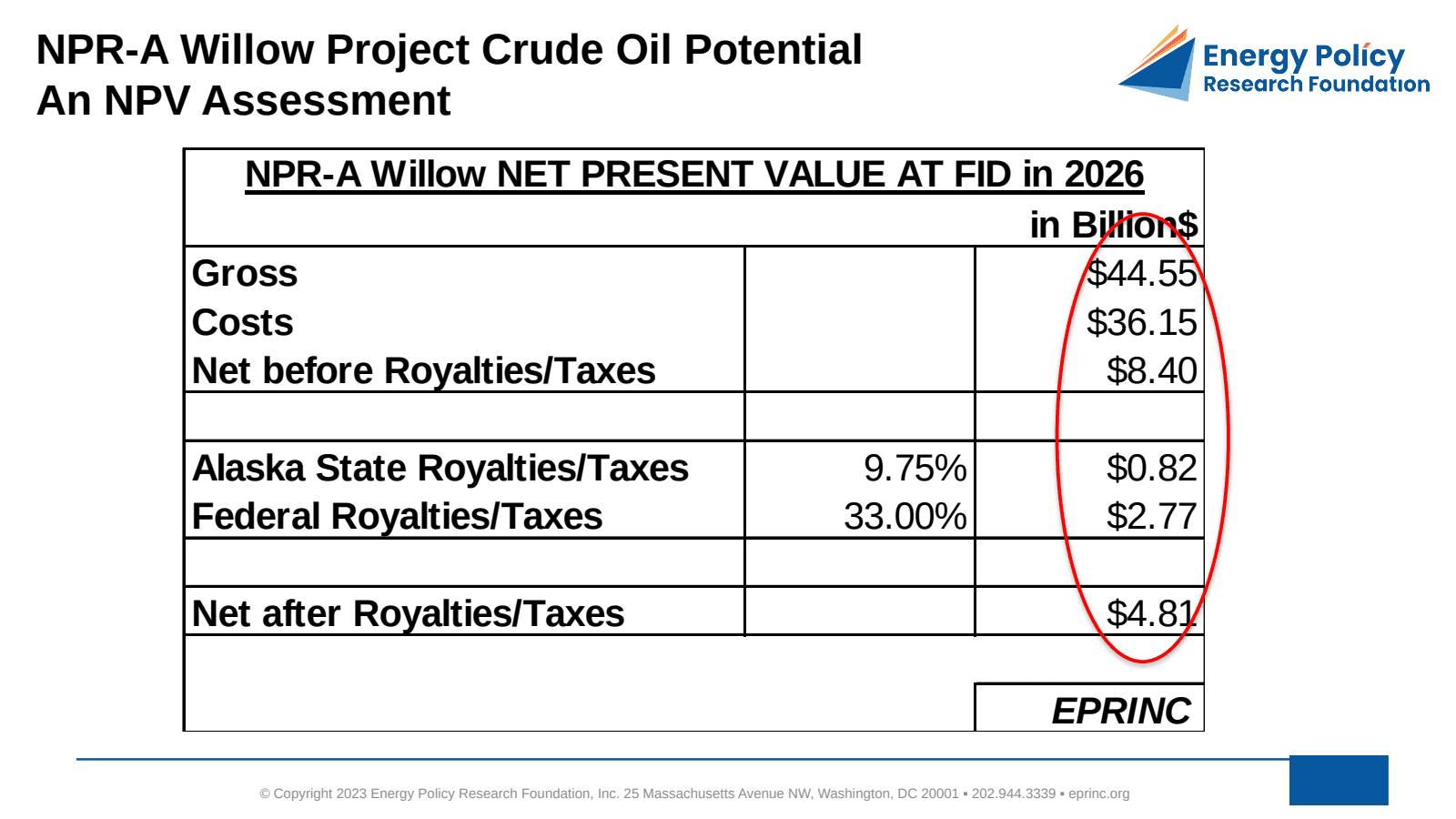
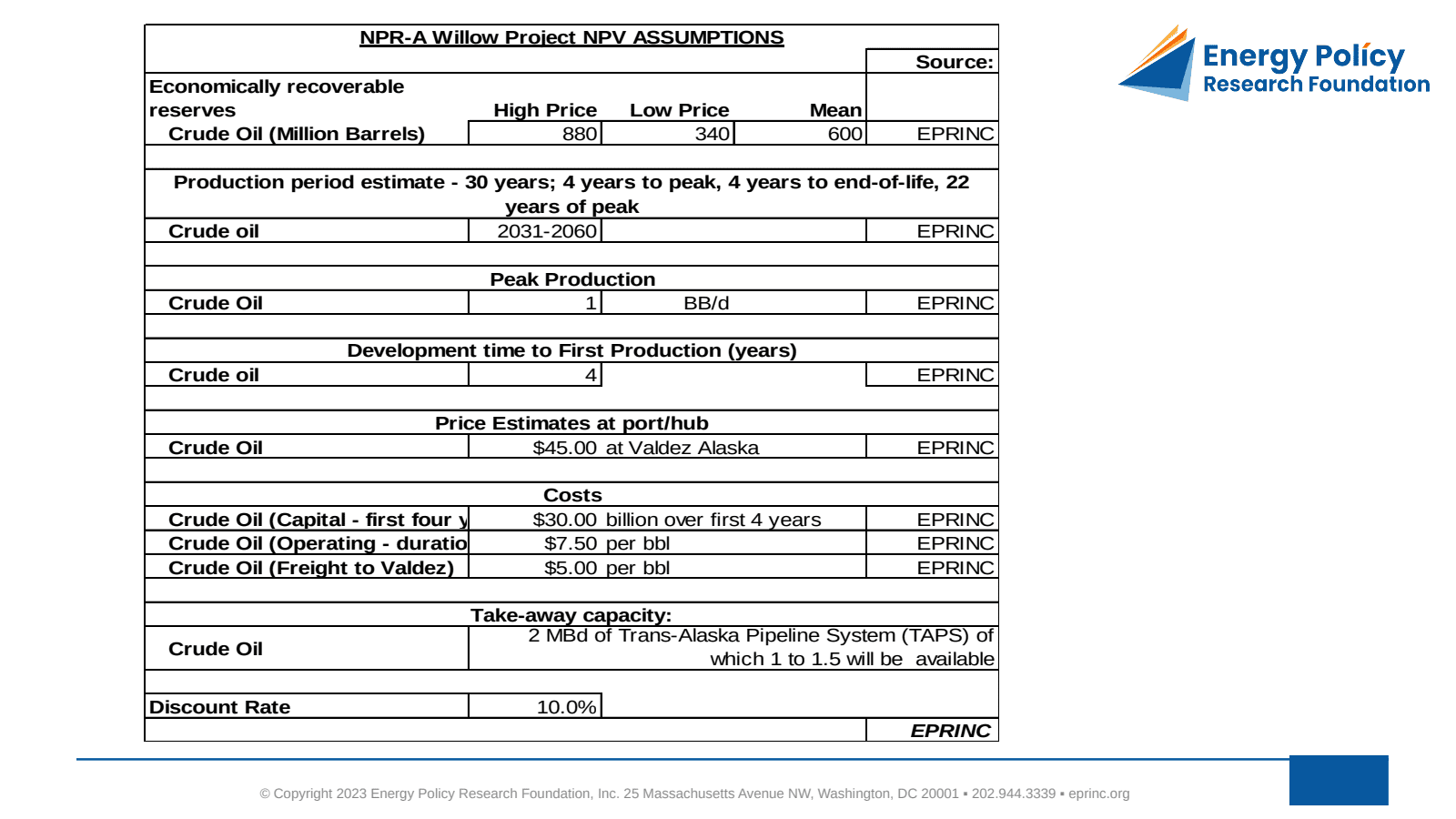
Over a 30-year production interval, with a peak plateau of 22 years, the project is expected to yield total production of 600 million barrels. The chart summarizes the project’s projected economics assuming a final investment decision in 2026, the earliest such a decision could be made:
- Net present value: $44.6 billion (2026)
- Federal royalties and taxes: $2.8 billion
- Alaska State royalties and taxes: $820 million
By drawing on the existing TAPS infrastructure, Willow offers a platform to demonstrate the broader production potential of the full NPR-A resource, estimated at up to 15 billion barrels.
From the EPRINC Chart of the Week archive.
Cite: EPRINC, “After Extensive Deliberation The National Petroleum Reserve-Alaska (NPR-A) Willow Project Is Set To Yield Revenue For Both The State And The Federal…,” Chart of the Week 2023-14, April 3, 2023.