
Over the past decade, two developments have reshaped global natural gas production and trade. The first is the technological innovation that unlocked growth in U.S. natural gas production and made LNG exports commercially viable. The second is the redirection of trade flows after Russia launched its full-scale war against Ukraine in February 2022. Together, they turned U.S. LNG from a new export into a pillar of global energy security.
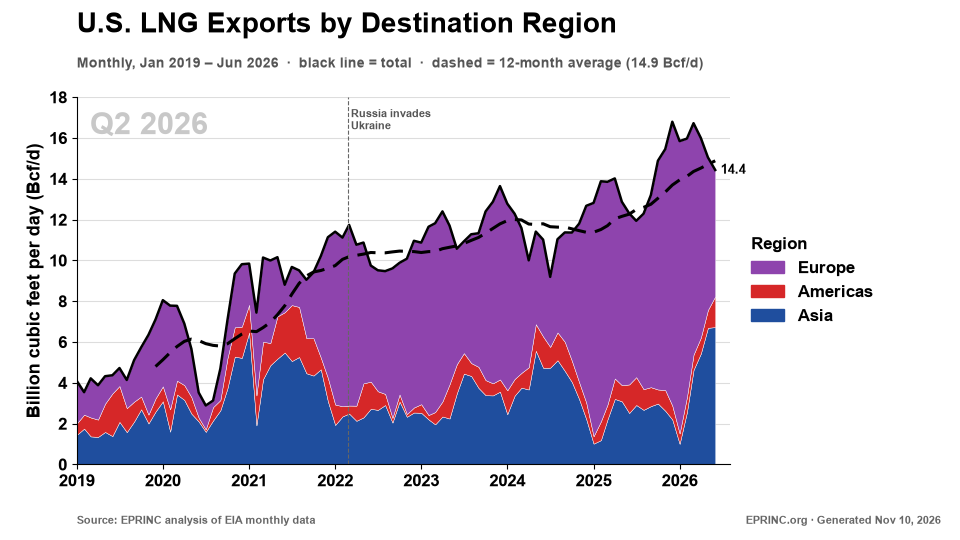
In 2021, U.S. LNG exports averaged 9 BCF/d. About half (4.4 BCF/d) went to Asia, anchored by demand from South Korea and Japan, while Europe received 3 BCF/d, roughly one-third. In the twelve months through June 2026, exports averaged 14.9 BCF/d, about two-thirds above the 2021 level.
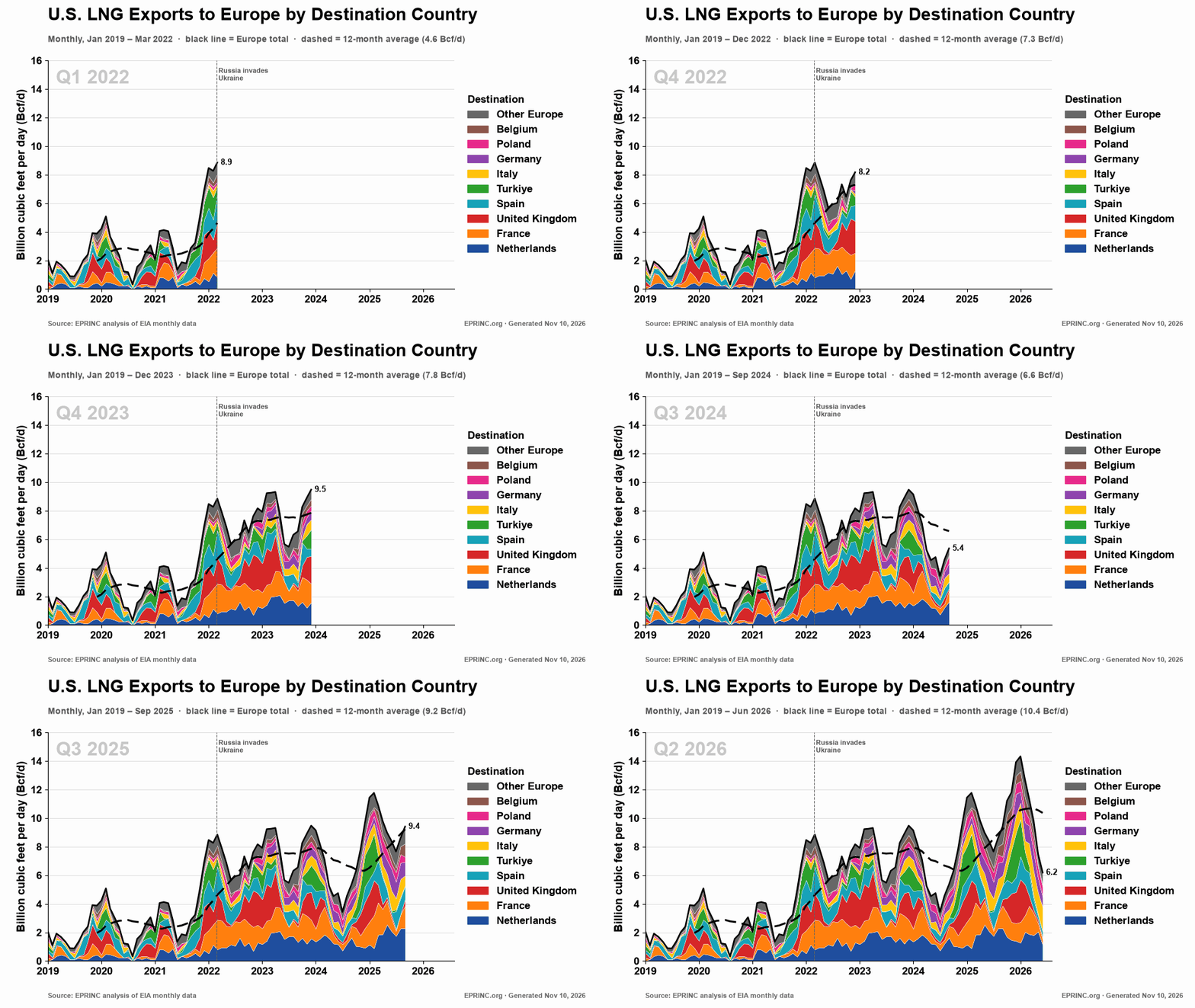
As volumes grew, most of them went to Europe. Since 2022, Europe has received an average of almost 70% of U.S. LNG, while Asia’s share has fallen to about 25%. The remainder has gone mainly to the Americas, where Brazil and the Dominican Republic are small but steady buyers. Within Europe, the Netherlands, France, and the United Kingdom have been the largest destinations. Germany had no LNG import terminal before the war and now takes regular cargoes.
2026 has tested that pattern. Iranian strikes on Qatar’s Ras Laffan complex in March damaged two of its 14 LNG trains, and with the Strait of Hormuz still disrupted, QatarEnergy has renewed force majeure notices every month, most recently through November. About 80% of Qatari LNG normally goes to Asia, so Asian buyers moved quickly to replace it, and flexible U.S. cargoes followed the price. U.S. deliveries to Europe fell from more than 14 BCF/d in early 2026 to 6.2 BCF/d in June. According to Reuters reporting of LSEG data, June was the first month since mid-2024 in which Europe took less than half of U.S. LNG exports. By July, DOE data show Asia and Europe almost tied as destinations.
The pendulum has since swung back. Europe’s share recovered to about 52% in August, per DOE. In October, U.S. exports reached their second-highest monthly level on record as European buyers secured supply ahead of winter. QatarEnergy is itself now seeking long-term U.S. LNG supply through 2031 to help meet its own customer contracts.
The loss of Qatari supply, together with continuing alliance cohesion against Russia’s invasion of Ukraine, has strengthened demand for U.S. LNG in both basins. U.S. exports are no longer just Europe’s replacement for Russian pipeline gas. They are now the flexible supply that balances the global market when other supply fails, and a central part of allied economic security.
Cite: EPRINC, “U.S. LNG Exports and European Natural Gas Imports: Revisited,” Chart of the Week 2026-39, November 12, 2026.