
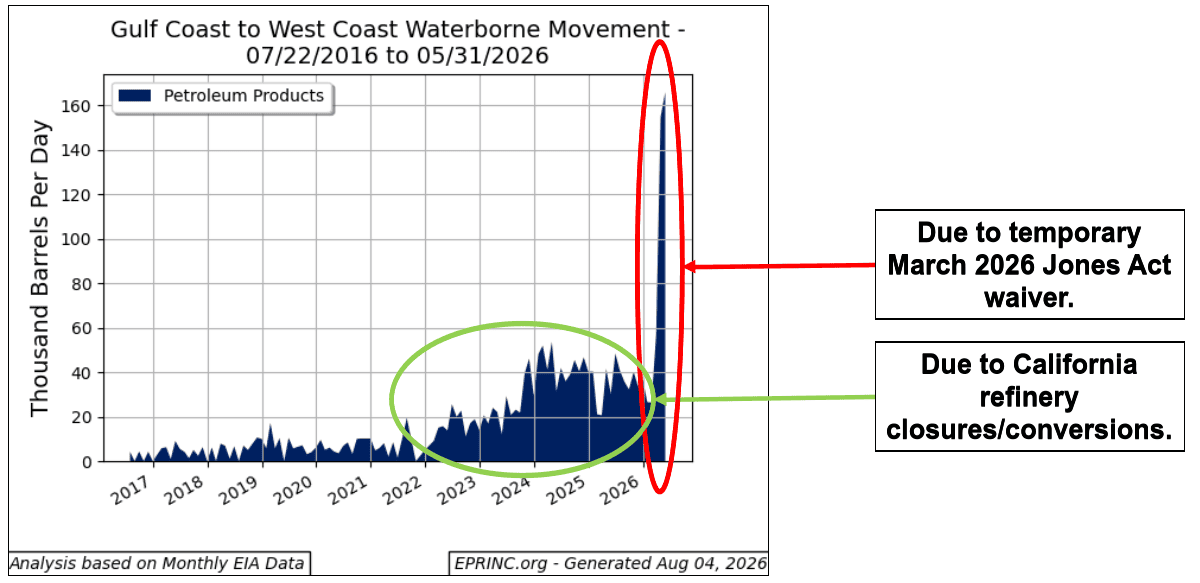
Combined April and May 2026 waterborne receipts of Gulf Coast petroleum products into the U.S. West Coast, overwhelmingly California, reached 126 thousand barrels per day (MB/d), almost four times the daily average of January and February (Figure above, red highlight). The surge coincides with the temporary Jones Act waiver granted in mid-March, which lifted the requirement that domestic maritime cargo move exclusively on U.S.-built, U.S.-flagged, U.S.-crewed vessels.
That requirement carries a real price. A Jones Act tanker costs roughly $240 million to build against $50 million for a comparable foreign-built vessel, and costs about four times as much to operate. Of a global tanker fleet of 7,500 vessels, only 60 qualify. With those constraints suspended, product moved.
The demand side matters as much as the supply side. California has shuttered or converted roughly 500 thousand barrels per day of refining capacity out of an earlier 2.8 million barrel per day base over the last five years, tightening regional supply and pushing the state toward greater reliance on imports and inter-regional shipments even before the current waiver took effect (Figure 1, green highlight).
The waiver is due to expire August 16, 2026, which would make it the longest suspension in the program’s history at 150 days. The White House is reportedly weighing another extension as gasoline prices remain elevated nationally, with officials also considering narrowing its scope. Whatever the outcome, the spike in Figure 1 is a clean measurement of what the Jones Act normally costs U.S. commerce, not what it protects.
For more information on this chart, please contact Max Pyziur (maxp@eprinc.org).
Cite: EPRINC, “West Coast Product Receipts: The Jones Act Waiver’s Sixfold Surge,” Chart of the Week 2026-27, August 5, 2026.