
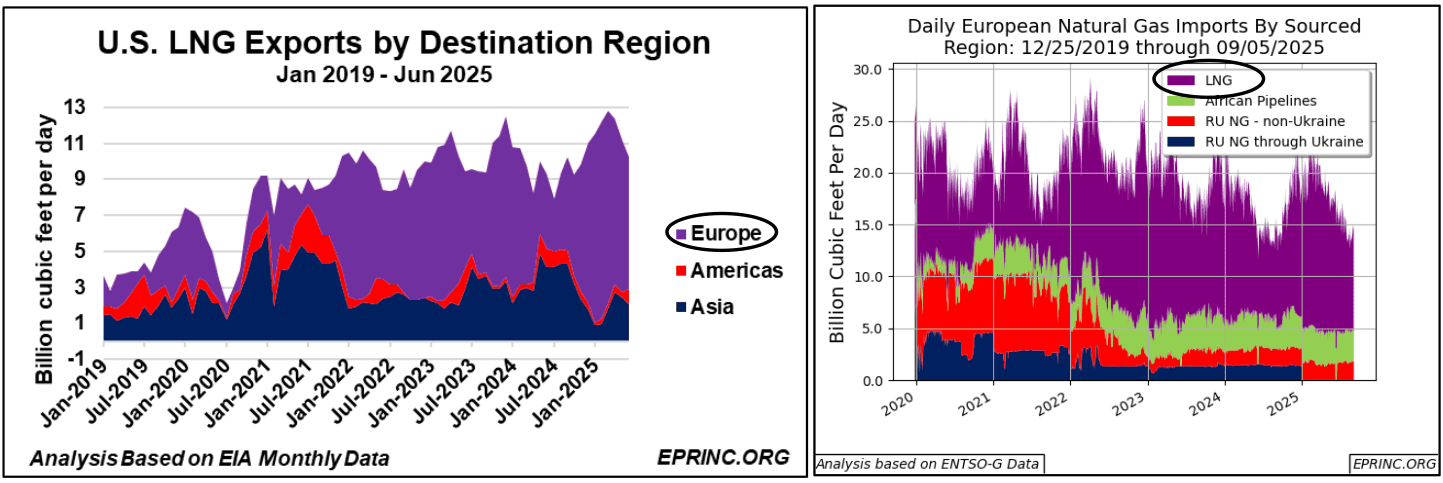
This week’s chart pairs the growth and destination of U.S. LNG exports with the shifting composition of European natural gas imports, illustrating how the two have moved in tandem since 2019. The shift reflects both technological innovation that expanded U.S. natural gas production and a redirection of trade flows following Russia’s February 2022 full-scale war against Ukraine.
U.S. natural gas production began rising rapidly in the late 2000s and was expected to exceed domestic requirements, prompting large investments in export capacity, notably liquefaction facilities along the U.S. Gulf Coast. The first Gulf Coast LNG plants were commissioned in 2016 with export capacity of roughly 2 billion cubic feet per day (BCF/d). By 2025, U.S. LNG capacity reached 15 BCF/d, with another 10 BCF/d under construction or planned through 2030.
In late 2019, pipelined Russian natural gas accounted for almost 60% of European imports, LNG for 30%, and the balance came via pipelines from Algeria and Libya. Following the escalation of the war and a series of reciprocating steps, pipelined Russian flows to Europe have been severely curtailed. When a transit agreement lapsed on January 1, 2025, Ukraine stopped pipelining Russian gas to Europe; Europe had received an average of 3 BCF/d via pipelines in 2024. During 2025, an average of 1.7 BCF/d of Russian gas — less than 10% of Europe’s imports — has moved via TurkStream, running under the Black Sea to Turkey and onward into Europe.
U.S. LNG has moved to fill this gap. During 2019, U.S. LNG exports averaged 4.5 BCF/d, of which 1.75 BCF/d (40% of the total) went to Europe. So far in 2025, U.S. LNG exports have averaged 11.7 BCF/d, of which 9.5 BCF/d (81% of the total) has gone to Europe.
On July 28, 2025, the Trump administration concluded a nonbinding framework agreement for the EU to purchase $750 billion of U.S. energy over three years ($250 billion per year). In the trailing twelve months through June 30, 2025, the United States exported 2.756 trillion cubic feet of LNG to Europe; at an average price of $7.43 per thousand cubic feet, the value of those exports was $21.3 billion, and had Europe taken all U.S. LNG exports the value would have risen to $26.2 billion — underscoring that U.S. LNG is one component of broader U.S. energy exports and is increasingly central to global energy security.
From the EPRINC Chart of the Week archive.
Cite: EPRINC, “U.S. LNG Exports and European Natural Gas Imports — Note the Complementarity,” Chart of the Week 2025-35, August 25, 2025.