
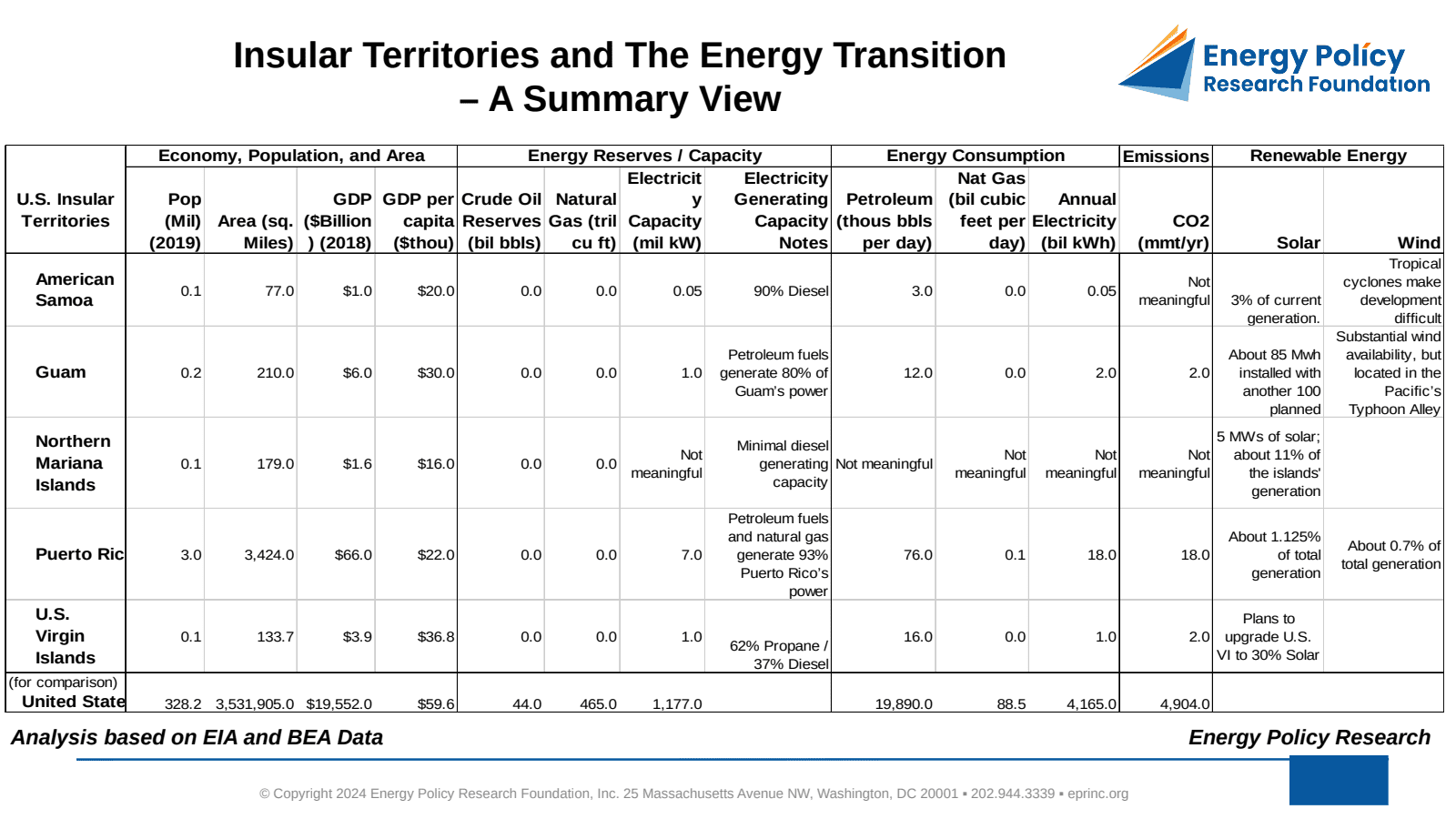
Ahead of an April 11, 2024 oversight hearing by the House Natural Resources Committee’s Subcommittee on Indian and Insular Affairs, titled “Energizing the Territories: Promoting Affordable and Reliable Energy Sources for the U.S. Insular Areas,” EPRINC assembled a table summarizing the territories’ economies, energy reserves and electricity capacity, energy consumption, CO2 emissions, and solar and wind development. Insular areas are territories under U.S. jurisdiction but not part of a state or the District of Columbia; the primary ones are American Samoa, Guam, the Northern Mariana Islands, Puerto Rico, and the U.S. Virgin Islands.
Together these territories have a population of roughly 3.4 million, with Puerto Rico accounting for 3 million. Combined per capita GDP is $22.7 thousand, or 38.1% of the U.S. average of $59.6 thousand. Their economies rest largely on military bases and tourism, with basic manufacturing and services prevalent in Puerto Rico and garment production in the Northern Mariana Islands. Imported petroleum products are the primary source both for electricity generation and for transportation fuels.
CO2 emissions are minimal at 22 million metric tons per year, equal to 0.45% of the U.S. total of 4.9 billion metric tons and 0.06% of the global sum.
Solar and wind use remains limited. Solar irradiance (measured on a scale of 3.8 to 7) averages 6.2 across the territories—comparable to the northern reaches of Arizona, New Mexico, or Nevada—yet installed capacity is low. Expansion plans exist, the most ambitious being the U.S. Virgin Islands’ target of 30% of generation from solar. Wind is more difficult: American Samoa and Guam sit in the Pacific’s Typhoon Alley, requiring turbines and infrastructure able to withstand tropical cyclones.
As EPRINC’s Max Pyziur noted, the resource endowment is present, but raising capital for renewable energy investment in these lower-income island territories—and implementing it—may prove challenging.
From the EPRINC Chart of the Week archive.
Cite: EPRINC, “U.S. Insular Territories and The Energy Transition: A Summary View,” Chart of the Week 2024-14, April 1, 2024.