

With little letup in hostilities and substantial damage to Persian Gulf and Russian refining capacity, global diesel prices have surged. The U.S. weekly average diesel price has risen above $6 per gallon, past the June 2022 record of $5.82, and West Coast prices have broken $7 (Main figure).
According to commercial sources, Russian diesel production is down 350 thousand barrels per day (KB/d), and Middle East diesel supply losses are estimated at between 730 and 835 KB/d. Together that is a shortfall of over 1 million barrels per day (MB/d). The disruption also extends beyond oil. The conflict in the Strait of Hormuz cut off Qatari LNG shipments to Asia, and when Asian buyers lose access to LNG they turn to coal and diesel instead, which tightens the global diesel balance further.
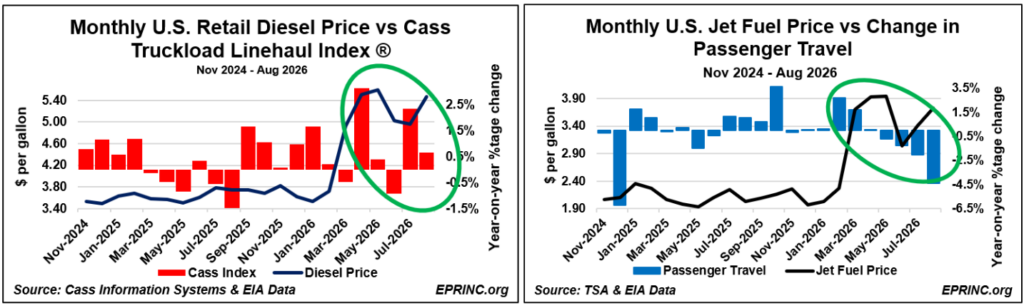
The impact on U.S. commercial activity has been mixed. Despite higher diesel prices, year-on-year trucking activity was positive in every month but one from March through August 2026 (Figure 2, left pane). Air travel has fared worse. Jet fuel is produced from a subset of diesel molecules and is just as exposed to global shortages. With roughly 80% of air travel discretionary and airlines passing higher fuel costs on to passengers, the decline in U.S. air travel over the past six months has been unambiguous (Figure 2, right pane).
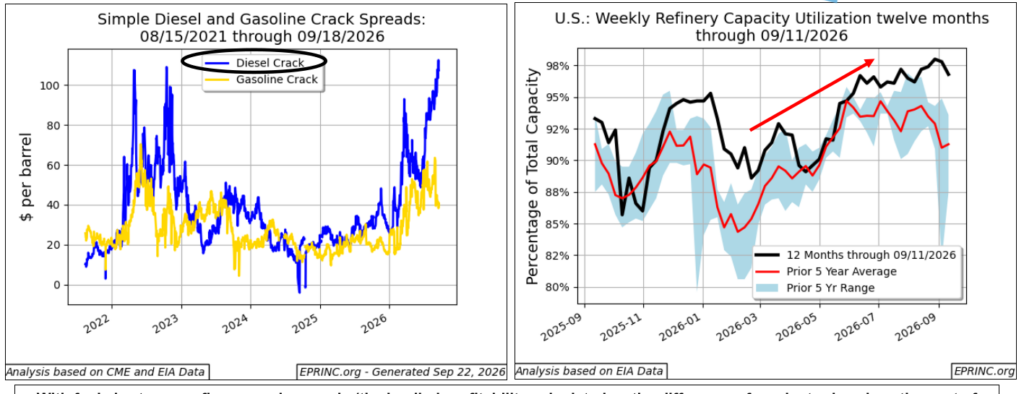
Refiners have responded as far as they physically can. Diesel crack spreads (the implied profitability of refining, measured as product prices minus the cost of crude oil) have spiked above $100 per barrel and diverged sharply from gasoline cracks (Figure 3, left pane). U.S. refiners, with over 18 MB/d of capacity, are running at an unprecedented 98% utilization (Figure 3, right pane).
Amid these price surges, Republican lawmakers led by Sen. Chuck Grassley have introduced legislation to curtail U.S. diesel exports, and on September 22 President Trump said he supports a ban. A day later, Energy Secretary Chris Wright said a flat ban “definitely doesn’t work,” but the idea remains under consideration. If enacted, it would be the most significant intervention in U.S. energy export markets since the crude oil export restrictions of 1975, which followed the 1973 Arab oil embargo. The interventions of that era backfired, turning a supply shock into gas lines and rationing.
A diesel export ban would likely backfire as well. Refiners already running flat out cannot produce more without new capacity. Cut off from export markets, Gulf Coast refiners would see storage fill and margins fall, and many would reduce runs to catch up on maintenance postponed during the crisis. Because gasoline and diesel are produced together, the result would be less gasoline, diesel, and jet fuel, and higher pump prices.
The diesel a ban does keep at home would mostly be stranded on the Gulf Coast, where refineries are set up to serve export markets. Pipeline and shipping limits make it hard to move that fuel to the East and West Coasts, where prices are highest. Diesel near Gulf Coast refineries would likely get cheaper, while much of the rest of North America, tied to the global diesel market, would see prices rise as supply chains struggled to adjust. New England is most exposed. The region has long struggled to bring in distillate from the rest of the country, and heating oil prices could climb sharply just as winter begins. It is not at all clear that the national average price of diesel would fall.
Better tools exist. A ban would make both the U.S. and global refining systems less efficient, and that efficiency is what has delivered lower U.S. fuel prices and energy independence. Standardizing gasoline specifications would let fuel move more freely between regions, and relaxing Renewable Fuel Standard blending mandates would lower compliance costs and free up refining capacity. Measures like these add supply and flexibility instead of taking them away.
Cite: EPRINC, “U.S. Diesel Price Spikes and Why an Export Ban Would Backfire,” Chart of the Week 2026-32, September 24, 2026.