

On September 8, OpenAI announced that a swarm of roughly 10,000 AI agents, working together for about 88 hours, had produced a proof resolving a version of the Navier-Stokes existence and smoothness problem, one of the seven Millennium Prize Problems and an open question for roughly 90 years. These problems were identified in 2000 as the seven biggest problems in math. Only one of the seven had been settled before, and that took the famous mathematician Grigori Perelman seven years of solitary work.
AI is advancing at an unimaginable rate, with profound implications for the rate of fundamental research and technological breakthroughs.
The Navier-Stokes equations describe how fluids move. They sit underneath the study of turbulence, and turbulence sits underneath combustion, chemical processing, pipeline flow, metallurgy, and every numerical model of a burning or flowing system. Fundamental research of this kind has no immediate application; however it is applied later, in ways nobody working on it could have named in advance. Essentially all of the technology in our modern economy traces back to work that at one point in time was fundamental research like this.
We covered the first sea change moment back in May when OpenAI announced a proof of the Erdös Unit Distance Conjecture which was solved both quickly and at a fraction of the cost of a human mathematician. Since then there have been a number of problems in increasing importance solved by AI, but this solution is another turning point moment not just due to being one of the most prominent problems in human history, but because it represents the first time an organization has invested millions of dollars in a pure mathematical target to be solved with AI (figure below).
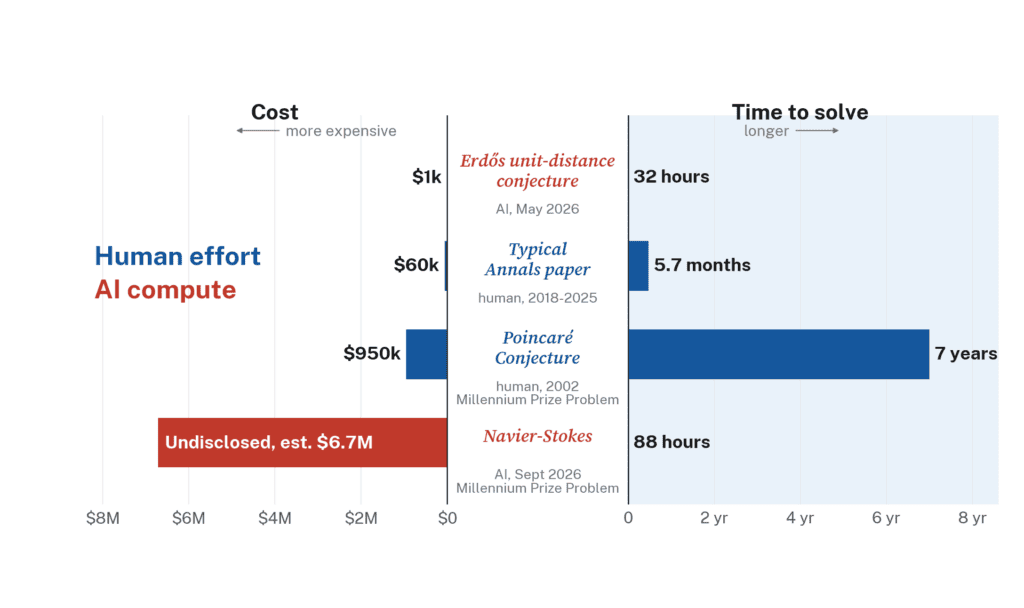
The result is astounding. Over the course of 88 hours, OpenAI spent the same amount of money that would have employed over 1000 mathematicians working together as a team to solve this problem (main figure). It did this by running a 10,000 agent swarm concurrently, with agents autonomously forming teams and talking to each other and sharing their best insights. Typically mathematics done by humans cannot be done in teams of more than a handful of individuals, this represents a major change in the way intelligence can be applied to hard problems concurrently.
The price tag makes the largest mathematics paper on record, according to EPRINC’s analysis, roughly estimated a $6.7 million, the geometric mean of the high and low estimates and consistent with OpenAI having an internal sizable discount over standard API pricing they offer. This result was not more efficient than human mathematicians, and had the agents run sequently rather than concurrently they would have taken a total of 44 years (see chart below, note log scale).
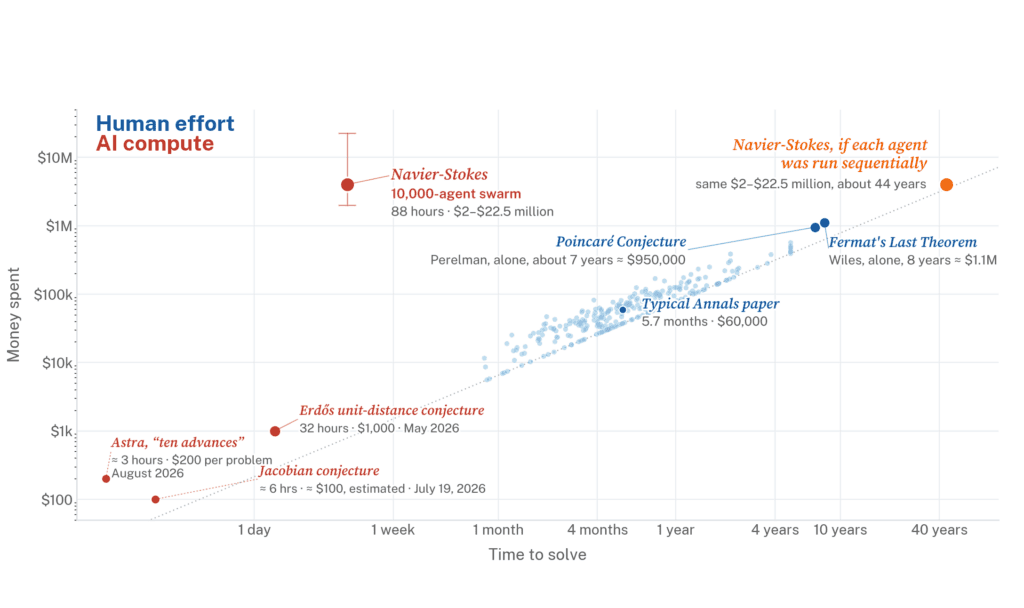
Whereas past mathematical results have been on par or slightly more efficient than human mathematicians, in this case the standard relationship between time to solve a problem and the cost of that problem breaks down. This is first time where a massive investment in one of humanities hardest problems can produce a result right now, in a weekend rather than after 7 years of a geniuses solitary work. We are entering an era where investments in fundamental research can bring breakthroughs at lightening speed, immediately, rather than unpredictably in time.
And of course at EPRINC, we want to know what the energy cost of this is. Based upon our estimates, we find that the electricity needed to produce this Millennium result is equivalent to powering nine American homes for a year, with peak power usage of 2 MW. This is minuscule, about the same that a solitary mathematician would have used powering their home for a several-year campaign in isolation. The electricity cost of this is ~$7,000, around 0.11% of the total campaign cost: essentially a rounding error.
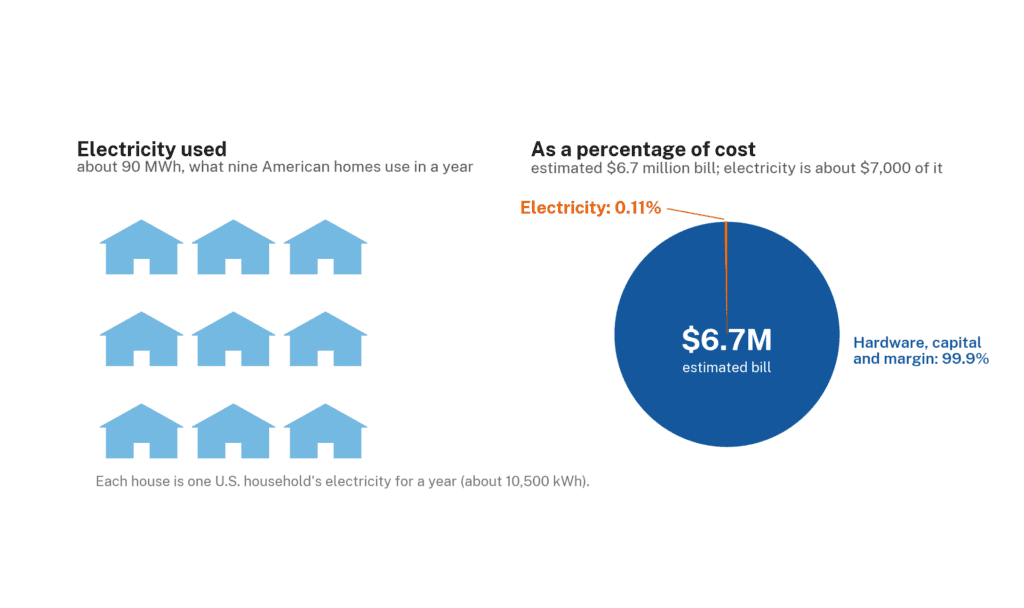
Electricity can now be turned cheaply on demand into breakthroughs on the hardest questions that humanity has ever asked. Assuming we have enough electricity to support it and the ability to build the critical infrastructure at scale, the long-term potential for the pace of technological progress and the American economy is enormous.
Cite: EPRINC, “AI Solves a Millennium Prize Problem: The Pace of Fundamental Research,” Chart of the Week 2026-31, September 17, 2026.