
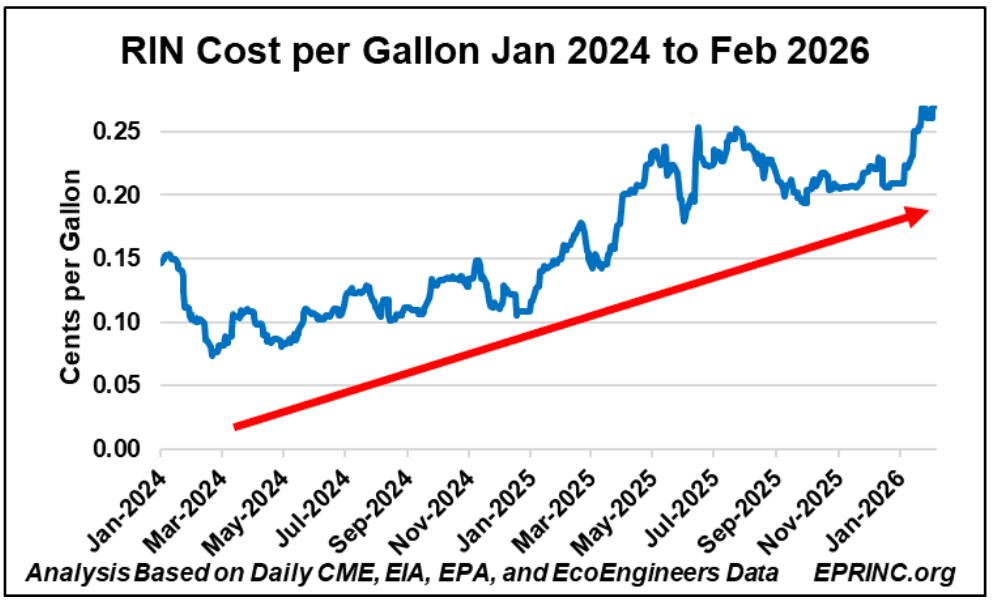
Under U.S. law, refiners and importers must blend specified volumes of biofuels into transportation fuels. This requirement, known as the Renewable Fuel Standard (RFS), was enacted in 2005, strengthened in 2007, and is administered by the Environmental Protection Agency (EPA). Following a period of statutory blending requirements that ended in 2022, EPA’s authority to set blending percentages has become discretionary. Provisional blending percentages for 2026 and 2027 are currently under debate and review, along with provisions for reallocating previously granted exemptions as additional blending requirements.
Compliance is managed through Renewable fuel Identification Numbers (RINs), a credit system that tracks whether blending obligations are met. RIN prices reflect the stringency of the mandates, and these costs are ultimately passed on to consumers of gasoline and diesel.
Using a model adapted from S&P Platts, the chart presents EPRINC’s ongoing estimate of the RFS’s additional cost per gallon of fuel. At a current estimate of 27 cents per gallon and 196 billion gallons of annual fuel consumption—137 billion gallons of gasoline and 59 billion gallons of diesel—the projected total annual cost to U.S. consumers is almost $53 billion.
Despite statutory requirements to finalize blending mandates in the November preceding each compliance period, EPA has delayed the mandates and reallocations for 2026 and 2027. Amid this uncertainty, expectations of an aggressive final RFS determination have been pushing RIN prices higher, adding further to consumer costs.
From the EPRINC Chart of the Week archive.
Cite: EPRINC, “The Renewable Fuel Standard: Cost to Consumers – Revisited,” Chart of the Week 2026-06, February 2, 2026.