
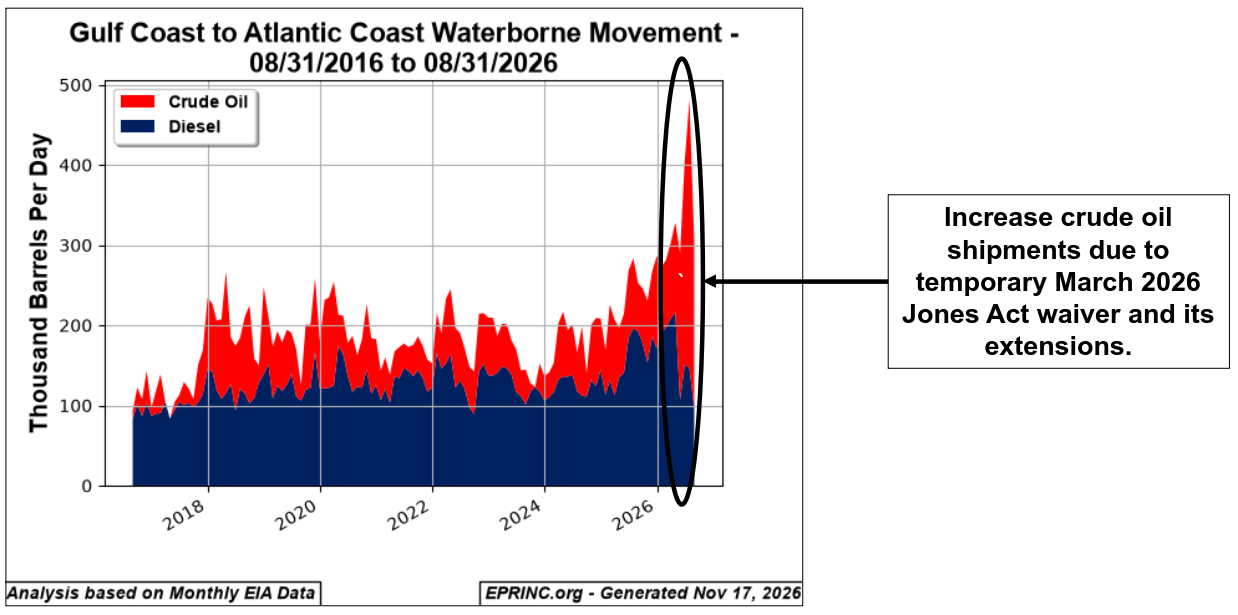
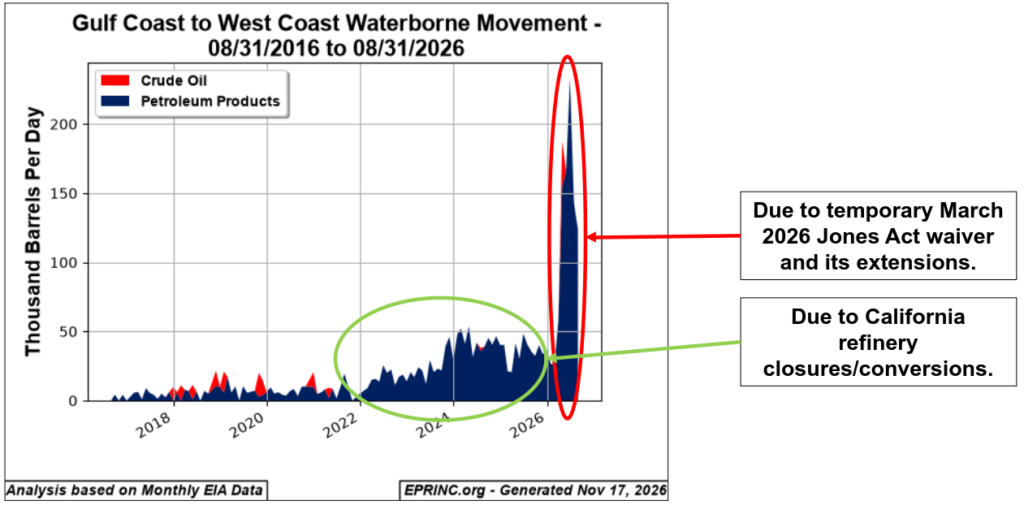
Between March and the end of August 2026, domestic waterborne shipments of crude oil and petroleum products from the U.S. Gulf Coast to both the East and West Coasts jumped sharply.
April-August 2026 receipts of Gulf Coast petroleum products into the West Coast, dominated by California, averaged 146 KB/d, almost 4.3 times the May 2025 to February 2026 average (Figure 1).
Crude oil deliveries to Mid-Atlantic refineries rose in similar fashion, averaging 208 KB/d from April to August 2026 versus 80 KB/d over May 2025–February 2026, a 2.6-fold increase (Figure 2).
A series of temporary Jones Act waivers drove these gains.
On Friday, November 13, 2026, while attention was focused on major national IT disruptions late in the week, the Trump administration extended the Jones Act waiver for a third time. As with the second extension, the waiver runs for 90 days, through February 14, 2027, and covers 237 categories of goods, concentrated in crude oil, petroleum products, petrochemical feedstocks, and fertilizers. Each exempted voyage must also pass an extensive pre-authorization process.
This differs significantly from the prior waivers that expired in August 2026 that had a more expansive list of 600 categories of goods and less oversight and pre-authorization.
Further reading:
EPRINC’s first Jones Act Chart of the Week (2026-27), “Jones Act Waiver’s Sea-Change in West Coast Fuel Receipts,” published August 4, 2026
“Why the Jones Act’s Temporary Waiver Was Renewed Again,” by EPRINC’s Max Pyziur and Matthew Sawoski, published August 20, 2026 in The National Interest.
EPRINC Distinguished Fellow Diana Furchtgott-Roth had her Jones Act views published in The Washington Examiner on August 18, 2026 titled “Trump just slashed gas prices with one quiet move. Here’s why you didn’t hear about it.”
Cite: EPRINC, “The Jones Act Waiver Has Been Extended a Third Time,” Chart of the Week 2026-40, November 20, 2026.