
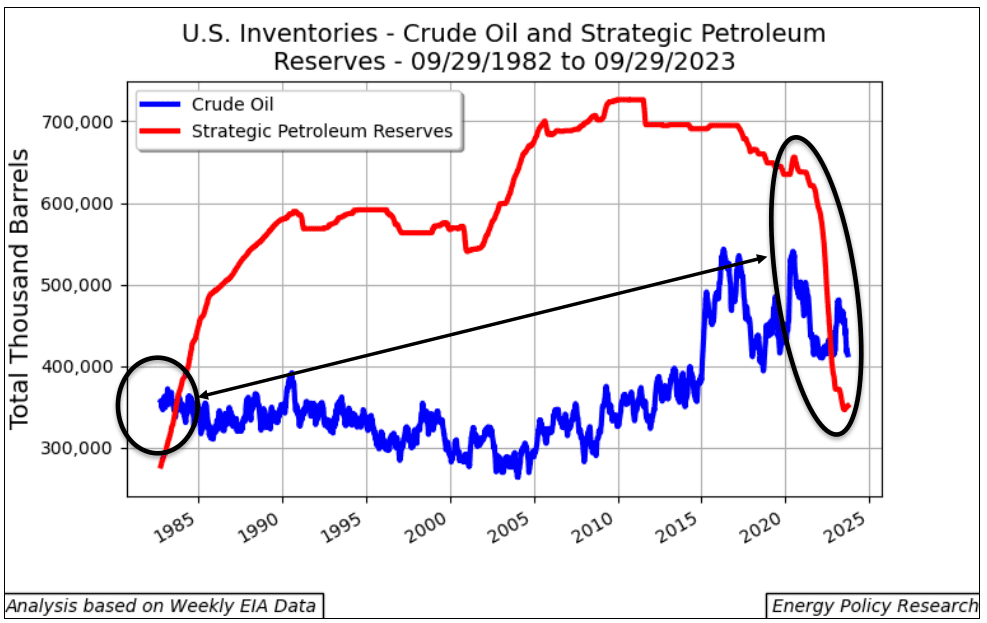
The Strategic Petroleum Reserve (SPR) exists to cushion the U.S. economy against disruptions to crude oil imports, releasing supplies in emergencies such as embargoes, military engagements, major disruptive weather events, and sea lane blockages. Beyond its capacity to release oil, the reserve provides value through deterrence: the larger the stock, the less likely an adversary is to attempt disrupting U.S. crude oil supplies. Conceptually, this parallels an aircraft carrier group, whose value derives not only from executing its capabilities but from dissuading action in the first place—and which, in peacetime, should not be leased for excursion cruises.
Established in the 1970s in response to politically motivated embargoes and instability in Middle East producing countries, the SPR was designed to hold roughly 750 million barrels in Gulf Coast salt caverns near key refining centers and pipelines capable of moving crude inland. Although the United States and the broader Western Hemisphere are now net exporters of petroleum, the national economy remains fully integrated into the world oil market; a major disruption anywhere would still be highly disruptive to the U.S. economy and those of its allies. The reserve’s purpose is not to intervene in the normal operation of commercial markets that respond and adjust to price signals.
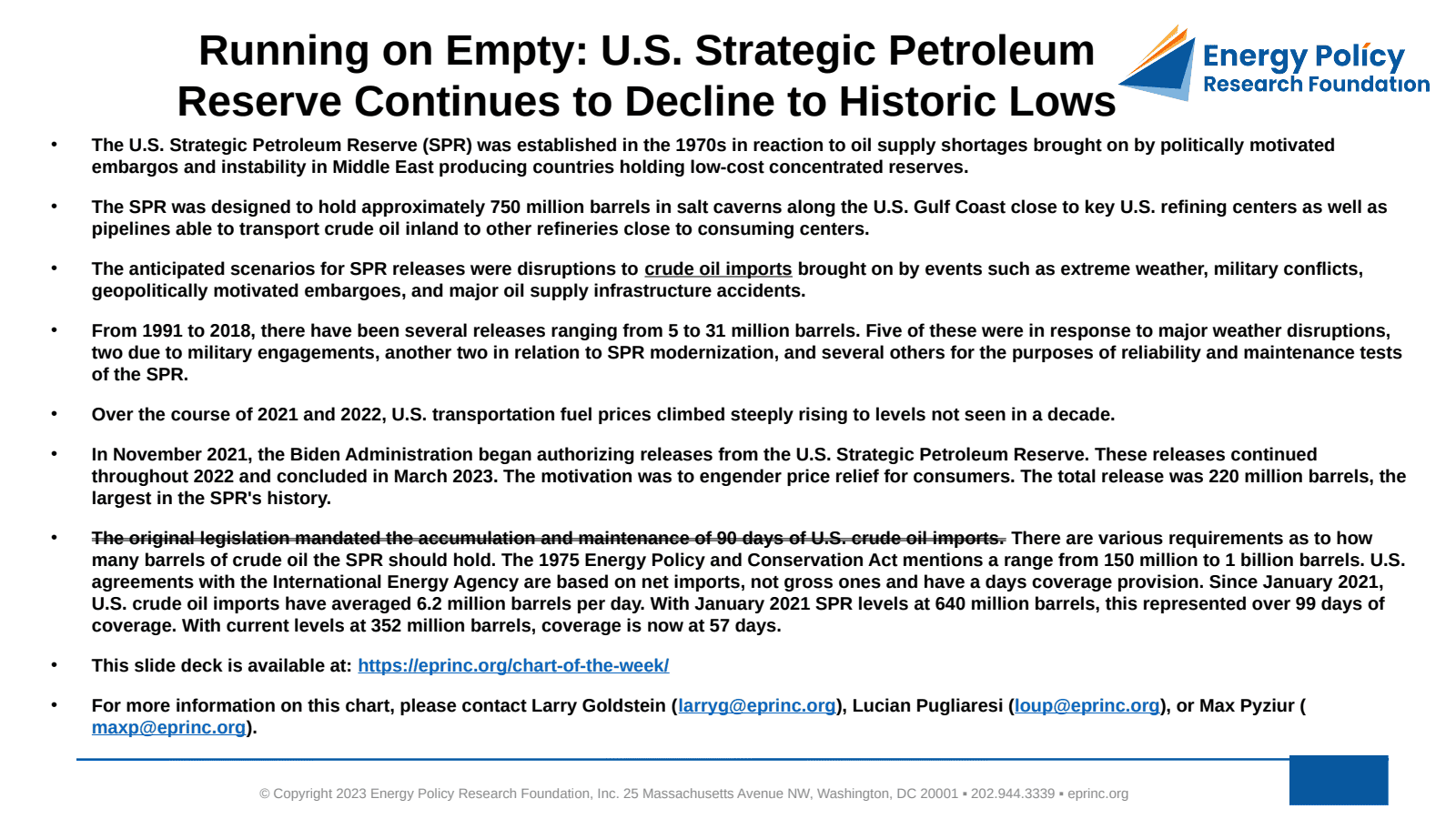
From 1991 to 2018, SPR releases ranged from 5 to 31 million barrels—five in response to major weather disruptions, two due to military engagements, two tied to modernization, and several for reliability and maintenance testing. That pattern changed in November 2021, when, amid transportation fuel prices climbing to levels not seen in a decade, the Biden Administration began authorizing releases to provide consumer price relief. Continuing through 2022 and concluding in March 2023, these drawdowns totaled 220 million barrels—the largest release in the SPR’s history.
The original legislation mandated maintaining 90 days of U.S. crude oil import coverage. With imports averaging 6.2 million barrels per day since January 2021, the reserve’s 640 million barrels at that time represented more than 99 days of coverage. At current levels of 352 million barrels, coverage has fallen to 57 days.
From the EPRINC Chart of the Week archive.
Cite: EPRINC, “Running on Empty Revisited: U.S. Strategic Petroleum Reserve Continues to Decline to Historic Lows,” Chart of the Week 2023-39, September 25, 2023.