The Mozambique LNG (MZ LNG) project is an important opportunity to counter China’s growing economic influence in Africa, provide development support for Mozambique’s economy, enhance global energy security, all the while supporting U.S. job creation and the American economy, said Max Pyziur, EPRINC’s Research Director. President Trump’s February 17, 2025 nomination of John Jovanovic to be the U.S. Export-Import Bank’s (ExIm Bank’s) next president, once confirmed, should expedite ExIm’s MZ LNG critical financing.
The Resource
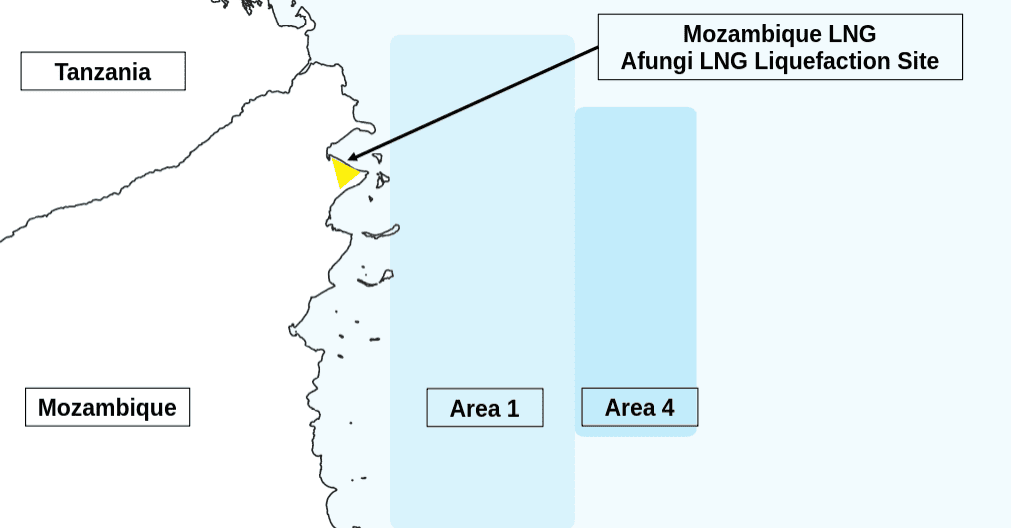
Large natural gas reserves located 27 miles off Mozambique’s northern coast were first identified in 2012 in an area known as the Rovuma Basin. The Basin is divided into two sections, Area 1 and Area 4, each holding 75 and 85 trillion cubic feet, respectively.
Initial efforts to develop Area 1’s resources were begun by Anadarko Petroleum. Phase 1 of the project (MZ LNG) is seeking to develop a 1.7 BCF/d (13.1 MTPA – million metric tons per annum) onshore LNG export facility located on Mozambique’s Afungi peninsula. The total cost for completion of the facility is projected to be over $20 billion. MZ LNG also has two planned expansions (Phase 2 and 3). All combined, they would enlarge the project to 5.3 BCF/d (40 MTPA).
Following Occidental’s acquisition of Anadarko in 2019, Anadarko’s Mozambique interest was sold. MZ LNG is currently owned by a consortium led by TotalEnergies (26.5%) and Mitsui (20%) with the balance held by two Mozambique (25%) and three Indian (28.5%) interests.
MZ LNG’s development has been impaired by two forces: militant activities not far from the onshore portion of the project leading to force majeure delays, and delays in the approval of financing.
The U.S. Export-Import Bank’s (ExIm Bank) purpose is to facilitate the export of U.S. goods and services. Recognizing China’s expanding regional African economic influence and seeking ways to counter this, the U.S. passed three key legislative initiatives to strengthen ExIm Bank activities:
- BUILD Act (Better Utilization of Investments Leading to Development) of 2018 creating the U.S. International Development Finance Corporation (DFC) to support infrastructure projects and to compete with Chinese-led consortiums where the latter has a strong presence;
- CTEP (China and Transformational Exports Program) established in 2019 commissioned to counter Chinese export subsidies and financing;
- MMIA (Make More in America) authorized in 2022 aiming to provide financing for export-oriented U.S. domestic industries.
Following numerous analyses, ExIm is set to provide $4.7 billion for MZ LNG, the largest single source of financing, followed by Japan’s JBIC (Japan Bank for International Cooperation) with $3 billion and NEXI (Nippon Export and Investment Insurance) at $2 billion. ExIm’s disbursement, key for the project’s commencement, is subject to final approval of its five-person board, something which was never completed during President Biden’s Administration.
Estimates of impacts on U.S. Economy
ExIm’s own internal analyses project that MZ LNG’s five-year construction period will lead to almost 17 thousand U.S. jobs at 68 suppliers in eight states (Florida, Georgia, Louisiana, New York, Oklahoma, Pennsylvania, Tennessee, and Texas).
However, independent private analyses foresee greater U.S. impacts from the project: 20,300 U.S. jobs from 140 suppliers located in 21 states (additional states include California, Illinois, Missouri, and Massachusetts) providing $2.7 billion in purchases that would generate $600 million in U.S. tax revenues.
From the EPRINC Chart of the Week archive.
Cite: EPRINC, “Mozambique LNG and the Role of The U.S. Export-Import Bank,” Chart of the Week 2025-08, February 17, 2025.