
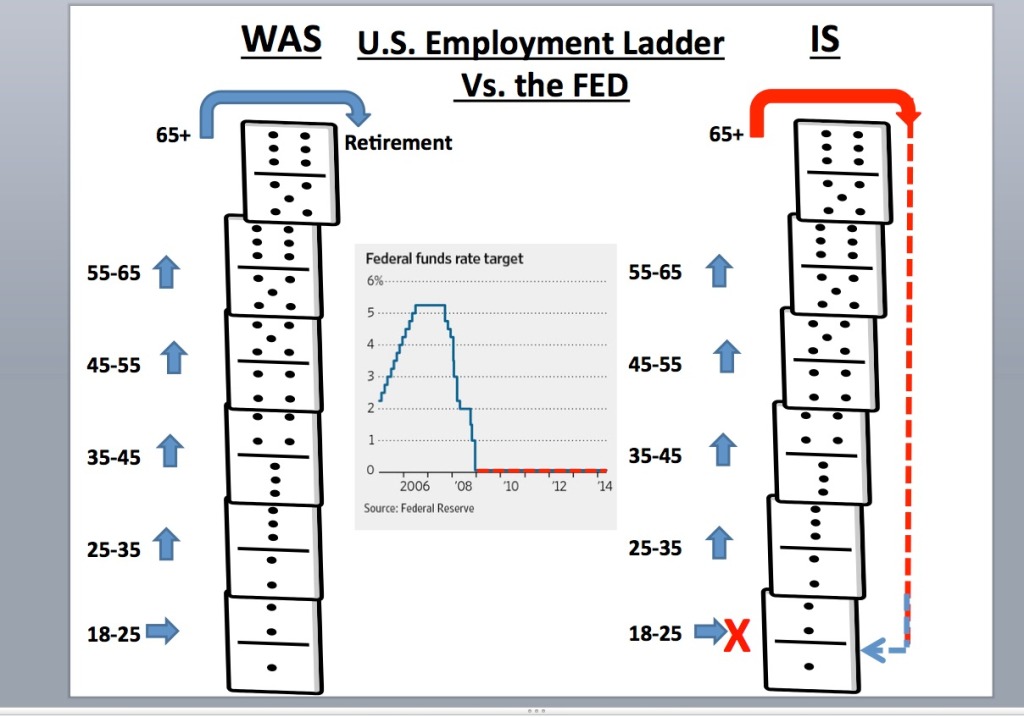
Employment vs. Fed

Larry Goldstein: Fed is allowing the economy’s muscle memory to atrophy

The hospital is insisting the patient remain indefinitely in a wheelchair while the family of the patient insists that all that is needed is a cane. Both the family and the hospital recognize that there will be some pain during the recovery, i.e. transition period.

By keeping the patient in the wheelchair for an indefinite period the hospital (unintentionally) is making the patient overly dependent on outside help, and not letting muscle memory to function. The cane might be uncomfortable for a period but would allow the patient to build back confidence, muscle and eventually allow him to stand once again on his own two feet.

Now, substitute the words FEDERAL RESERVE for HOSPITAL and the U.S. ECONOMY for the PATIENT.


Winners and Losers of QE

Net Interest Income (U.S.) 2007 – 2012

$ Billion


Federal Government 900
Non-Financials 310
Banks 150
Households -360


Source: McKinsey and Company

Picture if you can a patient in a hospital who had been very ill but now is getting better. The hospital is reluctant to fully release the patient but knows they have to do something. Remember, the patient with the initial help of the hospital is well on his way to recovery.Untitledemployment vs. Fed

Attached Files

Download:

Diana Furchtgott-Roth

Distinguished Fellow

Diana Furchtgott-Roth, an Oxford-educated economist, is a Distinguished Fellow at the Energy Policy Research Foundation. In President Trump’s first term, Diana served as Deputy Assistant Secretary for Research and Technology at the U.S. Department of Transportation and Acting Assistant Secretary for Economic Policy at the U.S. Department of Treasury. Diana served in the White House under President Reagan, President George H.W. Bush, and President George W. Bush. Diana is the author or coauthor of six books on economic policy and hundreds of articles. She is a frequent guest on TV and radio shows and writes regularly for the UK’s Daily Telegraph.

Dominick Blue

Distinguished Fellow

Dominick Blue is a Distinguished Fellow at the Energy Policy Research Foundation (EPRINC), where his research focuses on energy resilience, reliability, and the secure integration of emerging technologies into the power sector. His current work examines the intersection of advanced computing, infrastructure planning, and national energy security.
Dominick’s research portfolio includes analysis of AI and data center electricity demand-forecasting regional load growth, reliability implications, siting dynamics, and market coordination. He also leads studies on grid modernization and energy security, assessing resilience investments, interconnection constraints, and federal–state coordination under higher load scenarios. His additional work explores the revival of the U.S. nuclear sector, financing and licensing pathways for advanced reactors, and rebuilding domestic manufacturing capacity to support the nuclear supply chain.
Further research areas include gas-to-power infrastructure, pipeline and turbine capacity, and the role of gas in maintaining reliability within a diversified generation mix. Across these topics, Dominick focuses on translating complex technical findings into accessible policy insights for decision-makers at DOE, FERC, and state regulatory agencies.
Before joining EPRINC, Dominick held senior leadership roles in infrastructure, technology, and risk management, including Managing Partner and Director of Client Innovation for private investment and global critical infrastructure firms, respectively. A former U.S. Marine Corps Chief Warrant Officer Two in CBRN Defense, he brings a mission-driven perspective to energy resilience and safety. He holds a Masters of Business from the University of Southern California and has completed graduate studies in Computer Science at Georgia Tech, with research interests in AI systems, resilient infrastructure, and energy transition security.