
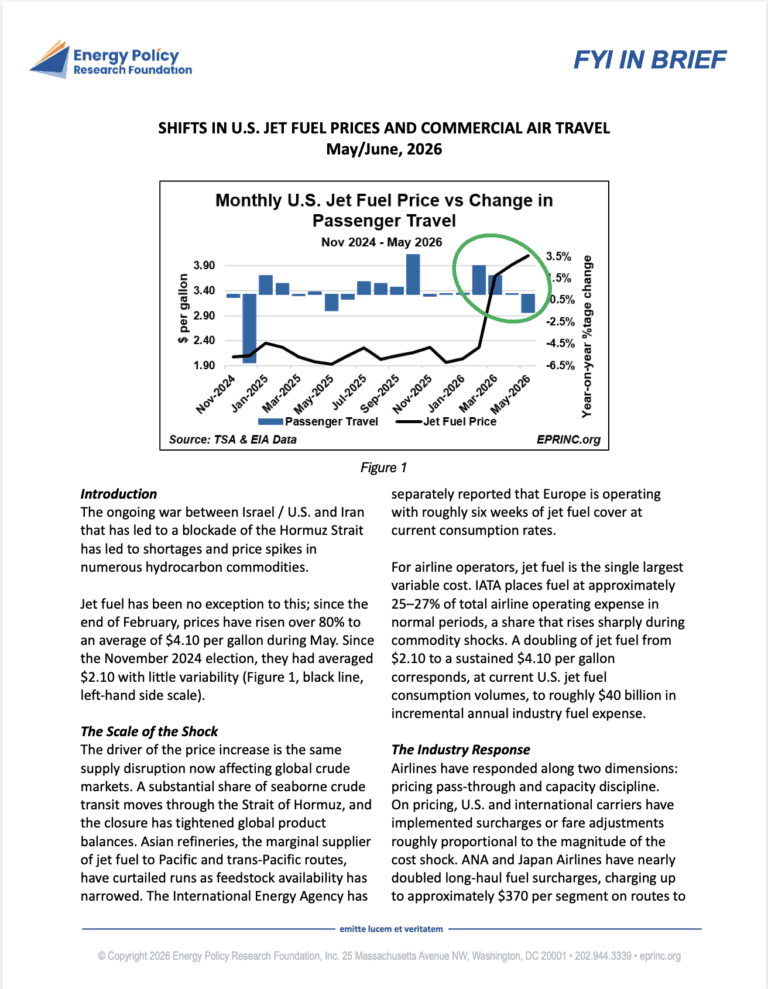
The ongoing war between Israel / U.S. and Iran that has led to a blockade of the Hormuz Strait has led to shortages and price spikes in numerous hydrocarbon commodities. Jet fuel has been no exception to this; since the end of February, prices have risen over 80% to an average of $4.10 per gallon during May. Since the November 2024 election, they had averaged $2.10 with little variability (Figure 1, black line, left-hand side scale).
The driver of the price increase is the same supply disruption now affecting global crude markets. A substantial share of seaborne crude transit moves through the Strait of Hormuz, and the closure has tightened global product balances. Asian refineries, the marginal supplier of jet fuel to Pacific and trans-Pacific routes, have curtailed runs as feedstock availability has narrowed. The International Energy Agency has separately reported that Europe is operating with roughly six weeks of jet fuel cover at current consumption rates. For airline operators, jet fuel is the single largest variable cost. IATA places fuel at approximately 25–27% of total airline operating expense in normal periods, a share that rises sharply during commodity shocks.