
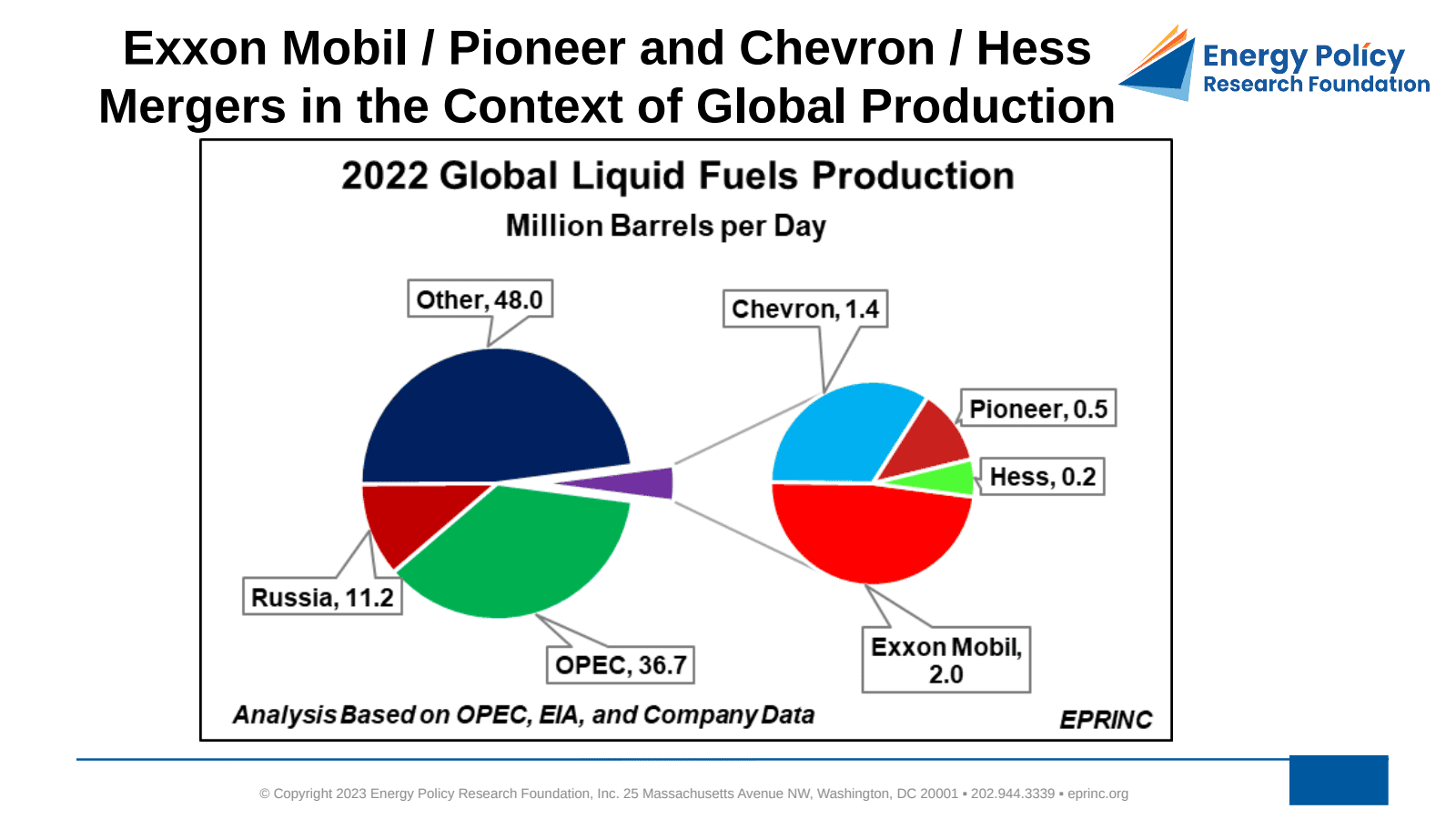
On October 11, 2023, Exxon Mobil announced its intent to acquire Pioneer Natural Resources, a dominant crude oil producer in the Permian Basin of West Texas. Roughly two weeks later, on October 23, Chevron announced an agreement to acquire Hess Corporation, once a major refiner and distributor of petroleum products that more recently has transformed itself into a crude oil exploration and production company. Each acquisition is valued at over $50 billion.
On November 1, 2023, twenty-three U.S. Democratic Senators sent a letter to the Federal Trade Commission requesting an immediate investigation into potential anti-competitive practices and anticipated economic harm to consumers from the two mergers. Opinions both challenging and supporting the Senators’ contentions have since been published.
Crude oil prices are set in global markets in response to supply and demand dynamics, as well as adverse weather and geopolitical events, among other factors. Against that backdrop, this chart measures the combined output of the four merging companies as a share of global liquid fuels supply.
The combined 2022 liquids production of the four companies is 4.2 million barrels per day, or 4.2% of total global liquid fuels supply. By comparison, OPEC and Russia control 47% of total global liquid fuels production, and in recent years have explicitly convened through OPEC+ to manage and limit the availability of fuel, thereby elevating prices.
Related reading: Jonathan Chanis, an asset manager and occasional EPRINC contributor, published an OpEd in the Wall Street Journal, “Chuck Schumer Doesn’t Know How Gas Prices Work.”
From the EPRINC Chart of the Week archive.
Cite: EPRINC, “Exxon Mobil / Pioneer and Chevron / Hess Mergers in the Context of Global Liquid Fuels Production,” Chart of the Week 2023-47, November 20, 2023.