
On April 25, 2024, EPA finalized its power plant rule (Docket EPA-HQ-OAR-2023-0072). The rule mandates that most coal- and natural gas-fired plants capture 90% of their emissions by 2035 and convert to hydrogen by 2038 or shut down. Any new natural gas plant not designed as a peaker—operating less than 40% of the time—must use carbon capture and storage (CCS) technology.
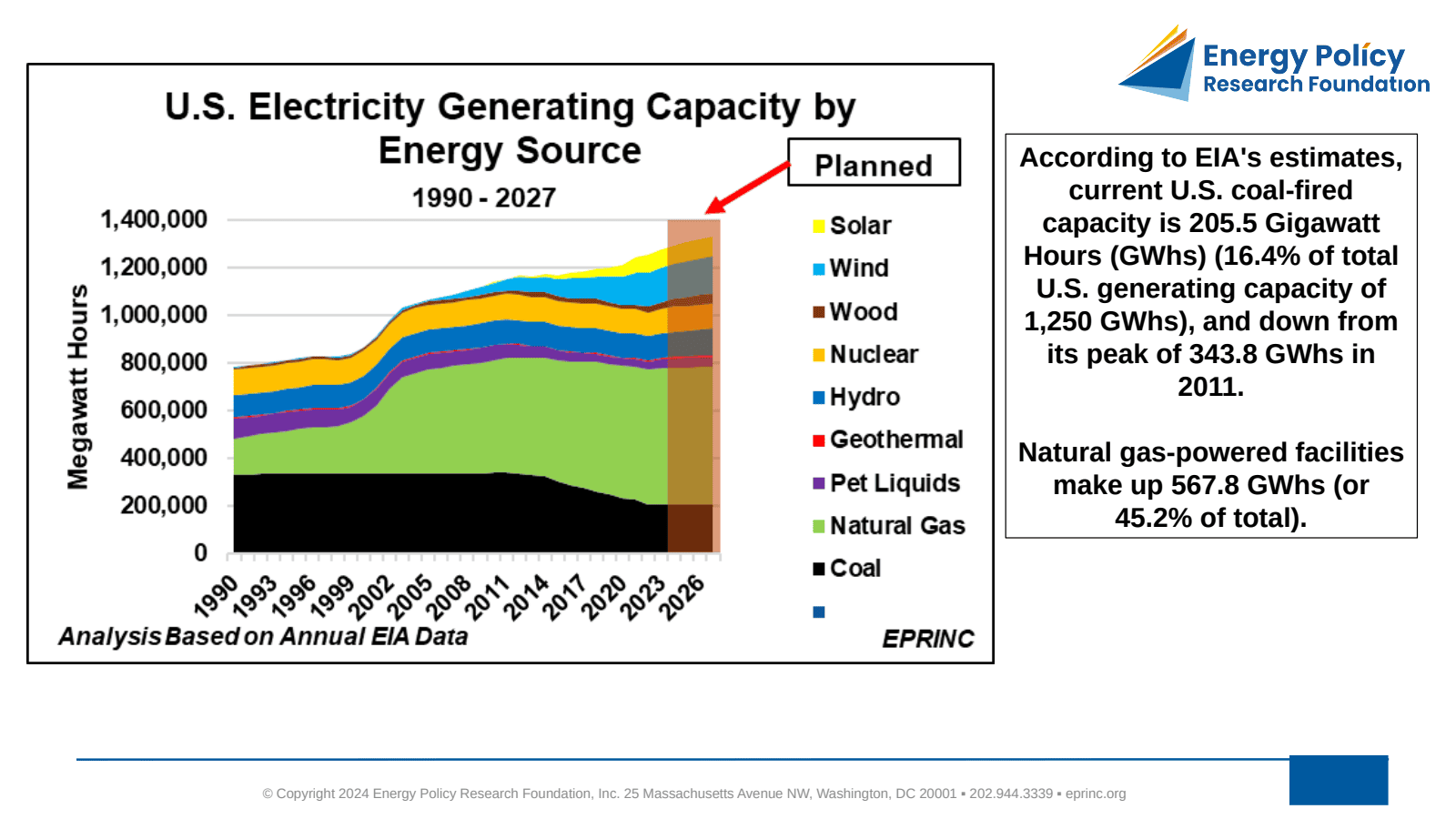
According to EIA estimates, current U.S. coal-fired capacity is 205.5 GWh, or 16.4% of total U.S. generating capacity of 1,250 GWh, down from a peak of 343.8 GWh in 2011. Natural gas facilities account for 567.8 GWh, or 45.2% of the total. Estimates of the rule’s impact vary: EPA’s own impact analysis projects 42 GWh (20.4%) of coal capacity and 210 GWh of natural gas capacity would be shut down, while EIA’s more aggressive forecast anticipates 155 GWh (75.6%) of coal capacity retiring. Through 2027, EIA reports new capacity additions would total 76.9 GWh, primarily solar and wind with some natural gas.
Over the last twenty years, U.S. electricity demand has grown at just 0.8% annually, compared with 5.7% annually during the high-growth period of 1950–1990. Residential demand has plateaued in part due to efficiency programs such as Energy Star, begun in 1992 and run primarily by EPA and to a lesser degree by DOE. Commercial demand grew at 1.2% annually, down from 6.6% between 1950 and 1990, and has similarly benefited from efficiency programs. Data centers have expanded capacity and throughput while containing energy use through faster processors, fiberoptic cabling, and low-energy solid-state storage drives.
Several forces now point toward renewed demand growth. Government incentives for the onshoring of U.S. manufacturing are set to lift industrial demand above its prior 0.2% annual growth rate. Despite data center efficiency gains, additional AI requirements are raising new demand concerns, and mandates for the electrification of residential heating and uncertainty around motor vehicle electrification add further pressure.
“EPA’s rule would considerably diminish the amount of available dispatchable generation just at a time where predictions of rapidly increasing electricity demand growth are rampant,” said Max Pyziur, EPRINC’s Research Director. “A better approach would be to first assess demand growth and potential grid vulnerabilities.” Utilities, system operators, and oversight authorities such as the North American Electric Reliability Council (NERC) are expressing concern over the increasing potential for a sizeable shortfall of reliable generating capacity in the face of rapidly increasing power demand.
From the EPRINC Chart of the Week archive.
Cite: EPRINC, “EPA’s Power Plant Rule, Declining U.S. Electricity Generating Capacity, and Growing Power Demand Have Capacity Requirements Been Underestimated in the Face…,” Chart of the Week 2024-17, April 22, 2024.