
electricity prices

EPRINC Interactive Chart: Changes in Electricity Prices Over the Past 20 Years (Desktop-friendly)

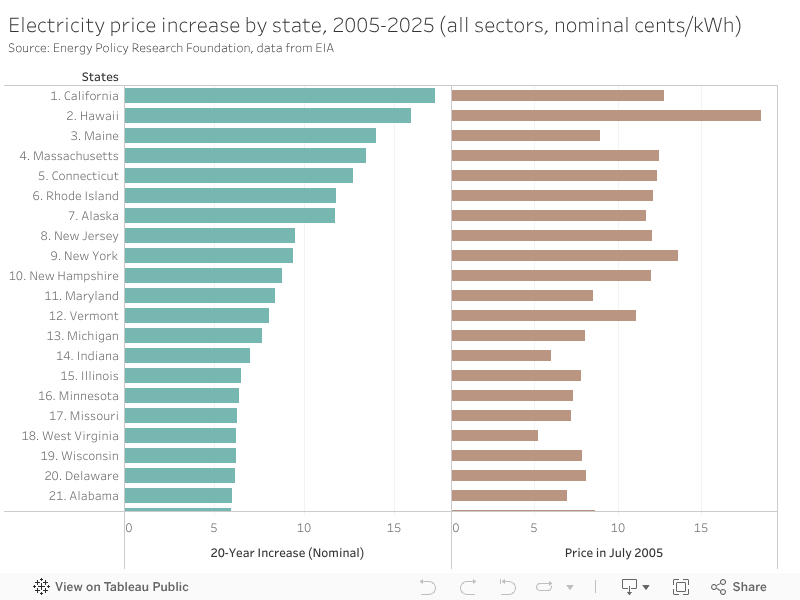
One of the perennial questions we ask at EPRINC is “What contributes most to electricity prices?” Bad policies, generation mix, or rising demand? This week’s chart takes a closer look at this question by comparing the 20-year increase in average electricity prices across all sectors in the 50 states.

California had the highest incremental increase between July 2005 and July 2025. The Golden State saw its price more than double, from 12.76 cents/kWh to 30.04 cents/kWh (in nominal terms). Five of the six New England states rank among the top 10 states with the steepest increases; Vermont didn’t fare much better, at 12th overall.

States with price growth of less than 5 cents/kWh (teal-turquoise) have either abundant, diverse energy resources such as hydropower or policy environments conducive to rapid deployment of affordable and reliable generation, particularly natural gas power plants.

One of the perennial questions we ask at EPRINC is “What contributes most to electricity prices?” Bad policies, generation mix, or rising demand? This week’s chart takes a closer look at this question by comparing the 20-year increase in average electricity prices across all sectors in the 50 states. This interactive chart answers this question.

Attached Files

Download:

Dominick Blue

Distinguished Fellow

Dominick Blue is a Distinguished Fellow at the Energy Policy Research Foundation (EPRINC), where his research focuses on energy resilience, reliability, and the secure integration of emerging technologies into the power sector. His current work examines the intersection of advanced computing, infrastructure planning, and national energy security.
Dominick’s research portfolio includes analysis of AI and data center electricity demand-forecasting regional load growth, reliability implications, siting dynamics, and market coordination. He also leads studies on grid modernization and energy security, assessing resilience investments, interconnection constraints, and federal–state coordination under higher load scenarios. His additional work explores the revival of the U.S. nuclear sector, financing and licensing pathways for advanced reactors, and rebuilding domestic manufacturing capacity to support the nuclear supply chain.
Further research areas include gas-to-power infrastructure, pipeline and turbine capacity, and the role of gas in maintaining reliability within a diversified generation mix. Across these topics, Dominick focuses on translating complex technical findings into accessible policy insights for decision-makers at DOE, FERC, and state regulatory agencies.
Before joining EPRINC, Dominick held senior leadership roles in infrastructure, technology, and risk management, including Managing Partner and Director of Client Innovation for private investment and global critical infrastructure firms, respectively. A former U.S. Marine Corps Chief Warrant Officer Two in CBRN Defense, he brings a mission-driven perspective to energy resilience and safety. He holds a Masters of Business from the University of Southern California and has completed graduate studies in Computer Science at Georgia Tech, with research interests in AI systems, resilient infrastructure, and energy transition security.