
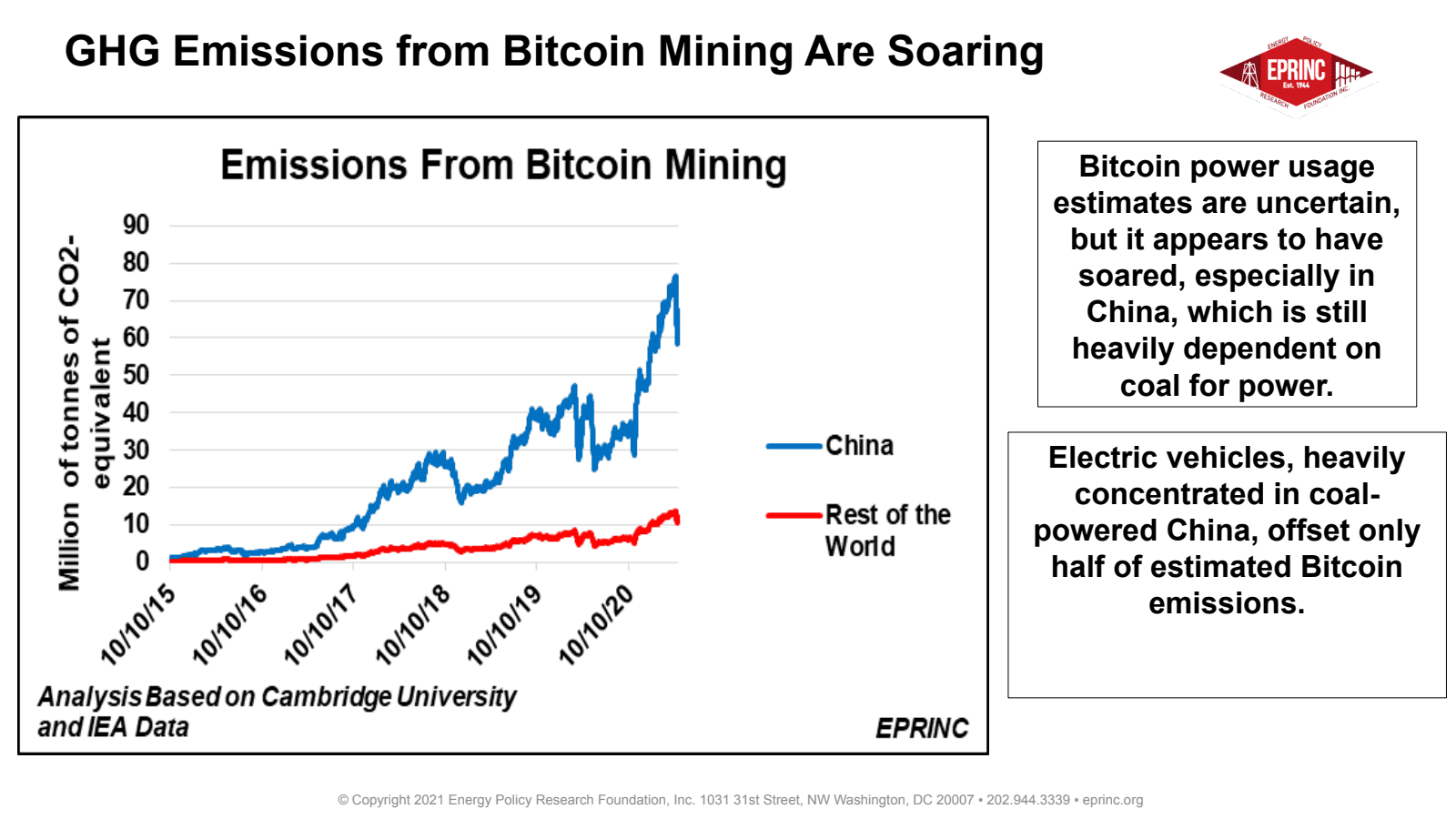
The chart estimates the greenhouse gas emissions associated with global bitcoin mining and compares them against the emissions avoided through electric vehicle adoption. Cryptomining—the process of creating cryptocurrency units and validating transactions on a blockchain ledger—consumes an estimated 1% of annual global electricity usage, exceeding the total electricity use of some nations, largely because many cryptocurrencies rely on the energy-intensive Proof of Work validation process.
Estimating bitcoin’s emissions requires navigating substantial data gaps and uncertainty. Published estimates of power consumption vary by a factor of five to fifteen even within a single year, and the Cambridge Bitcoin Electricity Consumption Index reports minimum, maximum, and “best guess” figures in which the maximum runs roughly ten times the minimum. The analysis here relies on Cambridge’s “guess” estimate as the most defensible single figure.
The geographic location of mining is similarly uncertain because much of the data is inferred rather than collected. Estimates of China’s share have ranged widely; a Nature study placed 79% of mining in China as of April 2020, the figure adopted here. Emissions per unit of power for China and the rest of the world are drawn from the IEA World Energy Outlook 2020, which lists power production and associated emissions for both China and the globe.
These assumptions carry clear caveats. A larger share of mining may draw on hydropower-heavy regions such as the U.S. Northwest, Canada, and Scandinavia, which would lower the emissions estimate, while cheap Chinese coal could raise it. The energy intensity of mining also rises and falls with profitability: when electricity and maintenance costs exceed mining profits, operators may power down equipment, but historically low prices have proven temporary and consumption has rebounded.
The policy context continues to evolve. Ethereum’s September 2022 “Merge” shifted the second-largest cryptocurrency from Proof of Work to the far less energy-intensive Proof of Stake, cutting that network’s energy use by an estimated 99.5%, though some displaced miners migrated to other Proof of Work networks. Congress has held hearings on the energy impact of cryptocurrencies, and Executive Order 14067 prompted a White House OSTP report examining the climate and energy implications of crypto-assets.
From the EPRINC Chart of the Week archive.
Cite: EPRINC, “Bitcoin Emissions Offset EV GHG Savings,” Chart of the Week 13, May 17, 2021.