
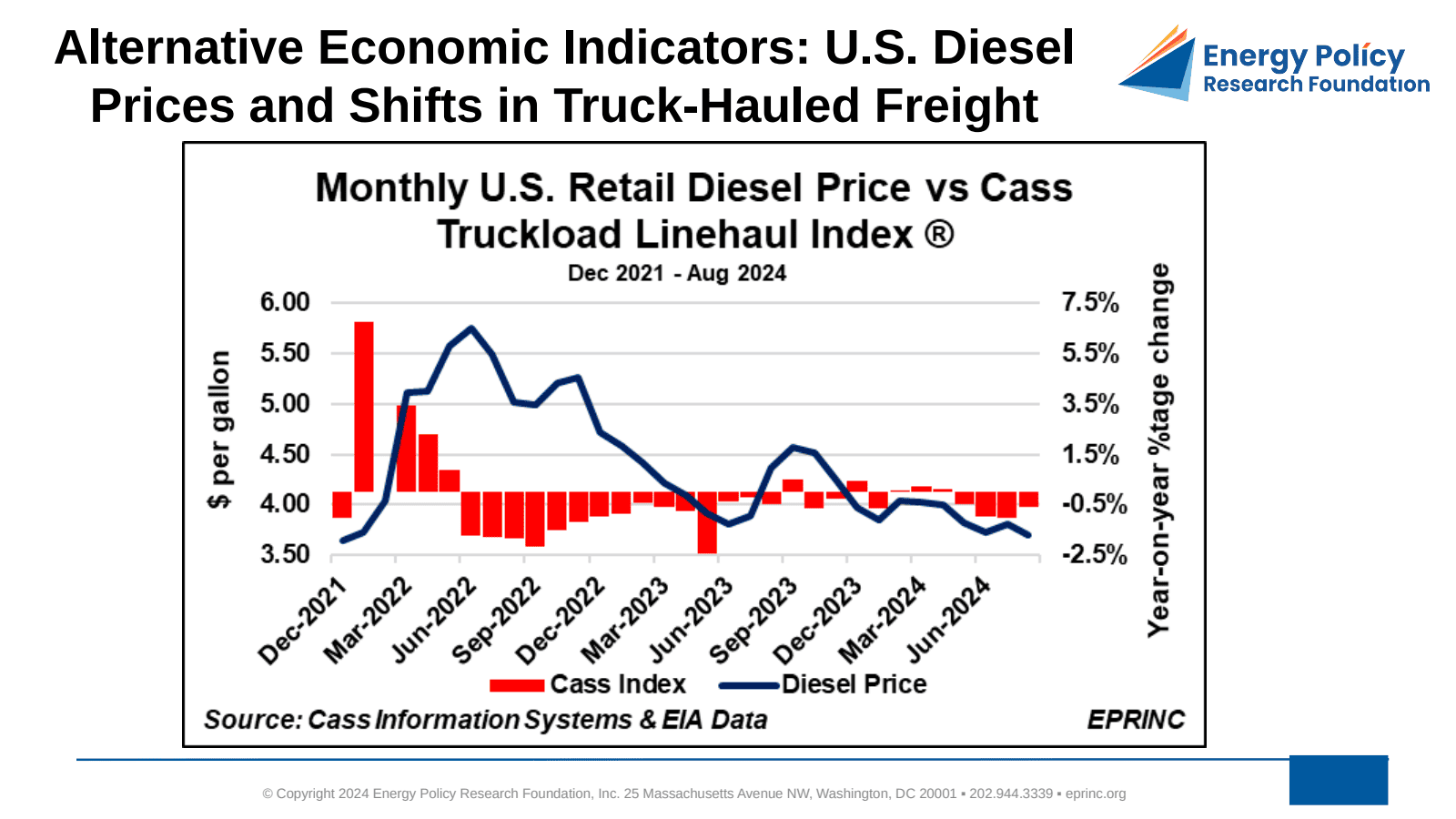
U.S. economists rely on a range of high-frequency aggregated indicators to gauge the direction of an economy, including the unemployment rate, GDP growth, interest rates set by the Federal Reserve, financial market indexes, orders for durable and consumer goods, and building permits. One informative set of alternative indicators pairs the retail price of #2 distillate in the form of diesel with an index of North American freight volumes compiled by Cass Information Systems.
#2 distillate is primarily marketed as heating oil (dyed red) or diesel (clear or dyed blue), with the dye signaling application and tax treatment. The market has shifted markedly toward transportation: in 1984, 30% of #2 distillate went to heating and 37% to trucking, but by 2020 those shares had moved to 8.5% for heating and 70% for trucking. Cass Information Systems, a St. Louis-based bank holding company specializing in freight invoice processing, uses that data to build proprietary indexes tracking North American freight; its Truckload Linehaul Index isolates per-mile truckload pricing from fuel and accessory costs. Together the two series provide a directional view of demand for durable and consumer goods, from manufacturer to warehouse to retail outlet, reflecting strength or weakness in both business-to-business and consumer markets.
The chart tracks North American trucking activity (red bars) against retail U.S. diesel prices (dark blue line). During 2020, COVID-19 brought a collapse in consumer demand and a breakdown in supply chains. Beginning in 2021, rapid vaccine development and falling infections drove a broad economic recovery. The chart illustrates how closely the two series moved through the late 2021/early 2022 rebound, with the expansion in trucking tied to rising retail diesel prices. As structural inflationary pressures emerged in mid-2022 and the Federal Reserve raised rates, economic growth subsided along with trucking activity and diesel prices.
The relationship underscores a basic link between production and fuel demand: goods that are not produced cannot be hauled, and weak freight activity translates into weak diesel demand. Read alongside declining industrial production, the two series offer a grounded, real-time check on the health of the broader economy.
From the EPRINC Chart of the Week archive.
Cite: EPRINC, “Alternative Economic Indicators: U.S. Diesel Prices and Shifts in Truck-Hauled Freight,” Chart of the Week 2024-38, September 16, 2024.