
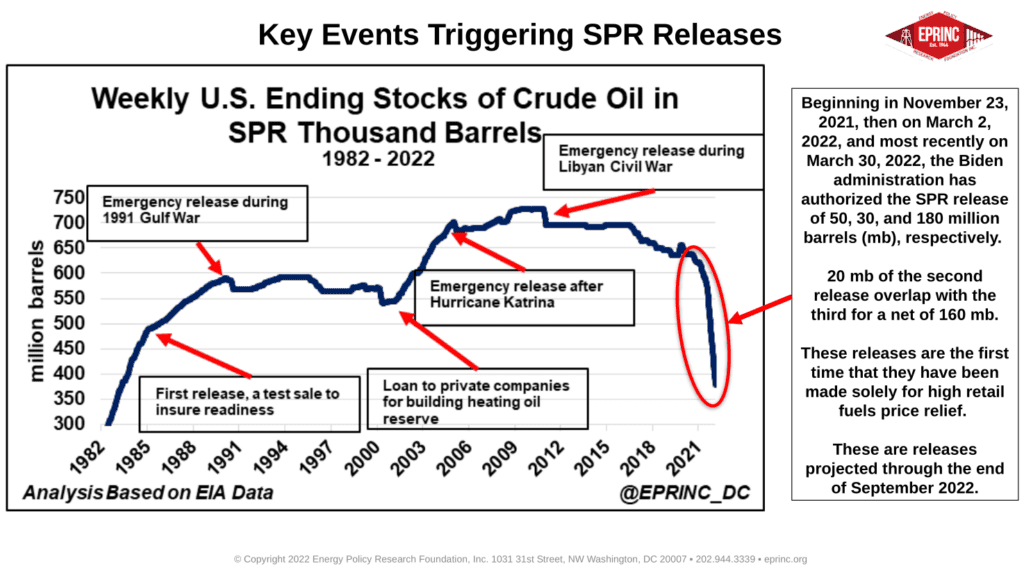
Beginning on November 23, 2021, then on March 2, 2022, and most recently on March 30, 2022, the Biden administration has authorized the SPR release of 50, 30, and 180 million barrels (mb), respectively. 20 mb of the second release overlap with the third for a net of 160 mb.
These releases are the first time that they have been made solely for high retail fuels price relief.
These are releases projected through the end of September 2022.
Beginning on November 23, 2021, then on March 2, 2022, and most recently on March 30, 2022, the Biden administration authorized SPR releases of 50, 30, and 180 million barrels (mb), respectively. 20 mb of the second release overlap with the third, for a net of 160 mb.
These releases are the first time that they have been made solely for high retail fuels price relief.
These are releases projected through the end of September 2022.
Over the course of 2021 and 2022, U.S. transportation fuel prices have climbed steeply, rising to levels not seen in a decade.
Aiming to signal policy-based relief, the Biden Administration has announced three sets of releases from the U.S. Strategic Petroleum Reserve (SPR), for a total of 240 million barrels through the end of September 2022.
These actions were taken after the Administration requested both U.S. producers and OPEC+ members to increase crude oil production in order to create price relief.
Critics asserted the conflicted policy, especially in light of the earlier KXL Pipeline cancellation and Federal oil and gas sales suspension.
The U.S. SPR was established in the 1970s in reaction to oil supply shortages brought on by political instability in producing countries in the Middle East. The action was coordinated by the International Energy Agency (IEA) on behalf of OECD member countries including the U.S.
The anticipated scenarios for any sort of SPR release were oil supply disruptions brought on by events such as extreme weather, military conflicts, geopolitically motivated embargos, and major oil supply infrastructure accidents. In the current moment, none of these sorts of events are impairing petroleum production, trade, and distribution.
Furthermore, any sort of release by one country would be done in conjunction with other OECD countries with oversight from the IEA. Only the release authorized on March 2, 2022 is in conjunction with other OECD countries.
From the EPRINC Chart of the Week archive.