
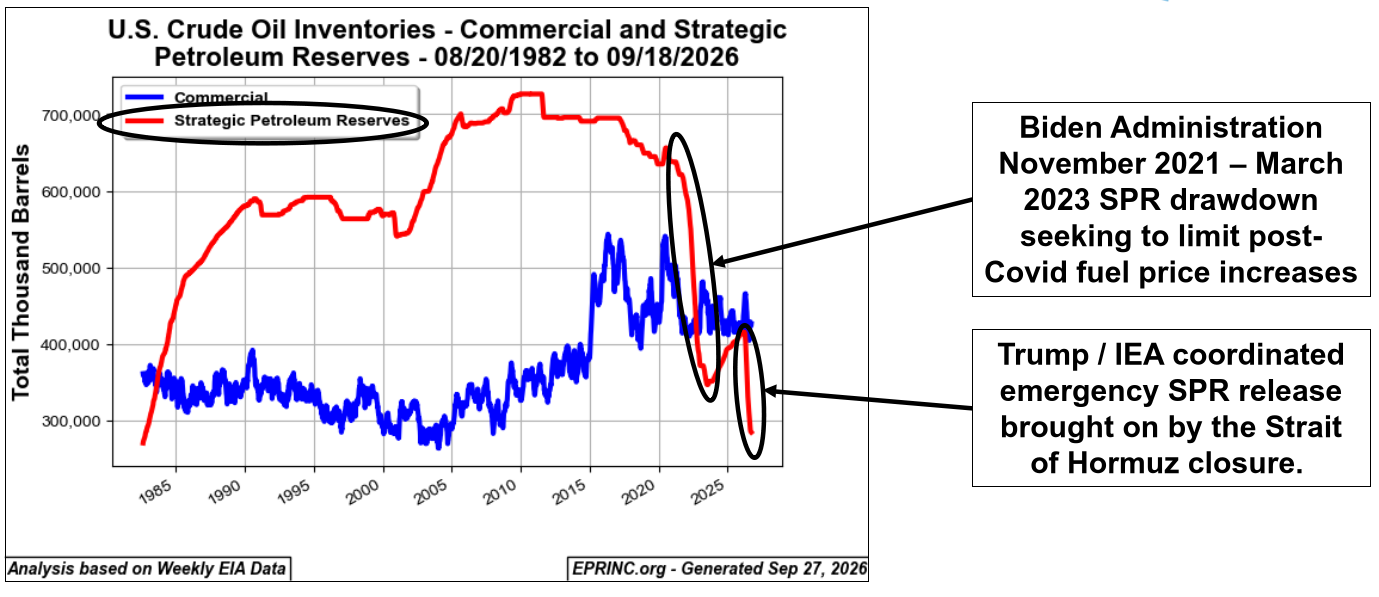
The U.S. Strategic Petroleum Reserve (SPR) held 284.5 million barrels (MB) as of September 18, 2026, according to the U.S. Energy Information Administration. That is just 14.5 MB above the 270 MB reported on August 20, 1982, the first published record of the reserve’s holdings. If the United States had to rely on the SPR alone for its crude oil supply, the reserve would last fewer than 20 days.
The current drawdown began soon after the Strait of Hormuz closed in March 2026, which quickly produced shortages and price spikes in hydrocarbons and other commodities. On March 11, the United States announced it would release 172 MB from the SPR over 120 days. That was its share of a 400 MB collective action coordinated through the International Energy Agency with 32 other countries. As of September 18, 133 MB of the authorized volume had been released.
On September 29, the Department of Energy announced it would offer up to 40 MB more, the last of the 172 MB. Energy Secretary Chris Wright also pressed European IEA members, several of which have released only a fraction of the volumes they pledged. If the final tranche is fully delivered, the reserve would fall to roughly 245 MB. That is below its first published level in 1982, and below the 252.4 MB threshold the Energy Policy and Conservation Act sets for the limited drawdown authority used in smaller supply shortages. Emergency releases such as this one are not bound by that threshold, but it marks the level Congress treated as the reserve’s working minimum outside a severe crisis.
The March authorization is structured as an exchange rather than a sale. By 2029, recipients must return 1.26 barrels to the SPR for every barrel received. On the volume released so far, that implies about 168 MB of future replenishment. The reserve will eventually be rebuilt, but those barrels do nothing to cushion the current crisis.
The SPR was already well below historical levels when this drawdown began. It held 415 MB at the time of the March 2026 authorization, down from 621.3 MB in November 2021. Between those dates, the Biden administration released 275 MB over sixteen months to limit post-COVID fuel price increases. Two emergency drawdowns in five years have left the reserve at its lowest level in more than four decades.
The pressure has now shifted from crude to refined products. As EPRINC documented in “U.S. Diesel Price Spikes and Why an Export Ban Would Backfire,” supplies of gasoline and jet fuel are constrained, but none more than diesel, the fuel of the supply chain. Damage to refining capacity in the Middle East and Russia has created a diesel shortfall of about 1 million barrels per day.
With strategic reserves and floating storage substantially depleted, two things are now critical: restoring transit through the Strait of Hormuz, and replacing lost diesel-producing refining capacity, whether by bringing it back online in the Middle East or adding it elsewhere.
Cite: EPRINC, “Hormuz and the Strategic Petroleum Reserve: Running on Empty, Revisited,” Chart of the Week 2026-33, September 30, 2026.