
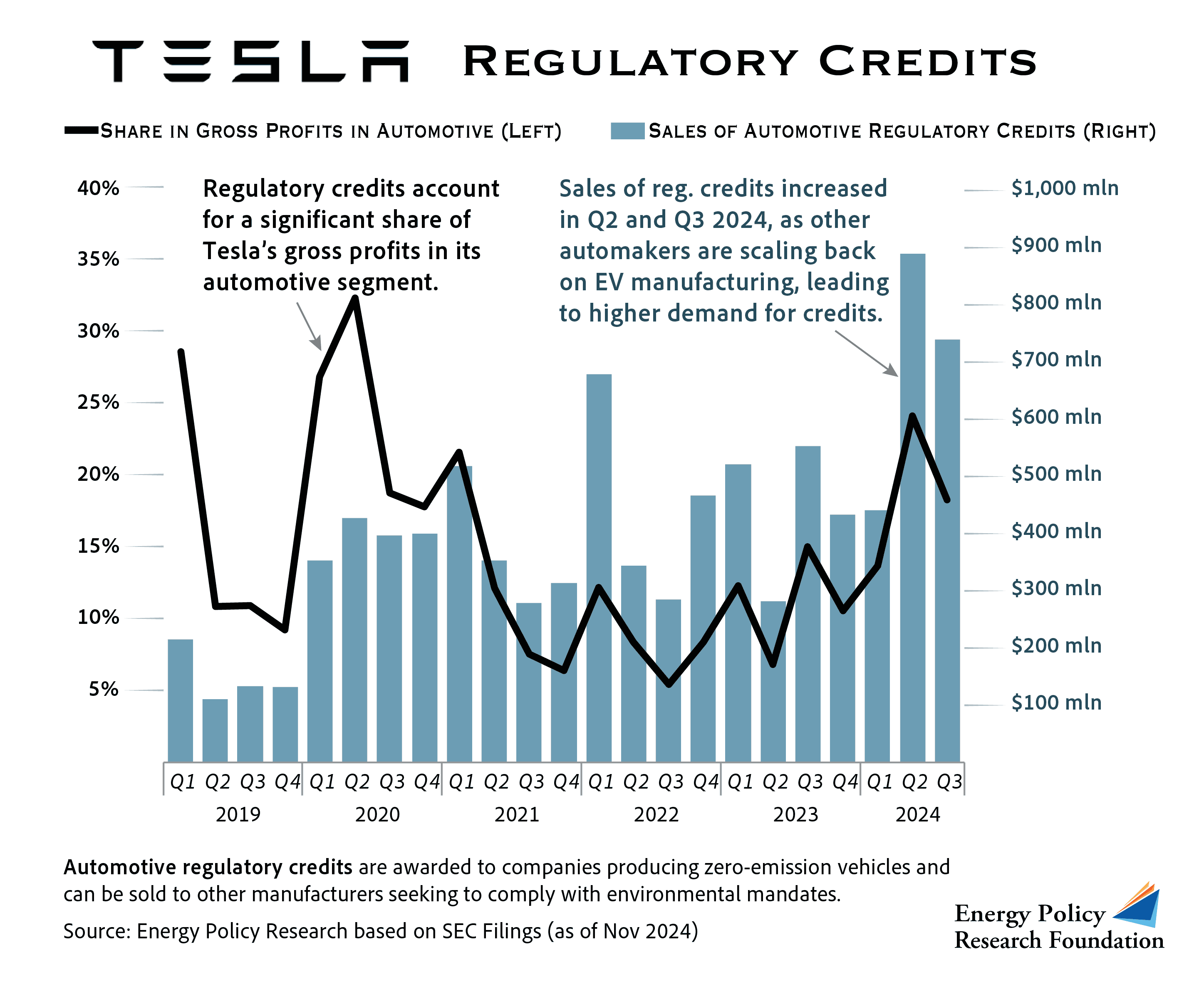
Tesla earns substantial income from “automotive regulatory credits,” a catch-all category for the economic benefit the company receives from the cap-and-trade programs various governments use to incentivize electric vehicle (EV) production. Because Tesla builds only EVs, it requires no offsets of its own and can sell 100 percent of the credits it earns. As there are no expenses associated with collecting these credits, their value relative to automotive gross profit indicates how much of Tesla’s automotive profit margin comes directly from regulatory programs.
The chart plots automotive regulatory credits as a share of Tesla’s automotive segment gross profit. That share has ranged roughly between 10 and 30 percent. It peaked in 2020, when the sale of regulatory credits provided $1.58 billion in revenue—turning what would have been a $718 million loss into Tesla’s first profitable year, at $862 million. The share has since declined from its pandemic high but is now rising again as other automakers scale back EV production and regulatory standards tighten. In fiscal year 2023, credit sales averaged roughly $990 per vehicle, effectively a premium paid by noncompliant manufacturers on each vehicle Tesla produced.
These programs typically fine automakers that fail to meet pro-EV standards, while manufacturers that exceed the standards may sell offsets to those that fall short. In the United States, Tesla draws revenue from two major schemes:
- Federally, the Corporate Average Fuel Economy (CAFE) standards set fleetwide average miles-per-gallon requirements. Because EVs use no gasoline, each EV receives 100 percent of the credit, exactly offsetting a vehicle only half as efficient as the standard requires.
- Thirteen states have adopted California’s Zero Emission Vehicle (ZEV) and Low Emission Vehicle (LEV) standards, which operate on a per-vehicle basis, requiring that a set percentage of a manufacturer’s cars under four tons be zero- and low-emission vehicles.
Other markets, notably the European Union and China, maintain comparable programs that create valuable credits for EVs sold there. The price Tesla receives per credit is set by the market but shaped by how stringent the standards and fines are. Information on which manufacturers are buying the credits is not publicly available in the United States. Under the planned tightening of CAFE standards in the 2024 EPA rule, Tesla’s credit revenue would be expected to increase, though those rules are likely to be rolled back under the Trump Administration over time.
From the EPRINC Chart of the Week archive.
Cite: EPRINC, “Tesla Automotive Credits And Gross Profit,” Chart of the Week 2024-46, November 11, 2024.