
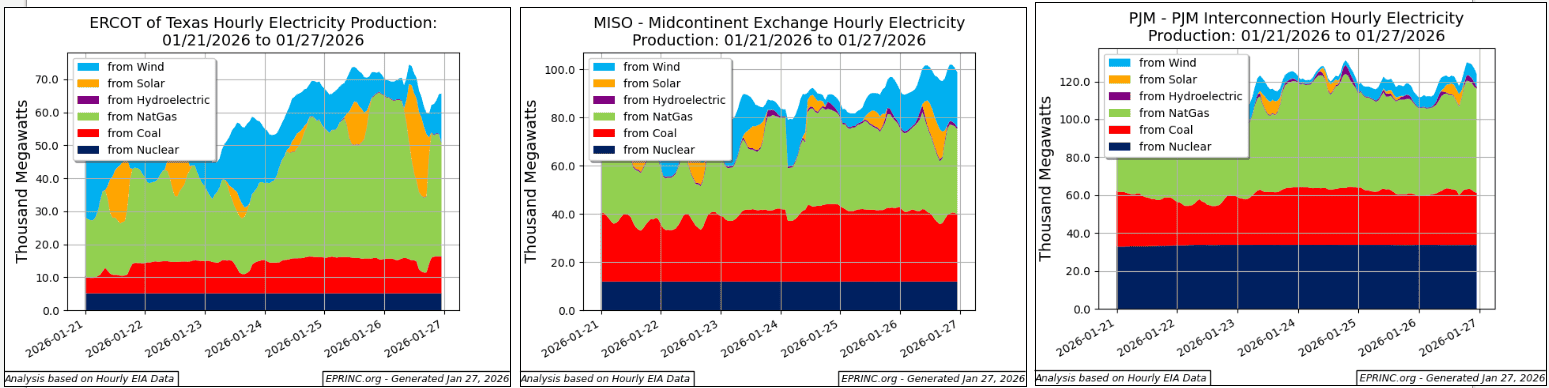
An arctic blast held temperatures below freezing from Texas through the Midwest and into the Mid-Atlantic and New England during Winter Storm Fern, a major snow and ice event that moved across the region from January 22 to 26, 2026. The storm tested three major grid operators: ERCOT (mostly Texas), MISO (the Mid-Continent from the Gulf to Canada), and PJM (Mid-Atlantic states with connections to parts of Indiana and Illinois that serve a large concentration of data centers in Northern Virginia). Because these regions are heavily dependent on electric heat—see EPRINC’s earlier chart, “U.S. Residential Heating by County”—power demand rose considerably across all three.
Average load over the duration of the storm was approximately 264 gigawatts (GW), with 85% supplied by dispatchable sources—41% natural gas, 24.4% coal, and 19% nuclear—and 15% from weather-dependent intermittent resources, comprising 12% wind and 3% solar. Load peaked at 298 GW, roughly 40% of total available U.S. generating capacity, at 10 a.m. ET on January 26, 2026, when dispatchable resources provided 90% of load and intermittent sources supplied the balance.
Coal, which has a strong presence in the MISO and PJM footprints, generated an average of 54 GW combined across those two regions during the storm, with coal reliance in PJM reaching 44% at its peak. Many coal plants that have notified authorities of pending shutdowns have been kept running under the U.S. Department of Energy’s 202(c) authority under the Federal Power Act, which permits the emergency use of power plants when outages or demand spikes threaten reliability and must be renewed every 90 days per plant.
“One challenge of operating legacy coal plants in these emergency situations is that they are frequently cycled over a 24-hour period rather than kept running continuously for days or weeks,” said Max Pyziur, EPRINC’s Research Director. “The cycling leads to faster degradation, substantial metal fatigue, and the occasional forced permanent shutdown due to the cycling’s irreparable damage.”
At the storm’s peak, PowerOutage.US reported roughly 1.1 million electricity customers without power, primarily in Texas, Louisiana, Mississippi, and Tennessee—a marked improvement over Winter Storm Uri in February 2021, when nearly 10 million customers in Texas alone lost power.
From the EPRINC Chart of the Week archive.
Cite: EPRINC, “Power Generation During Winter Storm Fern,” Chart of the Week 2026-04, January 19, 2026.