
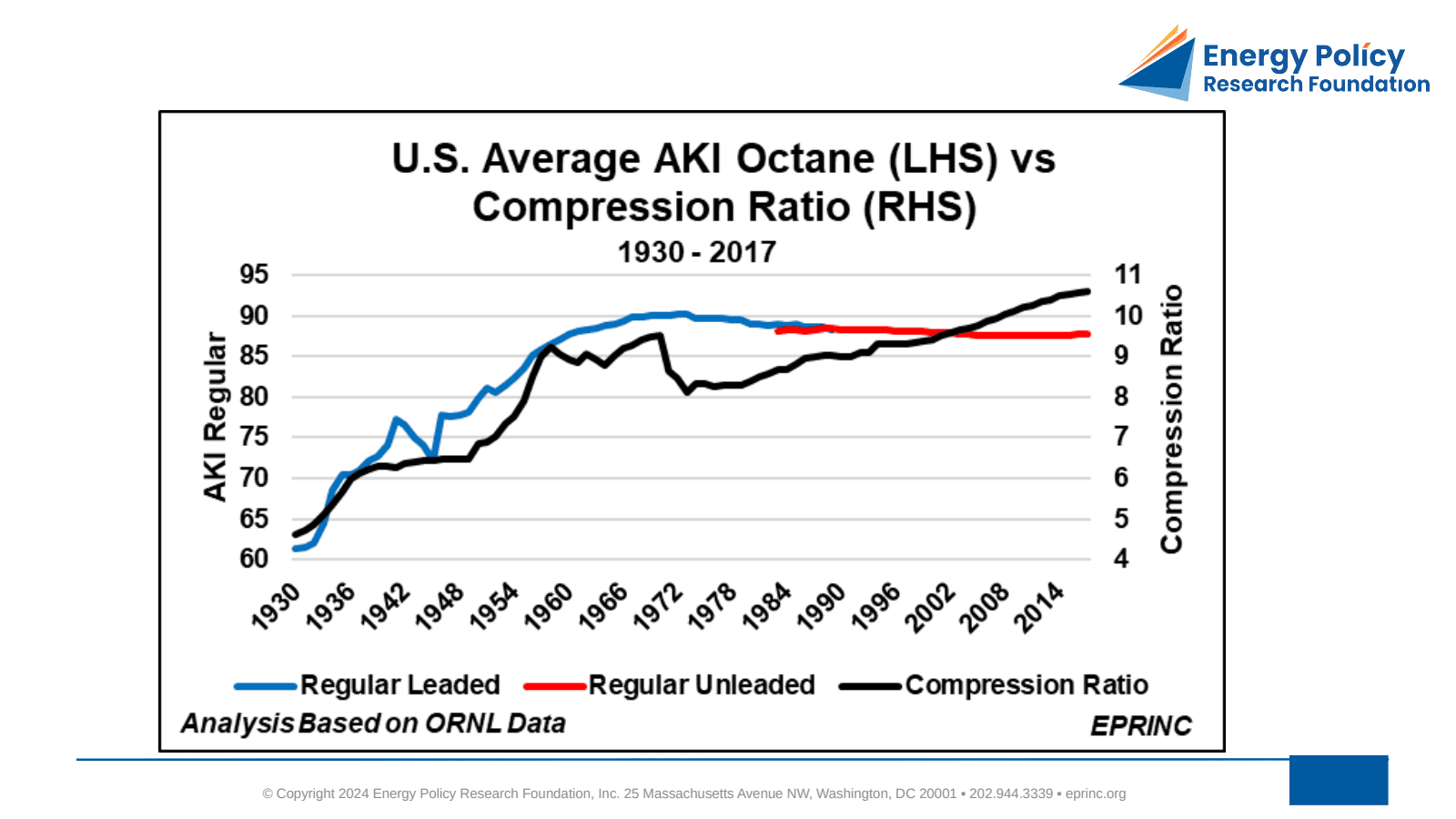
The chart tracks the parallel evolution of engine compression ratios and gasoline octane levels over the 20th century. A compression ratio is the ratio of a cylinder’s combustion chamber to the total volume of the cylinder. When gasoline-powered vehicles first came into widespread use, engines averaged a compression ratio of about 4-to-1. As demand for power and speed grew, compression ratios rose to an average of roughly 10.5-to-1 by the mid-1970s and have stayed at those levels since.
Vehicle power can be increased in three ways, in various combinations: adding cylinders, adjusting or expanding transmission gearing, or raising the compression ratio. Higher compression, however, caused early gasoline formulations to combust prematurely from compression alone — “pinging” or “knocking” — overheating engines, reducing power, and risking damage. Blending in octane suppressed compression-ignition, forcing combustion from the timed electric spark alone.
Octane components originally consisted of molecules with eight carbon atoms (hence “oct”), and can be sourced from petroleum refining or from non-petroleum additives that are either oxygenates or metallic. A gasoline’s octane rating represents how much it can be compressed before igniting without a spark. Two methodologies are in use: RON (Research Octane Number), measuring resistance to knocking during acceleration, and MON (Motor Octane Number), simulating high-speed driving. In the U.S., the number posted on the pump is the average of the two — the anti-knock index, or AKI. In 1930, regular gasoline posted an AKI of 61 and premium 71, compared with 87 and 93 today.
Through the mid-1970s, the dominant octane enhancer was lead, most often as tetraethyl lead (TEL). As motor vehicle pollution controls grew more stringent, lead was outlawed and other octane components gained prevalence. Developing and implementing octane additives that comply with pollution regulations is costly and adds to the price of fuel. With the shift away from lead, octane levels have been essentially unchanged since the 1970s.
As EPRINC Research Director Max Pyziur noted, increasingly stringent pollution control, fuel efficiency, and higher power in gasoline-powered vehicles continue to be achieved through technological innovation and greater computerization of a vehicle’s fuel, timing, and exhaust systems. The chart is drawn from EPRINC’s Gasoline Blending Primer, originally written in 2009 and fully revised on June 5, 2024, which traces how finished gasoline has evolved from a simple combination of a few refined petroleum components into many increasingly complex formulations adjusted for different regulatory jurisdictions — accomplished with little disruption to fuel availability but at added cost.
From the EPRINC Chart of the Week archive.
Cite: EPRINC, “Octane vs Compression Ratio,” Chart of the Week 2024-24, June 10, 2024.