
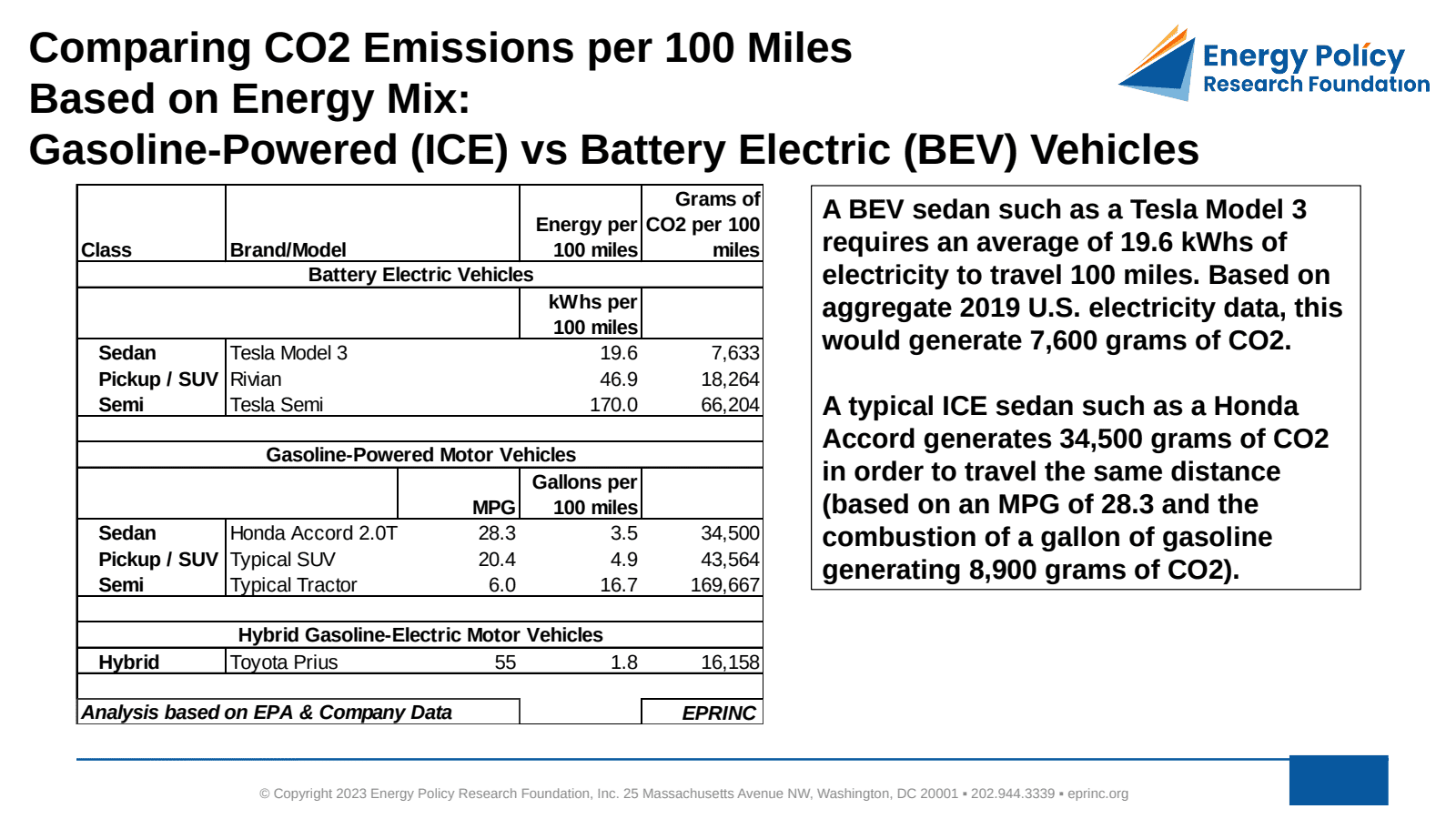
Motor-vehicle CO2 emissions can be measured across a range of scopes. The most expansive, termed “cradle-to-grave,” combines operating emissions with vehicle-cycle emissions from materials, production, and end-of-life disposal. Those broader estimates require multiple assumptions and can vary considerably. Operating emissions, by contrast, require fewer assumptions and can be derived more directly, and are the focus of this comparison.
While battery-electric vehicles (BEVs) produce no tailpipe emissions, the CO2 footprint of charging depends on the energy mix of the electricity used. Using the latest data available from 2019, the U.S. generated a total of 4,128 million megawatt hours of electricity, accounting for 1.6 billion metric tons of CO2 emissions, or 389 grams per kilowatt hour (kWh).
Applying that figure, a BEV sedan such as a Tesla Model 3, which requires an average of 19.6 kWh to travel 100 miles, would generate about 7,600 grams of CO2. A typical internal-combustion sedan such as a Honda Accord generates roughly 34,500 grams of CO2 over the same distance, based on 28.3 miles per gallon and 8,900 grams of CO2 per gallon of gasoline combusted.
The intensity of electricity generation has also been declining. With the continuing retirement of coal-fired generation and the increasing use of natural gas, U.S. CO2 emissions from electricity generation have fallen from 600 grams per kWh in 2001 to 389 grams per kWh in 2019.
From the EPRINC Chart of the Week archive.
Cite: EPRINC, “Comparing CO2 Emissions per 100 Miles Based on Energy Mix: Gasoline-Powered vs Battery Electric Vehicles,” Chart of the Week 2023-20, May 15, 2023.