

Recent reports that Middle East crude exports have returned to pre-war levels need a closer reading. According to Kpler data reported this week, September exports from the Gulf (excluding Iran) averaged roughly 16.5 million bpd, in line with the pre-war average. But about 40 percent of those barrels now leave by routes that avoid the Strait of Hormuz, compared with 17 percent before the war. The main routes are Saudi Arabia’s East-West pipeline to Yanbu on the Red Sea and the UAE’s pipeline to Fujairah on the Gulf of Oman. Restored exports are not the same as restored transit, a distinction EPRINC first examined in its April 8, 2026 Chart of the Week (2026-14).
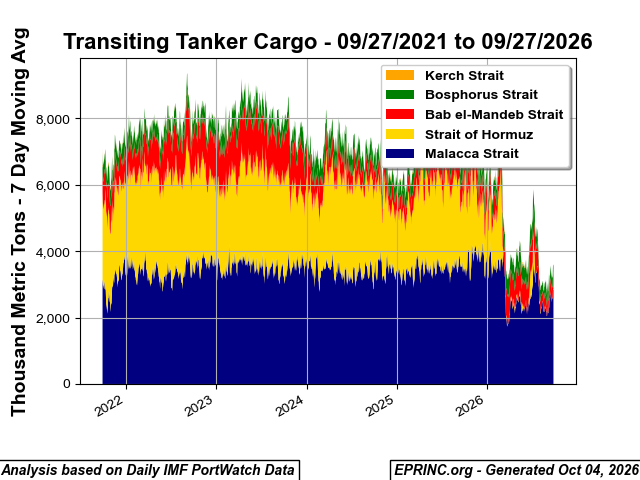
Shipping data from the world’s maritime choke points show how far traffic remains from normal. Over the past five years, regional wars have repeatedly disrupted the global economy, and vessel transits and cargo volumes have fallen sharply at several choke points. Tankers have been hit hardest, and they carry the crude oil, refined fuels, chemicals, and other liquids on which commerce and everyday life depend.
The Strait of Hormuz shows the disruption most starkly. The seven-day moving average of daily tanker volumes fell from more than 2 million metric tons (mt) in March 2025 to 264 thousand mt in March 2026, a drop of roughly 87 percent. Daily tanker transits fell by a similar share, from 45 to 6. The effects spilled into Asia: tanker volumes through the Strait of Malacca fell from 3.5 million mt to 2.8 million mt over the same period, a decline of about 20 percent.
Hormuz is the latest, but not the first, choke point to be disrupted. After Houthi forces began attacking shipping in the southern Red Sea in late 2023, tanker volumes through the Bab el-Mandeb fell from 1.2 million mt in January 2023 to 806 thousand mt in January 2024, a decline of about one-third, with transits falling from 25 to 15. That matters for the Hormuz bypass. Crude loaded at Yanbu must still leave the Red Sea through either the Suez Canal or the Bab el-Mandeb, and the East-West pipeline was itself shut from September 11 to September 22.
The Black Sea tells a similar story. As Ukraine has stepped up attacks on Russian energy infrastructure, daily tanker transits through the Bosphorus fell from 23 in August 2025 to 17 in August 2026. Farther north, tanker traffic through the Kerch Strait, about 35 thousand mt per day in late 2021 before Russia’s full-scale invasion of Ukraine, has since fallen to nil.
Rerouting has kept barrels moving, but not cheaply. Standard Chartered notes that exporters are moving oil “less efficiently and at considerably higher cost,” and the UK Maritime Trade Operations centre recorded eight attacks on vessels in a single week in early October. Brent remains above $100/bbl, against roughly $72/bbl before the war.
A note on data: IMF PortWatch data are open-source, provisional, and subject to frequent revisions. Commercial data are timelier and potentially more accurate.
Cite: EPRINC, “Choke Points under Fire: War-Driven Disruptions to Global Tanker Traffic,” Chart of the Week 2026-34, October 8, 2026.