
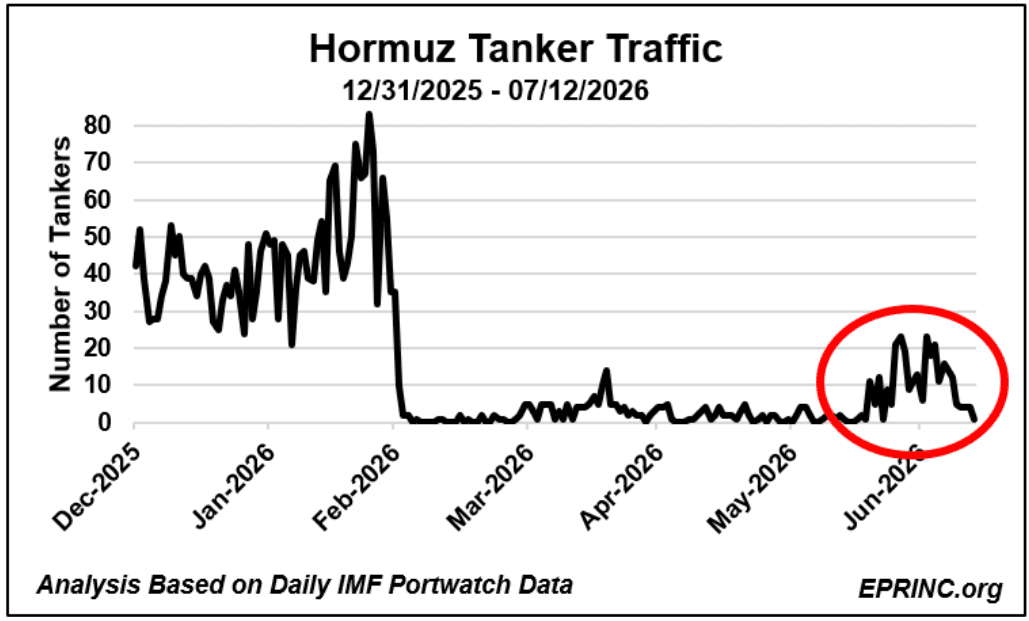
The mid-June resumption of tanker traffic through the Strait of Hormuz was the largest since the strait closed on March 5, 2026. Transits peaked near 23 per day and held in double digits for most of the second half of the month, against an April high of only 14. It was also, in absolute terms, still closed. Pre-war traffic ran roughly 30 to 50 tankers per day, and the strait normally carries up to 20 million barrels per day (MBD) of crude and products. At its best, the June window moved perhaps half of a normal day’s vessels (Figure 1).
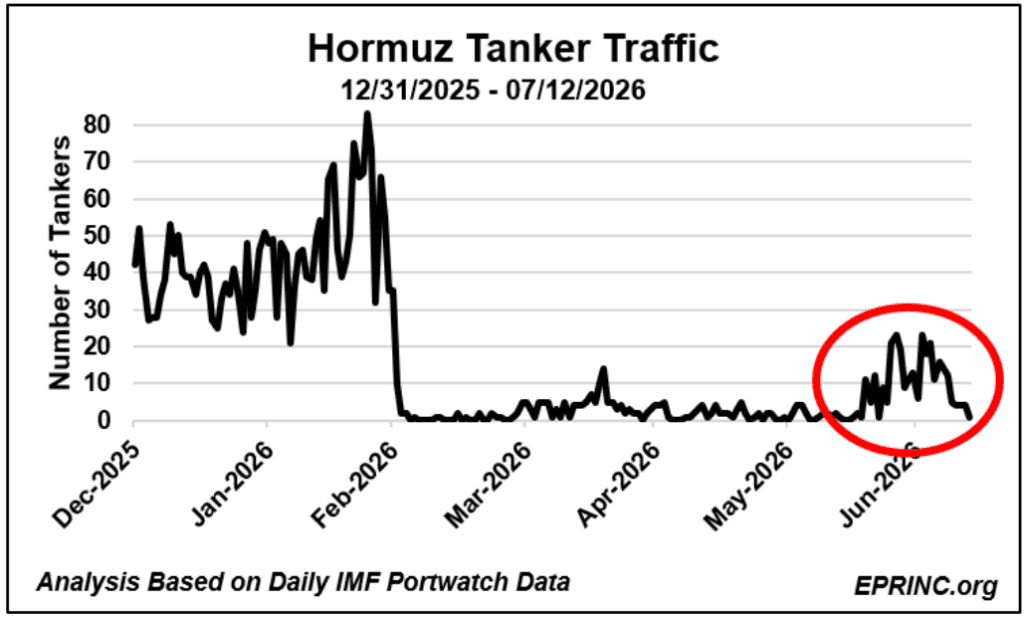
Figure 1
Yet Brent fell to $70.65 on July 2, a full return to pre-war levels. The physical market never justified that price. What justified it was the expectation of a reopening: the mid-June memorandum of understanding, the 60-day truce, and the resumption itself read as the leading edge of restored flows. The crude selloff ran ahead of the traffic recovery through late May and June, which is the signature of a market pricing anticipated barrels rather than delivered ones (Figure 2).
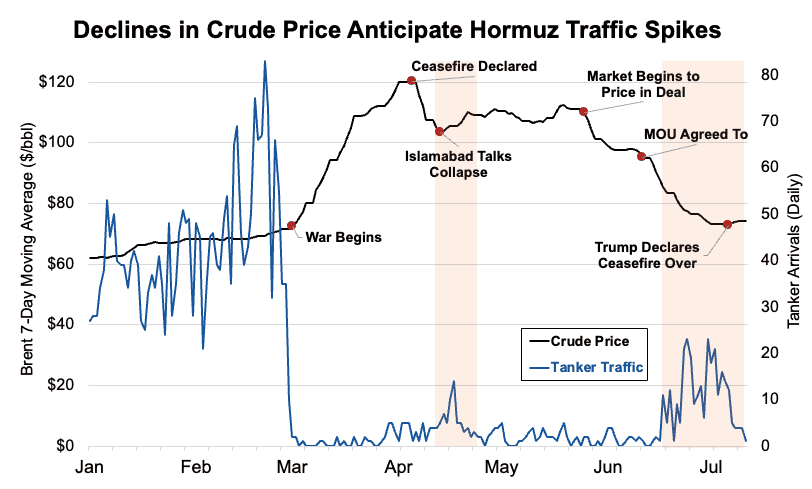
Figure 2
The trepidatiously rising traffic is now gone, and with it the expectation that the strait would return to normal. Following attacks on three tankers, President Trump declared the ceasefire over on July 8. Transits have since fallen to a two-month low, with seven vessels crossing on July 15 after the U.S. reimposed its naval blockade of Iranian ports. Brent has moved from $70.65 to roughly $85 in two weeks.
The world finds itself at a critical turning point, and it’s not substantially the risk oil throughput has declined; tanker traffic has been near 0 for most of the crisis. The risk is that the expectations have been shattered, which (along with strategic stockpile releases, which are in a much weaker position than March) have been the only thing holding the oil price down even at the height of the crisis. If the conflict remains unresolved for much longer, trouble is on the horizon.
Cite: EPRINC, “The Hormuz crisis has entered a new era,” Chart of the Week 2026-25, July 17, 2026.