
On April 12, 2023, EPA announced a proposed rule (Docket EPA-HQ-OAR-2022-0829) that, if implemented, would effectively increase the number of electric vehicles (EVs) in use. Under the proposal, 60% of automakers’ production would need to be EVs by 2030 and 67% by 2032, compared with the 5.8% of U.S. vehicles sold in 2022 that were EVs. The comment period closed July 5, 2023.
On May 8, 2023, EPA announced proposed new greenhouse gas standards for coal- and gas-fired power plants (Docket EPA-HQ-OAR-2023-0072). The rule would require most coal and natural gas plants to capture 90% of their emissions by 2035 and convert to hydrogen by 2038. EPA estimates the rule would lead to the retirement of 42,000 megawatts of coal capacity, and that the use of natural gas for power generation would decline by 37%. The comment period closed August 8, 2023.
The two rules pull in opposite directions: the motor vehicle rule mandates higher EV production and use, while the power plant rule reduces the amount of dispatchable and baseload electricity generation available to charge them.
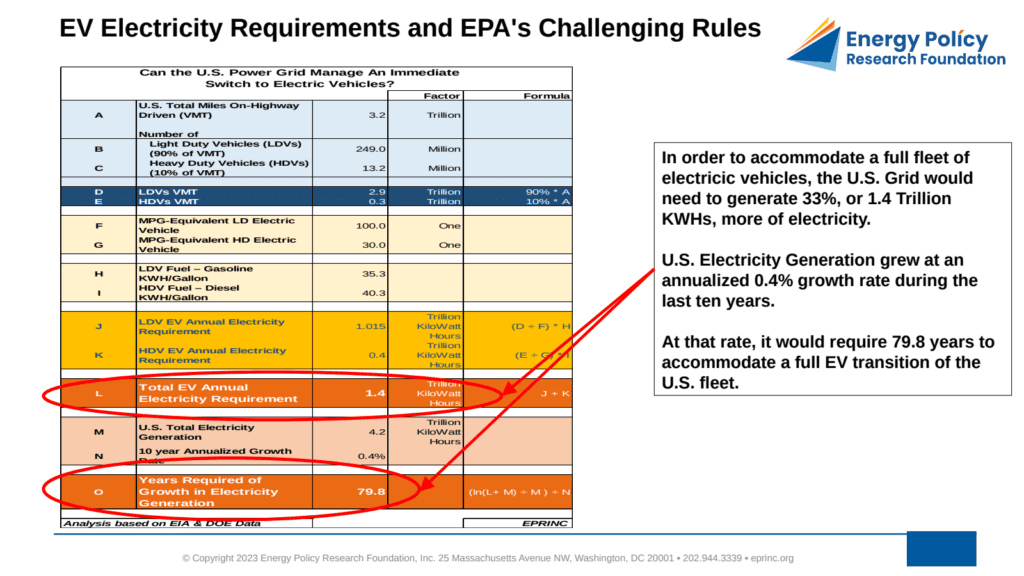
Assuming an immediate scenario of 100% EV usage, the chart projects that the U.S. grid would need to generate 33% more electricity — about 1.4 trillion kWh. Over the last ten years, U.S. electricity generation has grown at an annualized rate of just 0.4%. At that pace, accommodating a full EV transition of the U.S. fleet would take roughly 79.8 years.

From the EPRINC Chart of the Week archive.