
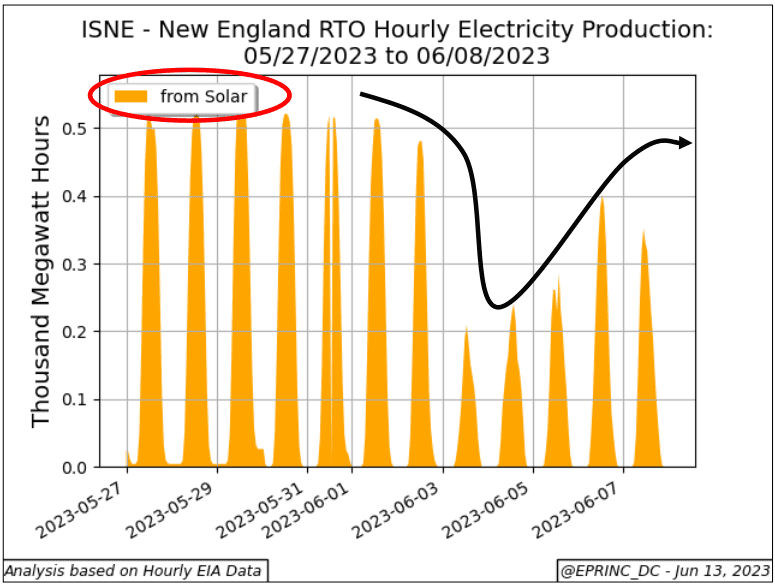
From June 5th through 8th, 2023, the Northeastern U.S. experienced intense smoke blown in from Canadian wildfires. While Canadian wildfires are not unusual during this period, weather systems that carry smoke southward and hold it at ground level for an extended three-day stretch are. The chart tracks the effect of this event on solar generation within ISO New England (ISO-NE), which during the episode produced between 40% and 80% of its usual output of roughly 0.5 thousand megawatt-hours for the period.
With the broad reconfiguration of the U.S. electricity system that began in the 1990s, the six New England states—Connecticut, Maine, Massachusetts, New Hampshire, Rhode Island, and Vermont—formed ISO-NE, a Regional Transmission Organization (RTO) that manages area-wide electricity generation and transmission for its member states.
To lower greenhouse gas emissions from electricity generation, most ISO-NE states have adopted renewable portfolio standards (RPS) mandating increasing amounts of generation from solar and wind facilities. Although ISO-NE’s installed solar and wind capacity and generation remain small at present, they are required to grow considerably. Maine and Massachusetts must reach 50% by 2040; New Hampshire is more conservative, authorizing only 10%; and Rhode Island and Vermont are more aggressive, targeting 100% and 75%, respectively.
The episode underscores why monitoring and forecasting weather systems are critical to integrating rising renewable generation into grids. Backup dispatchable systems must be maintained and available in the event of a loss of solar or wind generation.

From the EPRINC Chart of the Week archive.