
The chart tracks Texas/ERCOT electricity demand, the generation mix meeting that demand, and the resulting shortfalls during two cold-weather events in the winter of 2022-2023, alongside U.S. Gulf Coast refinery utilization. It follows February 2021’s Winter Storm Uri, when demand peaked on February 16th at 75 gigawatt hours (GWh)—against normal demand of 40 to 50 GWh—and the grid fell short by 25 GWh at the worst moment. Dallas Federal Reserve economists estimated Uri and its blackouts cost the state economy between $80 and $130 billion, alongside several hundred deaths. Though widely viewed as a one-in-ten-year event that prompted state legislative action many considered muted, comparable extremes returned twice within two years.
In late December 2022, Winter Storm Elliott pushed demand to a peak of 74 GWh. Natural gas produced 45 GWh, or over 70% of generation, while wind delivered 10 GWh, or 15%. Grid operators received limited air-pollution exemptions to allow greater use of coal, and ERCOT experienced generation deficits of up to 5 GWh.
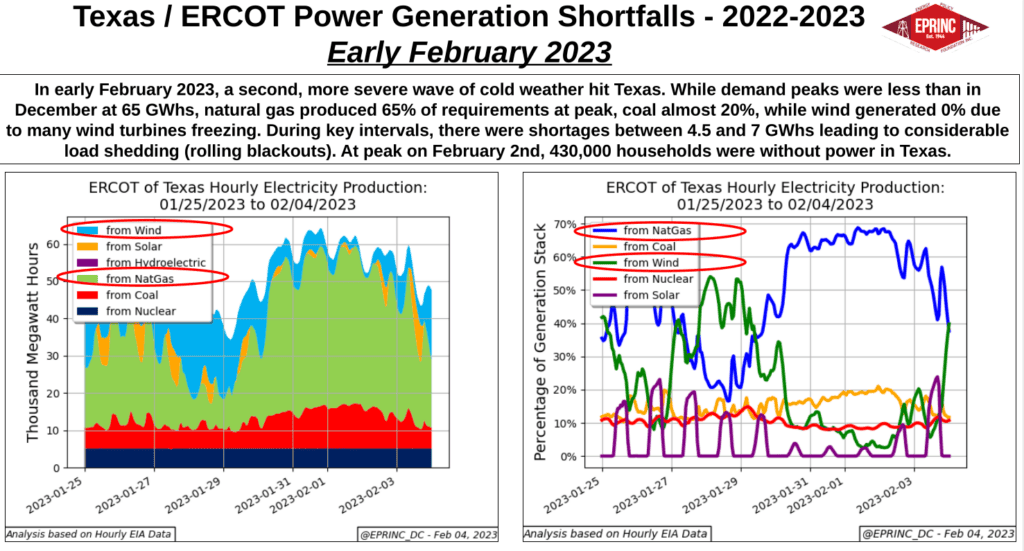
A second, more severe cold wave hit in early February 2023. Demand peaked lower, at 65 GWh, but the supply picture was more strained: natural gas met 65% of peak requirements, coal nearly 20%, and wind generated 0% as many turbines froze. Shortages of between 4.5 and 7 GWh at key intervals forced considerable load shedding through rolling blackouts, and at the February 2nd peak roughly 430,000 Texas households were without power.
The events also constrained the refining sector. During Winter Storm Elliott, U.S. Gulf Coast refining capacity utilization fell from 92% to 80%—about 1.1 million barrels per day. Utilization partially recovered in January 2023 before February’s cold kept it constrained.
Between the two storms, the Public Utility Commission of Texas voted on January 20th to adopt a market overhaul known as the Performance Credit Mechanism (PCM), allowing generators to earn credits particularly at times of peak generation need. The recurring shortfalls underscore Texas’ reliance on electric space heating: less than 1% of Texas homes used electric heat in 1950, a share that reached 62% by 2010, encouraged by low residential electricity prices, even as the state’s population grew from 5 million in 1930 to 30 million in 2020.


From the EPRINC Chart of the Week archive.