
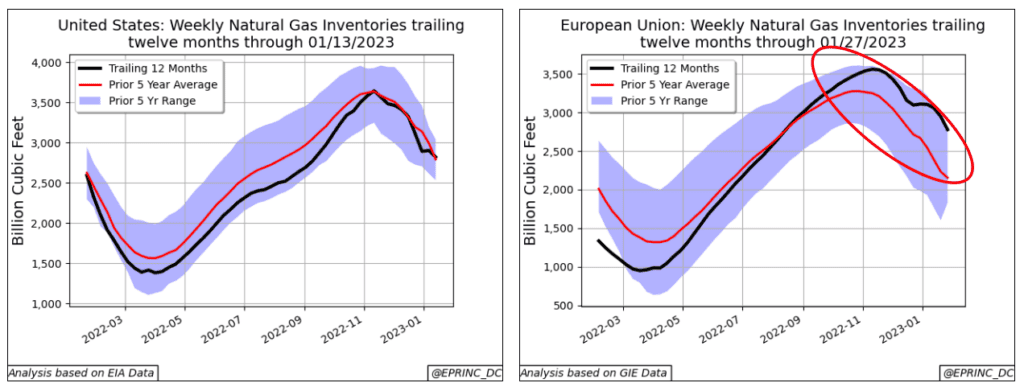
Coordinated emergency measures by European leaders, combined with mild winter weather, have muted natural gas demand and contributed to ample storage. Storage operators filled inventories aggressively ahead of the 2022-2023 winter.

Despite Russian natural gas deliveries being down by 80% in 2022, the European Union has managed to avoid a major shortage of natural gas. This has been due to a combination of coordinated emergency measures by the European Union leadership, a mild winter, and high prices that have dampened demand.
Nevertheless, Russia’s continued war against Ukraine and its weaponization of energy resources pose continuing challenges not only to European, but also to global energy security.
Beginning on March 25, 2022, key OECD members including the U.S., EU, and Japan convened a joint Energy Security Task Force in coordination with the International Energy Agency (IEA). The Task Force is organized around two primary goals: diversify liquefied natural gas (LNG) supplies in alignment with climate objectives; and reduce demand for natural gas.
In addition, the EU will upgrade its regulatory frameworks for energy security of supply and storage, as well as work with EU Members to accelerate regulatory procedures to review and determine approvals for LNG import infrastructure. For its part, the U.S. has pledged to support these emergency energy security objectives.
The Task Force reconvened in November 2022 and seeks to hold high-level meetings throughout 2023 in order to monitor as well as coordinate policies to avert any sort of potential crises arising from the shortage of energy supplies.
From the EPRINC Chart of the Week archive.