
Once or twice a decade during December and January, large-scale flows of warm, moist air and heavy precipitation deluge the Western United States, and particularly California. Dubbed the “Pineapple Express” for its origins near Hawaii, this phenomenon brings extended rainfall and snowfall across a landscape that is generally arid. From December 26, 2022 through January 17, 2023, the Pineapple Express returned: Santa Cruz received 36.18 inches of rain against a 12-inch norm for the combined months of December and January, and heavy snow fell across the Sierra Nevada, including 47 inches at Tahoe City.
California’s installed utility-scale solar generation capacity is formidable at 15,500 megawatts, more than any other state. Even so, capacity utilization falls considerably in December and January, dropping to 15% even when sunlight is available for the full duration of the shortened days.
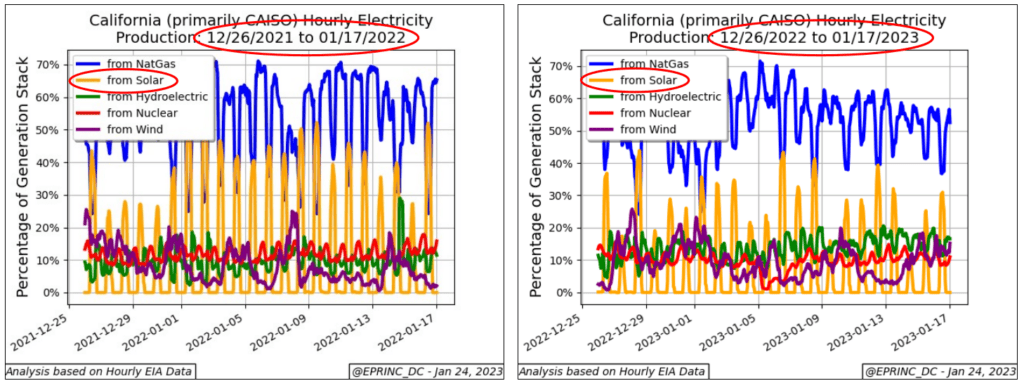
The chart compares midday solar generation across two winters. In the 2021-2022 period, California generated an average of 8.5 thousand megawatts at midday, or between 40% and 52% of total generation. During the 2022-2023 Pineapple Express, that average fell to 6.9 thousand megawatt hours, or between 20% and 40% of generation.
The episode underscores how a large solar fleet remains sensitive to weather, with extended cloud cover reducing output precisely during the winter months when capacity utilization is already at its lowest.

From the EPRINC Chart of the Week archive.