
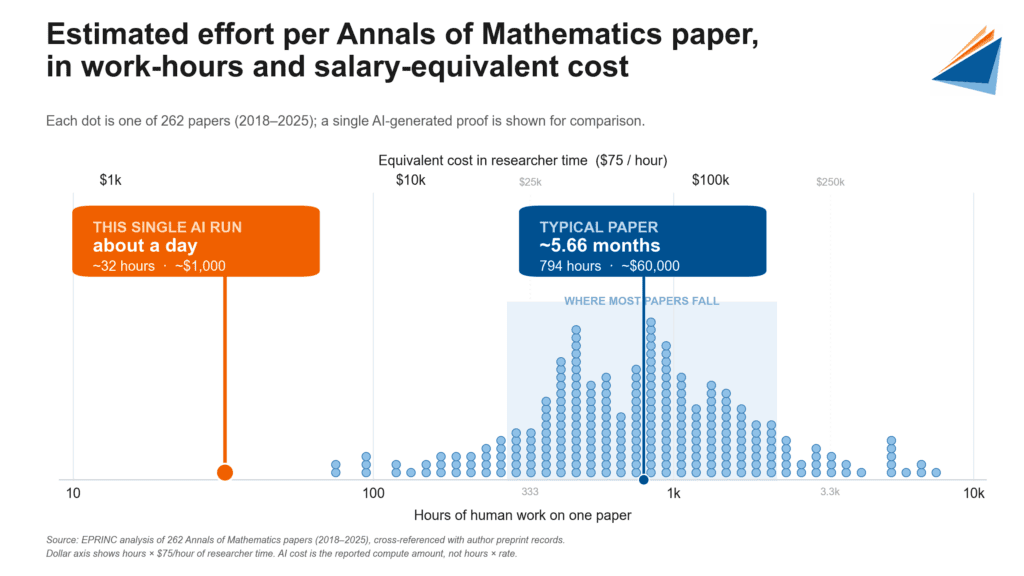
A general reasoning model resolved the 80-year-old Erdős unit-distance conjecture in approximately 32 hours of compute at a cost of roughly $1,000, producing a new family of point arrangements with more unit-distance pairs than the prior bound permitted. The model was given no research directions—only a precise statement of the problem—and its proof was subsequently checked and improved by mathematicians, underscoring that human verification remains the principal bottleneck.
A Fully Automated Solution
No research directions were given to the model. The statement was simply stated precisely, then the model was told to solve it completely, no partial credit allowed. The exact prompt fed to the model:

Fig. 2 of 4 · Chart 2026-21 · Source: EPRINC
“There is no doubt that the solution to the unit-distance problem is a milestone in AI mathematics: if a human had written the paper and submitted it to the Annals of Mathematics and I had been asked for a quick opinion, I would have recommended acceptance without any hesitation”
— Timothy Gowers, Fields Medalist
So, what’s “Annals-worthy” actually worth?


The Value of AI and the need for Reliable Electricity at Scale
- There are limited practical applications to this specific problem, however the result shows that AI can potentially solve certain open problems more efficiently than mathematicians. The proof the computer found was highly ingenious, involving connecting algebraic number theory to a seemingly unrelated field, a link previously unexplored.
- At present, AI’s application in research mathematics remains limited. This problem was in many ways ideally suited for LLM attack with many optimization decisions needing to be made in the specific choice of number field.
- A year ago AI struggled to do basic high school math. The trajectory has been improving astronomically.
- This proof was checked and improved upon by mathematicians. The key bottleneck remains verification; while when properly prompted AI can quickly confidently claim many solutions, verifying that these claims are correct takes human labor. Some mathematicians are currently working on this.
- Even if AI is used in a small subset of fundamental research tasks, it could lead to exponential speedups in research times across fields, leading to breakthroughs at rates previously unimaginable. What’s currently achievable previously in months to years may be achievable in weeks to days.
- This point means policymakers should adopt an increased likelihood that far-out technologies may be much closer than we imagined, thus have higher expected returns. Two examples might be nuclear fusion or cancer.
- AI has the potential to be immeasurably valuable to the U.S. economy, and its development should be prioritized.
- These breakthroughs are only possible with a reliable and robust electricity grid, deployed quickly at scale. We are entering an era where there is a direct conversion between electricity and technological breakthroughs.
From the EPRINC Chart of the Week archive.