
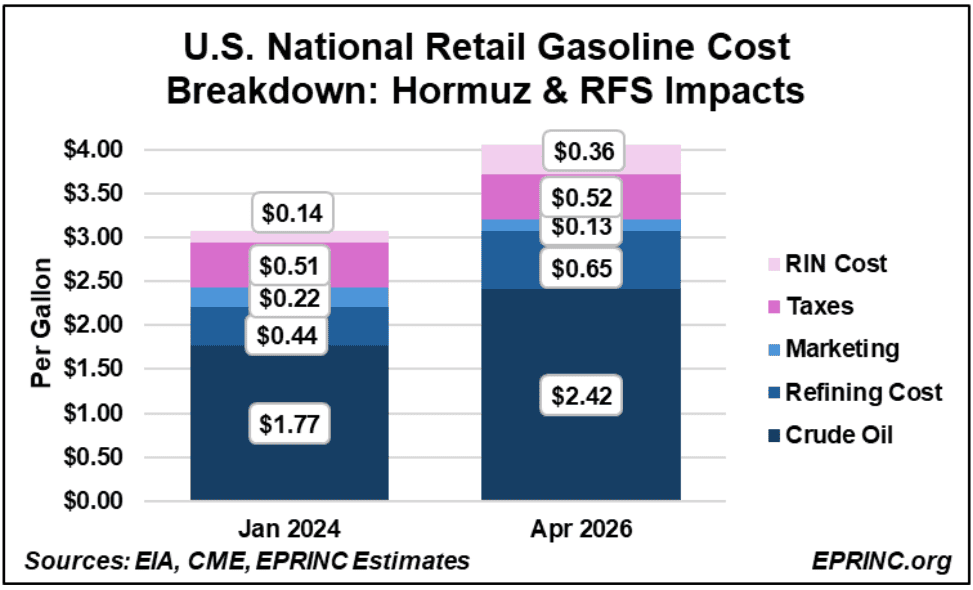
With the Strait of Hormuz closed for a second month amid the Israel/U.S.–Iran conflict, crude oil prices have spiked and policymakers have sought ways to mitigate rising transportation fuel costs. Deconstructing U.S. retail regular gasoline prices for two periods — January 2024 and April 2026 — EPRINC estimates that domestic crude costs have risen 37% in nominal terms, but the cost of RINs (Renewable Fuel Identification Numbers) has risen 164%.
RINs, the compliance mechanism of the Renewable Fuel Standard (RFS), represent the largest compliance burden for U.S. petroleum refiners and are central to the profitability of the U.S. biofuel industry. That burden is passed through to consumers in the form of higher fuel prices, and RIN prices reflect whether blending mandates are aggressive or lax.
Following extensive debate, EPA released final renewable volume obligations (RVOs) for compliance years 2026 and 2027 that are particularly aggressive relative to past years. The rule includes a provision to “reallocate” volumes tied to previously issued small refinery exemptions (SREs), restoring them to the 2026 and 2027 obligations. Advocacy on the share of exempt volumes ranged from 0% to 50% among petroleum interests to 100% among biofuel interests; EPA elected to reallocate 70%, adding to already high RVOs. Following the late-March 2026 announcement, RIN prices rose an additional 6% to 9%.
Using a model adapted from S&P Platts, EPRINC estimates the RFS’s added cost per gallon of fuel has risen from 15 cents in January 2024 to 36 cents in April 2026. At 36 cents per gallon and roughly 140 billion gallons of annual U.S. gasoline consumption, the projected total economic cost exceeds $50 billion annually to U.S. consumers.
Enacted in 2005 and strengthened in 2007, the RFS requires refiners and importers to blend specified volumes of biofuels into transportation fuels, on the rationale that biofuels generate lower greenhouse gas emissions. It is administered by EPA in consultation with DOE and USDA. Following the expiration in 2022 of the statutory schedule of increasing blending percentages, EPA’s authority has become discretionary, with the provisional 2026 and 2027 blending percentages — and the reallocation of prior exemptions — now under debate and review.

Fig. 2 of 3 · Chart 2026-16 · Source: EPRINC

Fig. 3 of 3 · Chart 2026-16 · Source: EPRINC
For more information on these charts, please contact Max Pyziur (maxp@eprinc.org)
From the EPRINC Chart of the Week archive.