
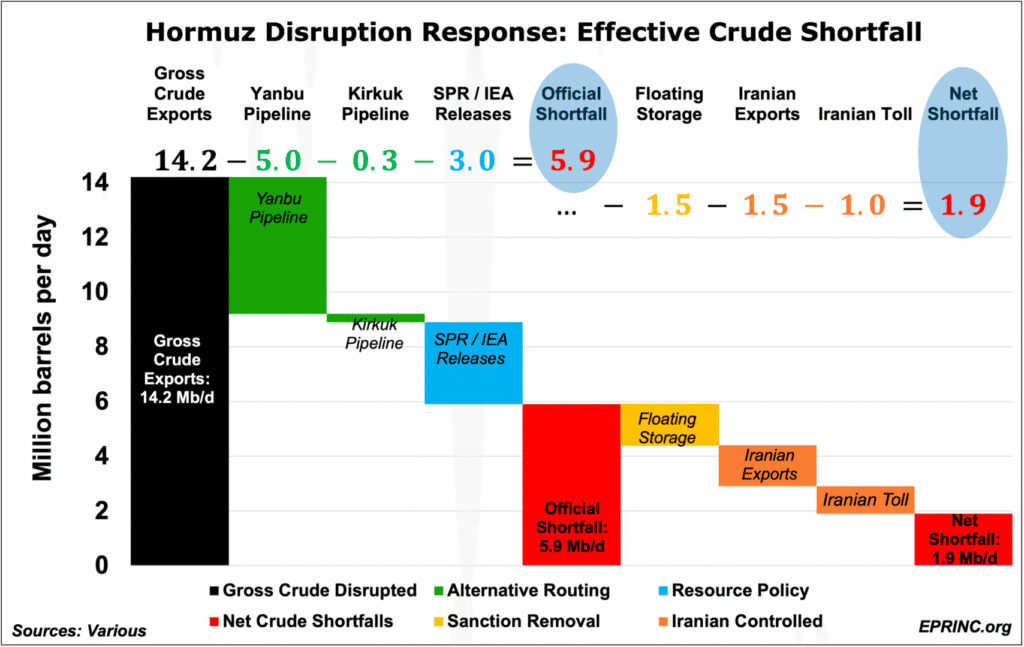
Since Iran’s closure of the Strait of Hormuz on March 1, 2026, estimates of the resulting shortfall in hydrocarbon exports through the waterway have ranged widely, with headline figures between 18.3 and 20 million barrels per day (MB/d). The most recent assessment from the U.S. Energy Information Administration (EIA) puts 2025 flows at 14.2 MB/d of crude oil and condensates and 5.9 MB/d of petroleum products, for a total of 20.1 MB/d.
The chart isolates crude oil and condensates—the 14.2 MB/d component—because it is the only category with logistical alternatives and policy mechanisms available to offset lost Hormuz transit. Gulf-sourced products, LNG, and NGLs/LPG have no comparable workarounds. Starting from that 14.2 MB/d, the analysis subtracts each available source of relief:
- Pipeline bypass routes: the Saudi Yanbu East-West Pipeline (7 MB/d nameplate) now moving 5 MB/d, up from minimal volumes, and the Iraqi Kirkuk Pipeline (0.3 MB/d) at nameplate.
- An IEA-coordinated release of 400 million barrels from global strategic reserves (including 127 million barrels from the U.S. SPR) over 120 days, providing roughly 3 MB/d of relief and lowering the shortfall to an official 5.9 MB/d.
- Floating storage, which stood at 222 million barrels in mid-February (139 million Russian, 61 million Iranian, 22 million Venezuelan), some of it sanctioned; with sanctions relief and shadow-market activity, conservatively another 1.5 MB/d.
- Iranian-controlled transit subject to tolls (estimated at $1/barrel), together with the movement of Iran’s own production, offsetting a further 2.5 MB/d.
After accounting for these logistical and policy responses, a significant global shortfall of 1.9 MB/d remains. The arithmetic illustrates both the reach of available mechanisms and their limits: even fully deployed, pipeline capacity, coordinated reserve draws, and Iranian-managed flows do not fully replace the volumes normally moving through Hormuz.
EPRINC is aggregating its work on the current crisis under Special Focus: Crisis at the Strait of Hormuz. On April 4, 2026, EPRINC Research Director Max Pyziur was quoted in the Chilean national newspaper La Tercera in a piece surveying how the closure is reshaping daily life worldwide (English translation).
From the EPRINC Chart of the Week archive.