
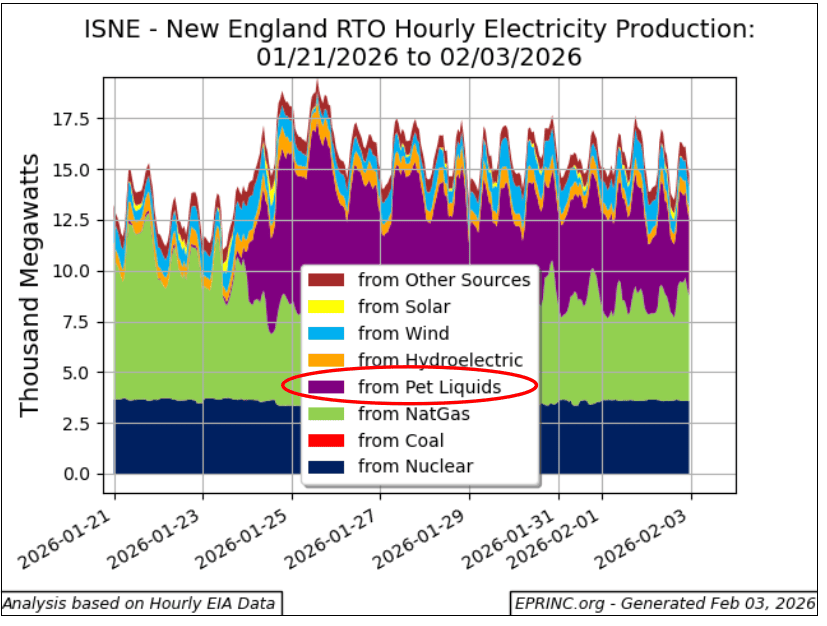
Winter Storm Fern began on January 21, 2026 in the Mid-Continent and reached New England on January 24th. While the snowstorm itself abated in late January, Fern’s arctic temperatures have persisted into mid-February, sustaining elevated demand on the regional grid.
ISO New England (ISNE), the grid operator for the six New England states, has seen its average load reach 16 gigawatts (GWs) since Fern’s arrival, with spikes to 20 GWs. Dispatchable generation supplied an average of 93% of that output, while weather-dependent power—primarily wind—provided the balance, averaging 1 GW.
With limited natural gas pipeline capacity in the region, ISNE relies on diesel-fired generation to meet peak cold-weather demand. Since the arctic weather began, diesel has accounted for an average of 5.1 GWs of generation, or 31.3% of total requirements, with peaks of 7.9 GWs, or 43.5% of the total.
That reliance carries a substantial cost. Imputed from NY Harbor diesel and Henry Hub natural gas prices over the past year, diesel has cost an average of 4.6 times the price of natural gas on an energy basis—underscoring the price premium the region pays for firm generation when pipeline capacity is constrained.
From the EPRINC Chart of the Week archive.